wayground logo

Free Printable Worksheets

Font size

S
M
L
XL
Worksheets

Energy Flow

Total questions: 102

Worksheet time: 56mins

Name
Class
Date
1.
The efficiency of energy transfer from a lower trophic level to the next highest level is roughly
a)
1%
b)
10%
c)
100%
d)
1000%
2.
Trophic levels are represented by 
a)
squares
b)
circles
c)
pyramids
d)
lines
3.
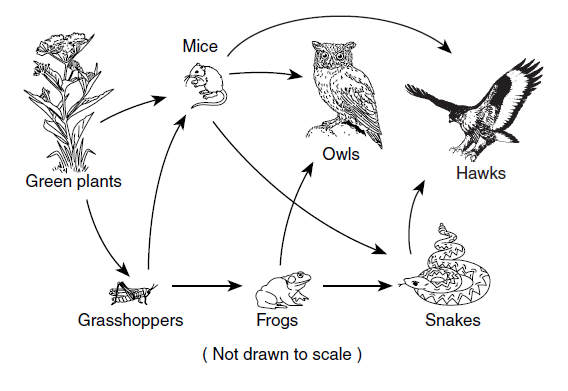
Which animal is the apex predator?
a)
hawk
b)
lizard
c)
snake
d)
grass
4.
Which animal is not the apex predator but, a predator to a mouse?
a)
hawk
b)
rabbit
c)
snake
d)
grass
5.
Why is a shark a carnivore.
a)
because it eats seaweed
b)
because it eats dead animals
c)
because it eats sand 
d)
because it eats other animals
6.
In the energy pyramid here, how much of the energy in each level gets lost as heat or used by the organism for survival?
a)
80%
b)
90%
c)
10%
d)
20%
7.
The arrows in a food chain or web represents what?
a)
They point to the organism that is being eaten.
b)
It shows how sunlight flows within an ecosystem.
c)
They show what direction the energy is flowing between organisms. 
d)
They represent how water is transferred within a habitat.
8.
Organisms that create their own energy from sunlight or chemicals
a)
Herbivore
b)
Omnivore
c)
Autotroph
d)
Heterotroph 
9.
Biomass refers to
a)
Chemical Energy
b)
Light Energy
c)
Rank in the feeding heirarchy
d)
Amount of living tissue in an ecosystem
10.
What does a food web represent?
a)
All connections of energy flow throughout all organisms in a habitat.
b)
The specific ways that mutualism is carried out.
c)
A single pathway or energy flow between organisms. 
d)
How carnivores get their food. 
11.
The image provided is an example of a(n):
a)
Producer
b)
Autotroph
c)
Consumer
d)
Insect
12.

Which of the following would be the definition of a scavenger/detritivore?

a)

Animals that eat insects.

b)

Organisms that feed on rocks, recycling the nutrients back into the ground.

c)

Organisms that eat only plants

d)

Things that feed on dead, rotting organisms (roadkill)

13.
Which of the following would provide the most energy in an ecosystem?
a)
Producers
b)
Herbivore
c)
Omnivore
d)
Carnivore
14.
A wolf eats a rabbit, that just ate some berries.  What would you call the rabbit?
a)
Producer
b)
Omnivore
c)
Primary Consumer
d)
2nd order Heterotrph
15.
An organism that obtains energy by eating other organisms.
a)
Consumer
b)
Producer
c)
Decomposer
d)
Detriov
16.
All living things are made of _______, and all living things need _______. 
a)
matter, plants
b)
energy, matter
c)
matter, energy
17.
Matter can by _____________ over and over again, and energy is needed for recycling matter. ___________ is not recycled, but it is converted from one form to another.
a)
destroyed,  matter
b)
recycled, energy
c)
destroyed, energy
18.
During ____________, _____________ convert light energy into the chemical energy in sugar molecules. 
a)
chemosynthesis, consumers
b)
chemosynthesis, producers
c)
photosynthesis, producers
19.
Some producers don't rely on light for energy. Bacteria near hydrothermal vents use sulfur molecules to produce their own ________. Producing energy-rich nutrient molecules from chemicals is called ________.
a)
consumers, photosynthesis
b)
photosynthesis, chemosynthesis
c)
food, chemosynthesis
20.
Organisms use energy to heal and repair themselves and grow or to stay warm. Organisms take food to release its energy and use it for ____________ and ___________ or transform it into _________.
a)
maintenance, growth, heat
b)
photosynthesis, chemosynthesis, producers
c)
chemosynthesis, photosynthesis, heat
21.
What is a food chain?
a)
A chain that shows how heat passes from organism to organism.
b)
A way of showing how matter and energy pass from one organism to another.
c)
A representation of all the predator-prey relationships in a community.
22.
What type of organisms are the first step in a food chain?
a)
Consumers
b)
Predators
c)
Producers
23.
Examples of producers:
a)
flies, fungus, and termites
b)
plants and organisms capable of chemo or photosynthesis
c)
lions, deer, and shrubs
24.
A food web is made up of 
a)
one food chain.
b)
only producers.
c)
many different food chains.
25.
How does an animal use the energy from the food consumes?
a)
To fuel its life processes such as respiration, digestion, and growth. And some energy is given off as heat.
b)
Only to move.
c)
To grow in weight. 
26.
What does an energy pyramid represent?
a)
Food pyramids show the different food chains in a community.
b)
Energy pyramids show the same total matter at all levels.
c)
Shows the amount of energy available at each feeding level in an ecosystem.
27.
Why can't the top level contain a large number of organisms?
a)
Because as energy moves from the bottom to the top level, less and less energy is available to higher levels.
b)
Because the original energy from producers is the total energy available to all the organisms in the energy pyramid.
c)
because only about ten percent of the energy available at one level is transferred to the next level.
d)
all of the above
28.
Autotrophs are organisms that produce their own food. Which do scientist classify as autotrophs?
a)
Chordates
b)
Fungi
c)
Plants
d)
Molds
29.
An organism that gets energy from breaking down dead organisms, non-living material or waste is a(an) ___________.
a)
producer
b)
consumer
c)
decomposer
d)
autotroph
30.
Eat primary consumers (can be carnivores and omnivores)
a)
Tertiary Consumers
b)
Secondary Consumers
c)
Quaternary Consumers 
d)
Top Predators 
31.
An organism that obtains energy by consuming plants and animals.
a)
Omnivores
b)
Carnivores
c)
Herbivores
d)
Humans 
32.

Consumers that eat only plants

a)

Carnivores

b)

Omnivores

c)

Herbivores

d)

Scavengers

33.

A food _______ is a series of events in which one organism eats another and obtains energy.

a)

chain

b)

web

c)

pyramid

d)

plate

34.

In the food web above, what organism is a tertiary consumer?

a)

Fox

b)

Frog

c)

Vole

d)

Grass

35.

Which of the following has the correct order of the trophic levels for a food web or chain.

a)

herbivores-decomposer-autotrophs-carnivores-

b)

decomposer-carnivores-autotrophs-herbivores

c)

producer-tertiary consumer-secondary consumer-primary consumer

d)

producer-primary consumer-secondary consumer-tertiary consumer-decomposer

36.

A worm is a/an

a)

autotroph

b)

heterotroph

37.

Which process do plants use to turn sunlight into food energy?

a)

photosynthesis

b)

cellular respiration

c)

transpiration

d)

evaporation

38.

Which kind of organism is an autotroph?

a)

consumer

b)

producer

c)

decomposer

d)

herbivore

39.

Which organisms are heterotrophs?

a)

photosynthesizers

b)

producers

c)

consumers

d)

plants

40.

Which organism is an example of a producer?

a)

moth

b)

mushroom

c)

rose bush

d)

cheetah

41.

Why are mushrooms important to the food chain?

a)

They recycle nutrients into the ecosystem.

b)

They produce food energy for other living things.

c)

They recycle oxygen into the atmosphere.

d)

They consume excess herbivores in the ecosystem.

42.

Maggots feed on dead and decaying organisms for energy. What are maggots?

a)

autotrophs

b)

producers

c)

decomposers

d)

heterotrophs

43.

In the food chain below, which is the producer?


grass --> mouse --> snake --> hawk

a)

grass

b)

mouse

c)

snake

d)

hawk

44.

Which is the primary consumer in this food chain?

a)

rabbit

b)

grass

c)

snake

d)

hawk

45.

Yellowfin tuna, or Thunnus albacores, are large sport fish that are found in tropical and subtropical waters around the world. They typically school under objects such as boats or patches of driftwood for protection from predators. Schooling under these structures also provides yellowfin tuna with easy access to a food source such as smaller herbivorous fish that may be foraging for food around the structures. Which trophic level does yellowfin tuna fill in a food chain?

a)

producer

b)

primary consumer

c)

secondary consumer

d)

tertiary consumer

46.

Food chains show energy transfer between organisms. The size of a food chain can vary, yet there is a limit to the number of levels that a food chain can reach. Why is there a limit to the number of levels that a food chain can reach?

a)

Plants are not infinitely in the world

b)

Producers can only eat what is available

c)

Carnivores are too big to be eaten

d)

Energy is lost when you move up a trophic level

47.

Which of the following describes an interconnection of food chains in an ecosystem?

a)

Food chain

b)

Food web

c)

Energy pyramid

d)

Producer web

48.

What is this an example of?

a)

Food chain

b)

Food web

c)

Energy pyramid

d)

Energy web

49.

Which organism is the primary consumer?

a)

Phytoplankton

b)

Gulls and terms

c)

osprey

d)

herbivorous duck

50.

What would happen to the organisms in the food web below if the number of phytoplankton and vegetation decreased?

a)

Only the small fish would be affected

b)

Only the osprey would be affected

c)

The small fish and wading birds would be affected

d)

The entire food web would be affected

51.

Which level does energy flow directly to after the producer level?

a)

Decomposer

b)

Producer

c)

Primary consumer

d)

Secondary consumer

52.

What would happen to this food chain if we doubled the population of the rabbits?

a)

The populations of the snakes and hawks would also increase.

b)

The populations of the grass, snakes, and hawks would decrease.

c)

The grass population would decrease. The snake and hawk population would increase.

d)

The grass and hawk population would decrease. The snake population would increase.

53.

Which most likely caused the rabbit population (light green line) to decrease over the first time unit (0 to 1) in the graph?

a)

A disease in the rabbit population

b)

A decrease in the amount of grass available

c)

A decreasing population of hawks

d)

A higher population of snakes than normal

54.

Trapping (or rabbit hunting) has severely reduced the population of rabbits in an ecosystem as shown in the bar graph. What is the most likely effect this will have on other organisms?

a)

The snake population will decrease while the grass population will increase

b)

The haw population will increase and the rabbit population will decrease

c)

The grass population will decrease and the snake population will increase

d)

The grass, rabbit, snake, and hawk populations will all decrease rapidly

55.

If a disease were to affect the snakes in the food chain, what will be the initial (beginning) effect on the populations of hawks and rabbits?

a)

The populations of hawks and rabbits will decrease.

b)

The populations of hawks and rabbits will increase.

c)

The population of hawks will increase. The population of rabbits will decrease.

d)

The population of hawks will decrease. The population of rabbits will increase.

56.

Which one of the statements given below is right?

a)

Herbivore is a producer

b)

Herbivore is a primary consumer

c)

Carnivore is a producer

d)

Carnivore is a primary consumer

57.

What is the feeding type of humans?

a)

Carnivore

b)

Herbivore

c)

Omnivore

d)

Consumer

58.
What is an example of a decomposer?
a)
Plum
b)
Mushroom
c)
Deer
d)
Bird
59.
Which of the following types of organisms would benefit most directly from the products of decomposer organisms?
a)
Decomposers
b)
Primary consumers
c)
Secondary consumers
d)
Producers
60.
A __________________ is a type of animal that hunts other animals to eat. 
a)
prey
b)
herbivore
c)
predator
d)
producer
61.

A consumer gets energy by doing what?

a)

Making it themselves.

b)

Breaking down biotic wastes and dead organisms and returning raw materials to the ecosystem.

c)

Sucking it up from the ground.

d)

Feeding on other organisms.

62.

In which trophic level do you expect the most energy amount to be?

a)

1st

b)

2nd

c)

3rd

d)

4th

63.

What is the unit containing all the organisms and their environment, interacting together in a given area?

a)

Population

b)

Community

c)

Ecosystem

d)

Habitat

64.

Which group of organisms is missing from the food web above?

a)

Carnivore

b)

Herbivore

c)

Omnivore

d)

Decomposer

65.
What is the function of ATP in living things?
a)
provides energy for cells
b)
stores genetic information
c)
provides structure in the nucleus
66.
Which structures shown in the Figure make up the ADP molecule?
a)
A and B
b)
A, B and C
c)
A, B, C, and D
d)
C and D
67.
What does the "TP" in ATP stand for?
a)
2 phosphates
b)
tri (3) phosphates
c)
Two proteins
d)
tri (3) proteins
68.
Which of the following can be compared to a battery in need of recharging?  (empty wallet)
a)
ADP
b)
ATP
c)
Ribose
d)
Adenosine
69.
What are the parts of the ATP molecule?
a)
adenine, thylakoids, stroma
b)
stroma, grana, chlorophyll
c)
adenine, ribose, phosphate groups
d)
NADH, NAHPH, FADH
70.
Which bond of the ATP molecule is broken in order to release energy?
a)
A
b)
B
c)
C
d)
D
71.
Which structures shown in the Figure make up the ATP molecule?
a)
A and B
b)
A, B and C
c)
A, B, C, and D
d)
C and D
72.
Using the figure, which parts of the molecule must the bonds be broken to form an ADP molecule?
a)
A and B
b)
B and C
c)
C and D
d)
all of the above
73.
Which of the following results in the storage of energy in terms of the ATP/ADP cycle?
a)
The breaking of the bond between the 5-carbon sugar and the 1st phosphate group
b)
The addition of a phosphate group
c)
The removal of a phosphate group
d)
The addition of glucose 
74.
Where is the energy stored in ATP molecules
a)
In the Ribose Sugar
b)
In the Adenine group
c)
In the Phosphate bonds
d)
In the Bank
75.
Where does the energy for ATP come from? 
a)
Nucleic Acid
b)
Protein
c)
Lipid
d)
Carbohydrate
76.
What is the source of energy for photosynthesis?
a)
carbohydrates-chemical
b)
sunlight
c)
heat-thermal
d)
electrical
77.
Which of the following is the correct equation for PHOTOSYNTHESIS?
a)
carbon dioxide + water --> oxygen + glucose
b)
carbon dioxide + glucose + water --> oxygen 
c)
oxygen + water --> carbon dioxide + glucose
d)
glucose+ oxygen ---> water + carbon dioxide 
78.
What are the products of photosynthesis?
a)
Carbon dioxide and water
b)
Carbon dioxide and oxygen
c)
Glucose and oxygen
d)
Glucose and water
79.
Which organelle does photosynthesis take place in?
a)
Mitochondrion
b)
Chloroplast
c)
Cytoplasm
d)
Nucleus
80.
The chemical energy used for most cellular processes and functions is found in___.
a)
ATP
b)
ADP
c)
carbohydrates
d)
the sun
81.
The low energy molecule ADP is converted into the high energy molecule ATP when___
a)
cell functions are performed 
b)
organisms consume carbon-based molecules
c)
a phosphate is removed
d)
sunlight is added
82.

Which carbon-based molecule is most commonly broken down to make ATP?

a)

proteins

b)

carbohydrates

c)

lipids

d)

nucleic acids

83.

Where does food store chemical energy?

a)

in the bonds

b)

in the elements (C, H, O, etc)

c)

in the protein

d)

in the fat

84.

What does ATP stand for?

a)

Adenine triple protein

b)

Adenosine triphosphate

c)

Adenine tripotassium

d)

Adenosine triple power

85.

Which carbon based molecule is LEAST likely to be broken down to make ATP?

a)

carbohydrates

b)

sugars

c)

lipids

d)

proteins

86.

When organisms use 'chemicals' to make carbon-based molecules, this is called__________?

a)

photosynthesis

b)

chemotherapy

c)

chemosynthesis

d)

phototherapy

87.

What must an organism do in order to make ATP?

a)

Exercise

b)

Consume and break down food

c)

Spend time in the sun

d)

Release waste in the environment

88.

What does ATP become after it is used for energy?

a)

It does not change

b)

Garbage

c)

Adenosine diphosphate

d)

Adenine monohydrate

89.

What biological macromolecule is usually used to build muscle and other cellular structures instead of being used for energy?

a)

carbohydrates

b)

lipids

c)

proteins

d)

sugar

90.
What is a substance called if it speeds up a chemical reaction?
a)
reusable
b)
catalyst
c)
specific
d)
fragile
91.
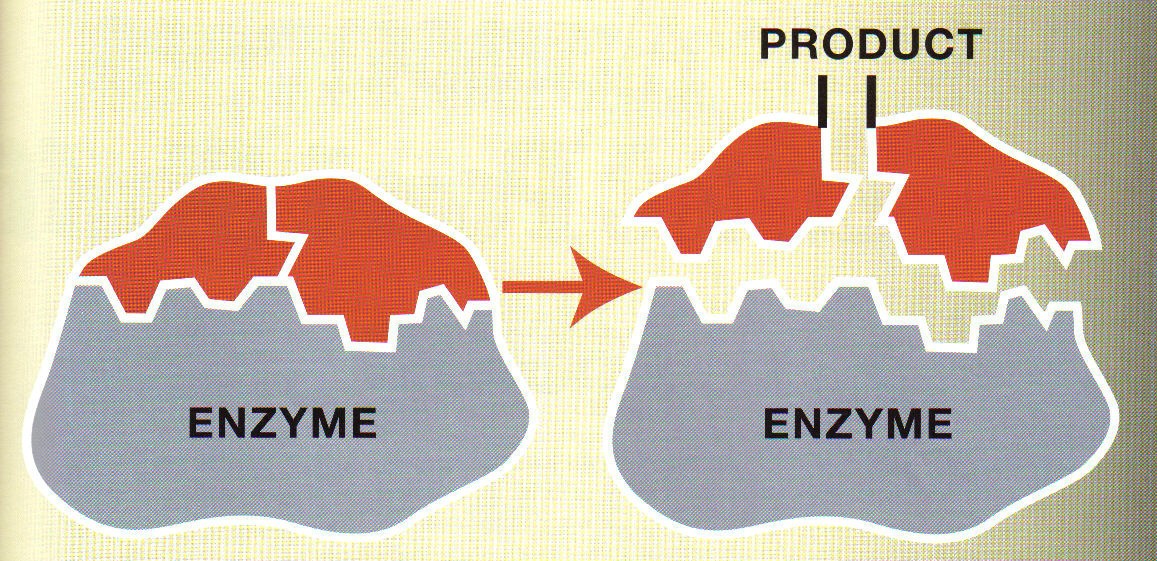
Each enzyme only has 1 substrate that will fit its active site.  What is this called?
a)
reusablility
b)
denaturation
c)
specificity
d)
fragility
92.
With what 3 letters do enzymes typically end?
a)
-ose
b)
-ase
c)
-ese
d)
-tic
93.
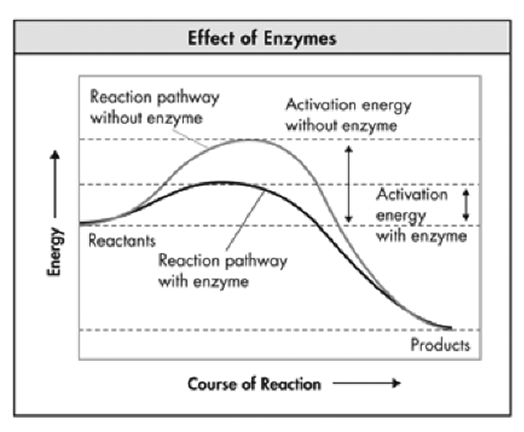
The graph shows how enzymes affect reactions in cells. Which statement best summarizes the information shown in the graph?
a)
Enzymes increase the energy of the reactants.
b)
Enzymes decrease the energy level of the products.
c)
Enzyme decrease the activation energy of the reaction.
d)
Enzymes reverse the direction of the reaction.
94.
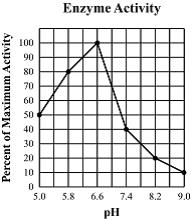
Which of the following conclusions can be drawn from this graph?
a)
The optimum pH of the enzyme is 6.6.
b)
The optimum pH of the enzyme is 5.8
c)
The enzyme’s activity increases as pH increases 5.0 to 9.0
d)
The enzyme’s activity is greater around pH of 8.0 .
95.
Any substance that is acted upon by an enzyme is called a(n)?
a)
Coenzyme
b)
Substrate
c)
Vitamin
d)
Polypeptide
96.
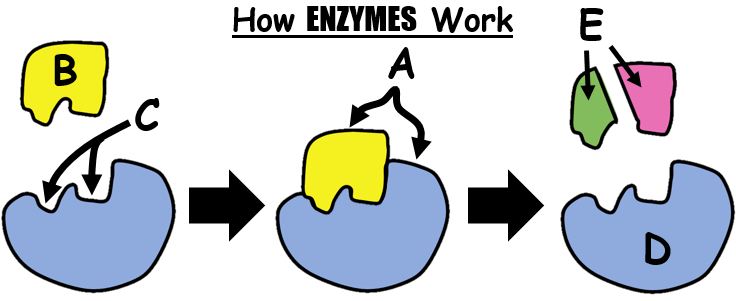
In the diagram, what is letter A? 
a)
product
b)
substrate
c)
enzyme-substrate complex
d)
active site
97.
Enzymes are...
a)
nucleic acids
b)
proteins
c)
lipids
d)
carbohydrates
98.
An enzyme speeds up a chemical reaction in the cell but can only be used once.  True or False? 
a)
true
b)
false
99.
What is the function of an enzyme?
a)
enzymes break themselves into small pieces
b)
enzymes slow down chemical reactions
c)
enzymes speed up chemical reactions
d)
enzymes combine products to form reactants 
100.
Which of these is most likely an enzyme?  
a)
Sucrose
b)
Galactose
c)
Fructose
d)
Amylase
101.

What happens when enzymes are heated to a high temperature?

a)

The enzymes die.

b)

The shapes of the enzyme are altered (denatured).

c)

The enzymes' amino acid sequence changes.

d)

The enzymes remain the same

102.
Enzymes speed up reaction rates by changing...
a)
Activation Energy
b)
pH
c)
Hydrogen Bonds
d)
Kinetic Energy