wayground logo

Free Printable Worksheets

Font size

S
M
L
XL
Worksheets

PT 201 Mid Term Review

Total questions: 100

Worksheet time: 4hrs 37mins

Name
Class
Date
1.

same number of protons, different number of neutrons

a)

atomic number

b)

mass number

c)

isotope

d)

ion

2.

a charged atom

a)

neutral

b)

isotope

c)

ion

d)

nucleus

3.
The element Tellurium has the atomic mass of 127.60 and its atomic number is 52. How many neutrons are in the element Tellurium?
a)
179.60
b)
127.60
c)
52
d)
76
4.

Groups on the periodic table are arranged...

a)

Vertically

b)

Horizontally

c)

Diagonally from bottom right corner

d)

Diagonally from top right corner

5.

Which accurately describes nonmetals?

a)

Poor conductors of electricity

b)

Often used in computer parts

c)

Both malleable and ductile

d)

Both dull and brittle

6.

What is the chemical symbol for Sodium?

a)

S

b)

So

c)

Na

d)

Ca

7.

How many neutrons does Chlorine have?

a)

17

b)

36

c)

35

d)

18

8.

How many periods are there in the periodic table?

a)

7

b)

9

c)

10

d)

18

9.

Each horizontal row on the periodic table is called a what?

a)

Group

b)

Row

c)

Period

d)

Family

10.

Which element would follow the pattern: Sn, Ru, Rb?

a)

Zn

b)

Ge

c)

Tc

d)

Re

11.
The smallest unit of matter that retains the properties of that matter is
a)
a molecule
b)
a compound
c)
a mixture
d)
an atom
12.

What are the horizontal rows of the periodic table called?

a)

Layers

b)

Lines

c)

Periods

13.
Beryllium is in group number______.
a)
Group 2
b)
Group 3
c)
Group 4
d)
Group 7
14.
The majority of elements on the periodic table are
a)
man made.
b)
nonmetals.
c)
metals.
d)
gases.
15.
Name group 2A on the periodic table.
a)
alkali metals
b)
alkaline earth metals
c)
noble gases
d)
transition metals
16.
Name group 8A on the periodic table.
a)
alkali metals
b)
alkaline earth metals
c)
transition metals
d)
noble gases
17.
Where are the nonmetals located on the periodic table?
a)
top left corner
b)
bottom left corner
c)
top right corner
d)
bottom left corner
18.
Which statement is true about the alkaline earth metal family?
a)
They have 2 valence electrons.
b)
They are found on the right side of the periodic table.
c)
They form -2 charges.
d)
They tend to gain valence electrons.
19.
What atom matches this electron configuration?
1s22s22p63s23p64s23d10
a)
Zinc
b)
Copper
c)
Nickel
d)
Germanium
20.
What atom matches this electron configuration?
1s22s22p63s2
a)
Neon
b)
Magnesium
c)
Aluminum
d)
Potassium
21.
Which electron configuration belongs to Chlorine (Cl)?
a)
1s2s2p3s3p5
b)
1s2s2p3s3p6
c)
1s2s2p3s3p7
22.
Electron arrangement that uses arrows
a)
Electron configuration
b)
Shorthand configuration
c)
Lewis dot structure
d)
Orbital diagram
23.
What is the shorthand electron configuration for Sulfur atom?
a)
[Ar] 3p4
b)
[He] 3s23p4
c)
[Ne] 3s23p4
d)
[Na] 3s23p3
24.
Which of the following is a p block element?
a)
Ca
b)
Ar
c)
Re
d)
Au
25.
What electron configuration matches an oxygen atom?
a)
1s22s22p63s2, 3p64s23d104p5
b)
1s22s22p4
c)
1s22s22p6
d)
1s22s22p63s23p64s23d1
26.
What is the electron configuration of Ag?
a)
1s2 2s2 2p6 3s2 3p6 4s2 3d10 4p6 5s1 4d10
b)
[Kr] 5s2 4d9
c)
1s2 2s2 2p6 3s2 3p6 4s2 4p6 5s2 4d9
d)
1s2 2s2 2p6 3s2 3p6 3d10 4s2 4d10 4p6 5d10 5s2 4d9
27.
Identify the Electron Configuration for Aluminum (Al)
a)
1s2s2p3s3p1
b)
1s2s2p3s3p3
c)
1s2s2p3s4p1
28.

This is a correct dot diagram for nitrogen (N)

a)

true

b)

false

29.

Which of these is incorrect?

a)
b)
30.

This could be the dot diagram of

a)

Mg

b)

Cl

c)

C

d)

O

31.
An isotope has three forms.  30% have a mass of 4 amu, 20% have a mass of 5 amu and 50% have a mass of 3 amu.  Average atomic mass will be closest to
a)
2 amu
b)
3 amu
c)
4 amu
d)
5 amu
32.
Calculate the average atomic mass of silver.
a)
106.38649amu
b)
111.91896amu
c)
107.8677amu
d)
121
33.
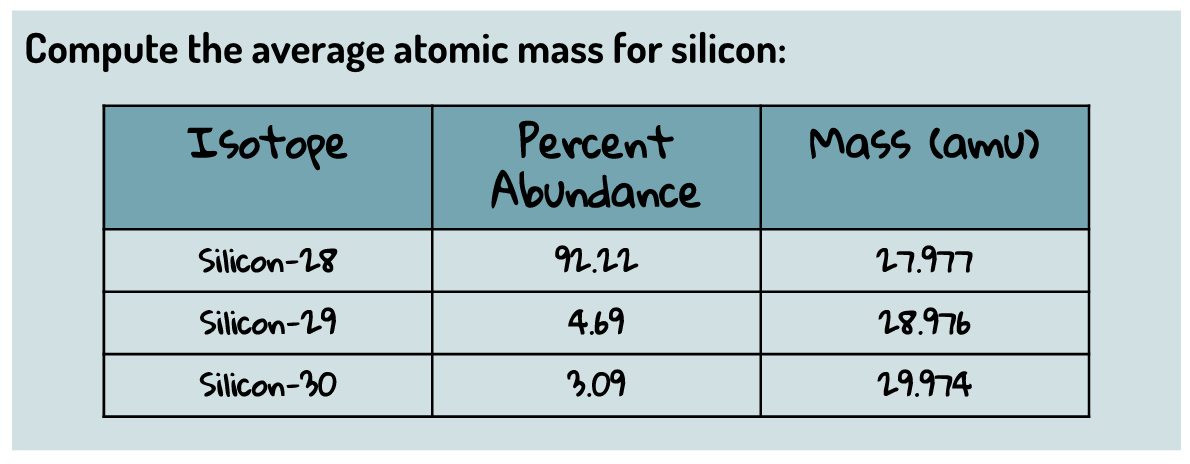
Compute the average atomic mass for silicon:
a)
27.977
b)
28.09
c)
28.976
d)
The average mass cannot be determined from provided information.
34.
Isotopes are atoms of the same element that have the same number of __________ but different number of __________ . Therefore, isotopes of the same element have different masses. 
a)
protons, neutrons
b)
protons, electrons
c)
neutrons, protons
d)
electrons, protons
35.
What is the atomic number of Neon, Ne?
a)
10
b)
20.1798
c)
10.1798
d)
7
36.
A neutral atom of the isotope 2612Mg would consist of
a)
12 protons, 26 neutrons, 26 electrons
b)
26 protons, 12 neutrons, 26 electrons
c)
26 protons, 14 neutrons, 14 electrons
d)
12 protons, 14 neutrons, 12 electrons
37.
A neutral atom would become an ion that has a charge of 2+ by 
a)
Losing two protons
b)
Losing two neutrons
c)
Losing two electrons
38.
Fluorine has an atomic number of 9. What can you conclude about an atom of fluorine from this fact?
a)
it has 9 protons
b)
it weighs 9 grams
c)
it has 9 electron shells
d)
it has a boiling point of 9 degree celsius
39.
If a sulfur atom has 16 protons, 16 electrons, and 16 neutrons, its atomic mass is:
a)
16
b)
32
c)
48
d)
64
40.
What do carbon-12 and carbon-14 have in common?
a)
they have same number of protons
b)
they have the same number of neutrons
c)
they have the same atomic mass
d)
they have the same atomic weight
41.
What is an ion?
a)
A Charged Atom
b)
A Large Atom
c)
A Small Atom
d)
A Cute Atom
42.
What is the formula for copper(I) sulfate?
a)
Cu(SO3)
b)
Cu(SO4)
c)
Cu2(SO3)
d)
Cu2(SO4)
43.
What is the formula for sodium nitrate?
a)
Na3(NO)
b)
Na(NO)
c)
Na3(NO3)
d)
Na(NO3)
44.
What is the formula for magnesium chloride?
a)
MgCl
b)
Mg2Cl
c)
MgCl2
d)
Mg(ClO3)2
45.
Name this compound: 
Ca(CO3)
a)
Calcium carbon oxide
b)
Calcium (II) carbonate
c)
Calcium carbonate
d)
Carbonate (I) calcide
46.
Name the following ionic compound: NaF
a)
nitrogen fluorine
b)
sodium fluoride
c)
nitrogen fluoride
d)
sodium fluorine
47.
Group 15 elements form what type of oxidation state?
a)
-1
b)
-3
c)
+3
d)
5
48.
Carbon dioxide
a)
C2O2
b)
C20
c)
CO
d)
CO2
49.
Phosphorous trichloride
a)
PCl3
b)
P3Cl
c)
P3Cl3
d)
PCl
50.
Bromine monoflouride
a)
BaF
b)
BrF
c)
Br2F
d)
BrF2
51.
PBr5
a)
Phosphorus Bromide
b)
Phosphorus Pentabromide
c)
Pentaphosphorus bromide
d)
Phosphorus Bromine
52.
BrO3
a)
bromine oxide
b)
monobromine trioxide
c)
bromine trioxide
d)
bromine (III) oxide
53.
nitrous acid
a)
H2(NO3)
b)
H(NO3)
c)
H(NO2)
d)
H2(NO2)
54.
hydrochloric acid
a)
H(ClO3)
b)
H(ClO2)
c)
HClO
d)
HCl
55.
HI
a)
iodic acid
b)
hydroiodic acid
c)
iodous acid
d)
hypoiodous acid
56.
H2(SO3)
a)
sulfuric acid
b)
hydrosulfuric acid
c)
sulfurous acid
d)
persulfuric acid
57.
What is the formula for nitric acid?
a)
H(NO2)
b)
H(NO3)
c)
H(NO4)
d)
H2(NO3)
58.
Name the acid: H(C2H3O2)
a)
Acetic Acid
b)
Acetous Acid
c)
Hydrogen Acetate
d)
Hydrogen Dicarbon Trihydrogen Dioxygen
59.
HBr
a)
hydrogen bromine acid
b)
hydrobromide acid
c)
hydrobromic acid
d)
hydrogen bromide
60.
What is the formula for hydrosulfuric acid?
a)
H2(SO3)
b)
H2S
c)
H2(SO2)
d)
H2(SO4)
61.
What is the element/ion symbol for Iron(III)?
a)
Fe
b)
Fe3+
c)
Fe3-
d)
Fe(III)
62.

What is the name of the compound LiOH?

a)

lithium hydrogen oxide

b)

lithium hydroxide

c)

lithium hydride

d)

lithium oxide hydride

63.
What is the formula for magnesium phosphide?
a)
Mg3P2
b)
Mg2P3
c)
Mg2(PO3)
d)
Mg3(PO3)2
64.

Name this compound:

CaCO3

a)

Calcium carbon oxide

b)

Calcium (II) carbonate

c)

Calcium carbonate

d)

Carbonate (I) calcide

65.

The chemical formula for an ionic compound of potassium and oxygen is

a)

KO

b)

K2O

c)

K2O2

d)

KO2

66.
Ionic compounds are written with
a)
cation (+ ion) first then anion (- ion)
b)
anion (- ion) first then cation (+ ion)
c)
either way is fine
d)
polyatomic ions first
67.
Ba+2, Br-1
a)
BrBa
b)
Br2Ba2
c)
BaBr2
d)
Br2Ba
68.
Ca+2, O-2
a)
CaO
b)
OCa
c)
Ca-2O+2
d)
Ca2O2
69.
The correct chemical formula for magnesium phosphide is
a)
MgP
b)
Mg₂P₃
c)
Mg₃P₂
d)
Mg₃(PO₄)₂
70.
When adding a subscript to a polyatomic ion, you should...
a)
multiply any subscripts on the polyatomic ion by the subscript you are adding
b)
put parentheses around the polyatomic ion before adding a subscript
c)
write the new subscript next to any subscripts on the polyatomic ion
d)
put the polyatomic ion in square brackets before adding the subscript
71.
What is the correct name for P₃Cl₆?
a)
Potassium chloride
b)
Phosphorous chloride
c)
Triphosphorous hexachloride
d)
Tetraphosphorous heptachloride
72.
The correct name of Mg₃N₂ is
a)
manganese nitride
b)
magnesium nitride
c)
magnesium (III) nitride
d)
trimagnesium dinitride
73.
What is the correct formula for aluminum phosphide?
a)
Al₃P₃
b)
AlP
c)
AlPO₄
d)
AlPO₃
74.
What is the correct name for SO₂?
a)
Sulfur oxide
b)
Sulfite
c)
Sulfur dioxide
d)
Sulfur II Oxide
75.
What is the correct name for CCl4?
a)
carbon tetrachloride
b)
monocarbon tetrachloride
c)
tetracarbon monochloride
d)
carbon chloride
76.
True or false: When naming ionic compounds, use prefixes to indicate subscripts
a)
True
b)
False
77.
 Ionic compounds must have...
a)
a metal and a polyatomic ion
b)
a cation and an anion
c)
only nonmetals
d)
only metals
78.
What is the formula for magnesium chloride?
a)
MgCl
b)
Mg2Cl
c)
MgCl2
d)
Mg(ClO3)2
79.
Sulfate
a)
SO42-
b)
SO32-
c)
SO4
d)
SO3
80.
Give the formula for phosphorus trifluoride
a)
P3F
b)
PF
c)
PF3
d)
P3F3
81.
The covalent compound N2O5 would be named
a)
nitrogen oxide.
b)
dinitrogen oxide.
c)
nitrogen pentoxide.
d)
dinitrogen pentoxide.
82.

Is the equation balanced?: 2H2O + O2 --> 4MgO + 3Fe

a)

yes

b)

no

83.

The coefficient in 3H2O is

a)

6

b)

5

c)

2

d)

3

84.
How many atoms of carbon (C) are in C6H12O6?
a)
3
b)
6
c)
12
d)
24
85.
Is this equation balanced?
a)
yes
b)
no
c)
Not enough information
86.

Decomposition is

a)

1 compound becoming 2

b)

Something decaying

c)

Death

d)

None of the above

87.

2Na + SrCl2 → Sr + 2NsCL

a)

Synthesis

b)

Combustion

c)

Single replacement

d)

Double replacement

e)

Decomposition

88.

Make this problem a double replacement reaction

AB + CD →

a)

AD + CB

b)

BB + CD

c)

AA + AD

d)

AB + CD

89.

Combustion will always have

a)

carbon

b)

oxygen

c)

carbon and oxygen

d)

oxygen and carbon

90.

Decomposition is just like

a)

Life

b)

Things decomposing

91.

synthesis is like a compound word

a)

True

b)

false

92.
What happens to matter during a chemical reaction?
a)
matter is neither destroyed or created
b)
some matter is destroyed
c)
some matter is created
d)
some matter is destroyed and some is created
93.
How many atoms of aluminum are on each side of the following equation: 4Al + 3O--> 2AlO3
a)
2
b)
6
c)
1
d)
4
94.
What is the part of the chemical equation in green called? 
Fe + S --> FeS
a)
products
b)
reactants
c)
yield
d)
chemical formula
95.
Which of the following shows the correct way to balance the chemical equation?
Fe + O2 -> Fe2O3
a)
4Fe + 3O2 -> 2Fe2O3
b)
2 Fe + 3O2 -> Fe2O6
c)
4 Fe + O6 -> 2Fe2O3
d)
None of the options are correctly balanced.
96.

What id the molar mass of UF6?

a)

101 g/mol

b)

238 g/mol

c)

257 g/mol

d)

352 g/mol

97.

Calculate the molar mass of KOH.

a)

28 g/mol

b)

56 g/mol

c)

84 g/mol

d)

112 g/mol

98.
The mole concept is important in chemistry because
a)
it allows us to distinguish between elements and compounds.
b)
atoms and molecules are very small and the mole concept allows us to count atoms and molecules by weighing macroscopic amounts of material.
c)
it establishes a standard for reaction stoichiometry.
d)
it provides a universally accepted standard for mass.
99.
Balance this equation:
MgCl2 --> Mg4+ Cl2
a)
It's already balanced.
b)
4MgCl2 --> Mg4+ 4Cl2
c)
4MgCl2 --> Mg4+ 5Cl2
100.
Is this equation balanced?
a)
yes
b)
no
c)
Not enough information