
 Worksheets
AP Fall Semester Test Review
Total questions: 80
Worksheet time: 1hrs 20mins
Proteins are made of...
C H O
C H O N P sometime S
C H O N P
C H O N sometimes S
Nucleic acids are made of...
C H O
C H O N P
C H O N S
C H O N
Tertiary protein structures are mainly stabilized by
Hydrogen Bonds
DiSulfide Bridges
Covalent Bonds
Ionic Bonds
which of the following terms refers to the order in which amino acids are linked together in a protein.
Primary
Secondary
Tertiary
Quaternary

What type of transport is represented by figure "C"
Active Transport
Facilitated Diffusion
Protein Transport
Osmosis
Movement of molecules "up" or "against" the concentration gradient (meaning low to high) is called
passive transport
active transport
diffusion
facilitated diffusion

ATP synthase directly uses _____________ to spin in order to connect phosphate onto ADP
diffusion from a proton gradient
diffusion from an electron gradient
active transport of a proton gradient
active transport of an electron gradient
What is it called when a hydroxyl group (-OH) and a hydrogen atom (-H) are removed as two sub-units are joined?
dehydration synthesis
hydrolysis
hydrophobic
hydrophillic

Jenna has a genetic disorder. Her husband Jeff does not. Jeff and Jen have 20 offspring - all ten of their girls do not have the disorder, but all ten of their boys do.
this disorder is a sex linked trait
this disorder is an complete (Mendelian) dominant trait
this disorder is a recessive trait
this disorder is an incomplete dominant trait
this disorder is a poly-genetic trait

If this pedigree shows a recessive disorder, what MUST the genotype of individual 4 be?
HH
Hh
hh


Peptide + Water ---> Amino acid + Amino Acid
What type of reaction does this demonstrate?

The head of a phospholipid is ?
Hydrophobic
Hydrophillic
Amphiphathic
The tail of a phospholipid is?
Hydrophobic
Hydrophillic
Amphiphathic


When is apoptosis initiated?
When DNA damage is repaired.
When cells are removed from the cell cycle.
When DNA damage cannot be repaired.
What is Apoptosis?
Cell programmed Death
Inflammation of cell
Phagocytosis
Plasmolysis
Hydrolytic enzymes must be segregated and packaged to prevent general destruction of cellular components. In animal cells, which of the following organelles contains these hydrolytic enzymes?
central vacuole
peroxisome
lysosome
chloroplast

Keratin is a protein found in hair. Where in a cell is keratin made?
nucleus
vacuole
ribosomes
mitochondria
Interconnected highway containing ribosomes to make proteins is called
Rough ER
Smooth ER
Golgi apparatus
mitochondria
What statement summarizes what happens during stage II of photosynthesis (the Calvin Cycle)?
It uses energy from ATP and NADPH, plus CO2 to produce glucose
It uses light energy and water to produce oxygen and ATP
It takes ADP and makes it into ATP
It takes in oxygen and glucose and produces CO2

Why is the cell membrane selectively permeable?
large, polar molecules can pass easily
small, nonpolar molecules pass easily
there is a doorman that lets molecules cross
only water can cross the cell membrane

Many human cells can be stimulated to divide by hormonelike growth factors that bind to receptor proteins (R) on the plasma membrane and trigger an internal signal-transduction cascade. In many cases, however, the process of contact inhibition prevents mitosis when cells are in direct contact with one another. Contact inhibition occurs when proteins called cell adhesion molecules (CAMs
) interact, causing them to change shape so that the growth-factor signaling proteins that normally associate with CAMs are replaced by another protein, called M. Both pathways are depicted in the figures.
Which of the following statements accurately uses the information presented to support the hypothesis that interruption of M function in a single body cell can result in cancer?
Protein 3 will be prevented from interacting with CAMs, causing the cell cycle to stop permanently.
The ras protein will remain bound to DNA, blocking expression of genes required for mitosis.
Growth-factor signaling can trigger mitosis in cells that are in direct contact with other cells.
The receptor proteins of body cells will no longer bind to growth-factor proteins.
Antidiuretic hormone (ADH) is important in maintaining homeostasis in mammals. ADH is released from the hypothalamus in response to high tissue osmolarity. In response to ADH, the collecting duct and distal tubule in the kidney become more permeable to water, which increases water reabsorption into the capillaries. The amount of hormone released is controlled by a negative feedback loop.
Based on the model presented, which of the following statements expresses the proper relationship between osmolarity, ADH release, and urine production?
As tissue osmolarity rises, more ADH is released, causing less water to be excreted as urine.
As tissue osmolarity rises, less ADH is released, causing less water to be excreted as urine.
As tissue osmolarity rises, more ADH is released, causing more water to be excreted as urine.
As tissue osmolarity rises, less ADH is released, causing more water to be excreted as urine
Which of the following is directly responsible for the shape of an enzyme/protein?
The amino acid sequence of the protein and the properties of the amino acids that make up the protein.
The temperature of the surrounding environment.
The pH of the surrounding environment.
The amount of substrate present.


The figure above shows a model of a ligand precursor being cleaved to produce an active ligand that binds to a specific receptor. Which of the following is most likely to reduce the binding of the active ligand to its receptor?
A change in the cytoskeletal attachment of transmembrane proteins
The presence of a large amount of the precursor form of the ligand
An increase in the ratio of the number of unsaturated to the number of saturated fatty acid tails of the membrane lipids
A mutation in the receptor gene that causes a substitution of a charged amino acid for a nonpolar amino acid in the ligand binding site of the receptor
Epinephrine is a protein hormone found in many animals. Epinephrine stimulates a signaling pathway that results in the breakdown of glycogen to glucose in the liver cells. Which of the following describes the initial steps in the process whereby epinephrine stimulates glycogen breakdown?
Epinephrine binds to a cell-surface receptor; the activated receptor stimulates production of the second messenger, cAMP
.
Epinephrine binds to a cell-surface receptor; the activated receptor catalyzes the conversion of glycogen to glucose.
Epinephrine diffuses through the plasma membrane; the hormone dimerizes in the cytosol.
Epinephrine is taken into the cell by endocytosis; glycogen is converted to glucose in the endocytotic vesicle.
Mitosis occurs in a:
Sex cell
Somatic cell
How many divisions take place in meiosis?
1
2
3
4
The process by which a cell divides into two genetically identical daughter cells is called-
cell duplication
mitosis
meiosis
interphase
Down Syndrome is also known as _________.
Trisomy 18
Trisomy 21
Monosomy X
Trisomy 13
Trisomy:
Missing 1 chromosome
3 chromosomes (instead of a pair)
Chromosomes are normal

SELECT ALL THAT APPLY:
Male
Female
No chromosomal abnormalities
Trisomy 21

SELECT ALL THAT APPLY:
Trisomy 18
Monosomy 18
Monosomy (of sex chromosomes)
Trisomy 21
Which of the following best describes prokaryotic DNA?
Prokaryotes have plasmid DNA that is floating in the cytoplasm.
Prokaryotes have plasmid DNA contained within a nucleus
Prokaryotes have linear DNA that is floating in the cytoplasm.
Prokaryotes have linear DNA contained within a nucleus
Mucin is a glycoprotein found in mucus that increases its viscosity. Carbohydrates are added to mucin in which of these structures?
cytoplasm
Golgi apparatus
nucleus
rough endoplasmic reticulum
What is the name of the process that helps yeast make bread rise?
Fermentation
Alcoholic fermentation
Lactic acid fermentation
Glycolysis

The polypeptide in the diagram consists of;
3 amino acids and 3 peptide bonds
3 amino acids and 2 peptide bonds
4 amino acids and 2 phosphodiester bonds
3 amino acids and 2 phosphodiester bonds
Identify the pairing and number of bonds in DNA double helix
A pairs with T (2 bonds) & G pairs with C (3 bonds)
A pairs with G (2 bonds) & T pairs with C (3 bonds)
A pairs with T (3 bonds) & G pairs with C (2 bonds)
A pairs with G (3 bonds) & T pairs with C (2 bonds)

Which of the following is least efficient?
A
B
C
D
What is the best explanation for why mitochondria have their own DNA?
It is required for ATP synthesis
The endosymbiont theory
Mitochondria store additional DNA from the nucleus
Mitochondria are needed for cellular respiration
Increase the surface area available for ATP synthesis
cristae
matrix
inner membrane
outer membrane

Which produces a protein that promotes apotosis in cells that have acquired mutations
p21
p53
p51
p19

Check the two correct boxes:
Plant Cell - cell plate; Animal Cell - cleavage furrow
Plant Cell - cleavage furrow; Animal Cell - cell plate
When you get cut, your skin cells release hormones that signal platelets to come and stop the bleeding. Platelets then release more hormones that signal even more platelets to help stop bleeding. The hormone signals continue until the cut is closed. This is an example of what type of feedback?
Positive Feedback Response
Negative Feedback Loop

The graph shows changes in glucagon and insulin secretions at different concentrations of blood glucose. Which of the following feedback mechanisms is best supported by the data?
A falling glucagon level causes a rise in the insulin level, which maintains equal amounts of both hormones in the blood.
A high glucagon level causes a rise in the insulin level, which maintains high levels of both hormones in the blood.
A low glucose level causes the release of glucagon, which stimulates the release of more glucose from tissues, which in turn lowers the amount of glucagon being released.
A low glucose level causes the release of insulin, which stimulates the release of more glucose from tissues, which in turn increases the amount of insulin being released.
The endocrine system incorporates feedback mechanisms that maintain homeostasis. Which of the following demonstrates negative feedback by the endocrine system?
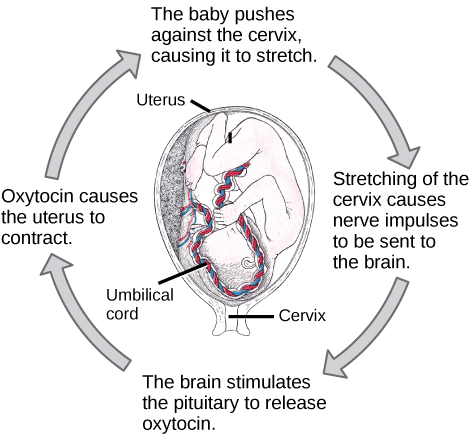
During labor, the fetus exerts pressure on the uterine wall, inducing the production of oxytocin, which stimulates uterine wall contraction. The contractions cause the fetus to further push on the wall, increasing the production of oxytocin
After a meal, blood glucose levels become elevated, stimulating beta cells of the pancreas to release insulin into the blood. Excess glucose is then converted to glycogen in the liver, reducing blood glucose levels.
At high elevation, atmospheric oxygen is more scarce. In response to signals that oxygen is low, the brain decreases an individual’s rate of respiration to compensate for the difference.
A transcription factor binds to the regulatory region of a gene, blocking the binding of another transcription factor required for expression.


