
 Worksheets
Thigh, Leg and Knee Test Review
Total questions: 36
Worksheet time: 1hrs 27mins
What does your knee anatomy consist of?
non of them
Femur, tibia, fibular, and patella
femur, tibial, fibula, patella
femur, tibia, fibula, patella
What are the ligaments?
Medial collateral ligament, lateral collateral ligament
Medial collateral ligament, lateral collateral ligament, Anterior cruciate ligament
vastis medialis, vastis leteralis
Medial collateral ligament, lateral collateral ligament, Anterior cruciate ligament, and the posteriar cruciate ligament
what does the acl do?
it does nothing
its a form of cushion to the femur base
it prevents posterior movement to the tibia
it prevents anterior movement to the tibia
Which ligament prevents the tibia from moving backward on the femur?
MCL
LCL
PCL
ACL
What does "C" of ACL stand for?
Cruciate
Collateral
Connective
Condyle
What does the "C" of MCL stand for?
Cruciate
Collateral
Connective
Condyle
What structures provides cushion between the femur and tibia?
ligaments
tendons
mensicus
tuberosities
What are the functions of the meniscus (select all that apply)
Shock absorber
Increase stability
Decrease friction
None of these
Which ligament prevents a valgus (lateral) force on the knee
ACL
PCL
MCL
LCL


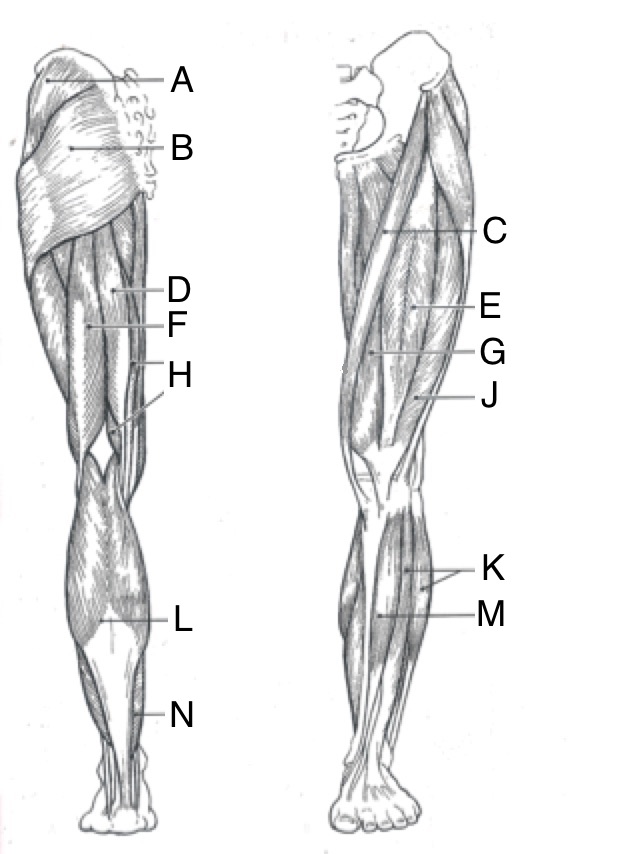
Letters "E", "G" and "J" all make up which muscle group?
Hamstrings
Quadriceps
Gluteals
Gastrocnemius
What attaches to the tibial tuberosity?
Hamstring tendon
Patellar Tendon
ACL
PCL
Most common MOI for non-contact ACL sprain is what?
"Plant and twist"
"Squat and step"
"Duck walk"
"Overstretching"
Which 2 of the following are cruciate ligaments?
ACL and LCL
MCL and PCL
PCL and ACL
MCL and LCL
A blow to the lateral side of the knee could cause a tear in which ligament?
MCL
ACL
PCL
LCL
What is the medical term for knee cap?
Femur
Tibia
Fibula
Patella
How many muscles make up the quadriceps?
2
4
3
5
What body part is responsible for lubrication and nourishment of the knee joint, weight distribution, and assistance with joint biomechanics.
Femur
ACL
Meniscus
LCL
Patellar tendonitis is also known as what?
Jumper’s Knee
Osgood-Schlatter Disease
Bursitis
Osteochondritis Dissecans
The job of the PCL is to
keep the femur from moving backwards under the tibia
keep the patella from dislocating
keep the tibia from moving backwards under the femur
prevent a patellar tendon strain
Osgood-Schlatter disease causes
a bump on the point of attachment of the patella tendon to the tibia
pain during activity
swelling
all of these
On which side of the knee will the patella most likely dislocate
anterior
posterior
medial
lateral
The shape of the top of the tibia at the knee is
round
flat
square
oblong
How long will a torn ACL need to heal properly?
1 month
3 months
6 months
1 year
If you tear your ACL you will not be able to play sports again.
true
false
An athlete goes down during a football game. Upon your evaluation, he tells you that he planted and twisted his knee and is complaining of ‘catching, clicking, and locking’. What is most likely his injury?
MCL tear
Meniscus tear
ACL tear
PCL tear
Knee bursitis will not heal or 'self reduce' on its own, and always requires surgery to drain the fluid.
True
False
A volleyball athlete collides with another player and falls down on the court during a game. Upon evaluation, you notice significant deformity where her patella is, and she is in significant pain. What most likely is the injury?
Patellar contusion
Patellar tendonitis
Patellar dislocation
Quadriceps tendon strain
A dislocation of the tibiofemoral joint puts what structures at risk?
arteries
veins
nerves
all of the above
The condition that can be caused when a fracture or dislocation occurs at the femoral head or neck and results in a decaying of the bone is called:
avascular necrosis
myositis ossificans
chrondomalacia
snapping hip

