
 Worksheets
Food chain 2
Total questions: 57
Worksheet time: 2hrs 54mins
Producers are:
animals
rocks
plants
Plants are called producers because they can produce their own:
music
food
air
Animals that eat only plants are called:
herbivores
omnivores
carnivores
Animals that eat only meat are called:
herbivores
carnivores
omnivores
Animals that eat both plants and animals are called:
herbivores
carnivores
omnivores
A food chain is:
an animal that eats only plants.
a diagram that shows how energy moves from one organism to another. (Grass>Mouse>Owl)
An animal that is hunted and eaten by another animal.
A living thing that breaks down dead plants and animals - such as, fungi, worms, bacteria, is:
decomposer
food web
omnivore
A system of many food chains that interact with each other:
predator
consumer
food web
An animal that hunts and eats other animals:
producer
plants
predator
A living thing that needs to eat other living things for food:
consumer
producer
desk chair
A living thing:
organism
rock
weather
An animal that is hunted and eaten by another animal:
predator
prey
scavenger
An example of a consumer:
grass
roses
dog
An example of a predator:
shark
mouse
rabbit
An example of prey:
lion
mouse
shark
Where do all life forms get their energy?
Food
Water
Plants
The Sun
Recently, a family of bobcats(predator) moved into an area with a large rabbit(prey) population. What changes may occur in the food chain?
The rabbit population may increase
The rabbit population may decrease
The rabbit population may increase first, then decrease
The rabbit population will remain the same
which one is a Producer?


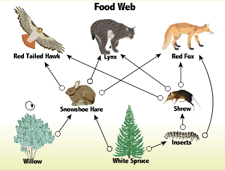


Why do people say adult lions are at the top of the food chain?
Adult lions have no predators in the wild.
Adult lions are prey for many different kinds of animals.
Adult lions are producers and can make food on their own.
Adult lions help other animals get food by hunting for them.
What is a food chain?
The flow of energy from one thing to another
The way animals eat each other
The way the sun makes everything
How the plants grow

*Remember Humans are on the top of all food chains because we do not get hunted.
What do plants need to make their own food?
Sun, Water, and Animals
Sun, Coke, and Soil
Sun, Water, and Soil
Nothing at all
What is a decomposer?


Food webs show you everything an animal eats. Food chains show you one thing.


The food web supports which statement?
Organisms are independent from one another.
Each organism has its own, unique food source.
Matter cannot move from one organism to
another.
Matter can be recycled between organisms
and their environment.

In the diagram, which organism provides nutrients for the
largest number of other organisms?
Seal
Herring
Snapper
Bluefish

What is the driving source of energy for the food web to
the right?
Sun
Orca
Seal
Larvae

Which organisms compete for food in the food web to the
right?
Orca and Herring
Seal and Copepod
Killifish and Snapper
Mackerel and Bluefish

What's the role of consumers in a food chain?
Use sunlight to make food
Eat other species and keep them from overpopulating
Break down dead stuff
Add nutrients to the soil

Which of these organisms would receive energy from the snake?
Plant
Rabbit
Mouse
Hawk

Which animal in the food chain is an herbivore and eats only plants?
wolf
fox
hedgehog
grasshopper
Which living thing is a predator?


Which living things are producers in the ocean?
dolphins
seaweed
penguins
sharks

What might happen if salmon become endangered?
Bears might have a hard time getting the energy they need.
Bears would have an easier time finding food.
There would be more bears in the wild.
There would be less insects in the wild.

Fossil teeth can tell about what a dinosaur ate. What do you think this animal ate?
spiders
fruit
insects
meat
What happens when a frog eats a fly?
Some energy moves from the predator to the prey.
Some energy moves from the prey to the predator.
Some energy moves from the producer to the consumer.
Some energy moves from the consumer to the producer.
Which living thing is a producer?


If the GRASS became diseased, which organisms would also be NEGATIVELY affected?
Rabbits only
Rabbits and snakes
Rabbits, snakes, and hawks
Rabbits and hawks (snakes benefit)
If the RABBITS became diseased, which organisms would also be NEGATIVELY affected?
Grass and hawks
Grass and snakes
Grass, snakes, and hawks
Snakes and hawks
If the RABBITS became diseased, which organisms would also be POSITIVELY affected?
Grass
Snakes
Nobody (all hurt)
Hawks
What happened after 12 months after the hawk population was MOSTLY killed off?
Snakes increased, Rabbits decreased, and Grass increased. Then everything balanced back out to almost normal.
Initially everything was stable, but the snake population killed all the rabbits and then died out themselves.
Everything went down significantly at first, then the hawks recovered.
Everything except the grass died off at first, then the rabbits recovered.

Which of the following is not true about predator-prey relationships?
Predators lower the size of prey populations
If a prey population grows, the predator population will grow too
Predators hunt/eat prey.
If a predator is removed, the prey population will die off.

What is the effect of removing prey from a food chain?
All predators above them will die or suffer.
The prey's predator will die or suffer, but everybody else should be fine.
The prey will always, eventually, come back
The predators population will grow

