wayground logo

Free Printable Worksheets

NEW

Font size

S
M
L
XL
Worksheets

8th Grade Science Exam Review

Total questions: 65

Worksheet time: 1hrs 11mins

Name
Class
Date
1.
Compared to the climate at location 1, the climate at location 3 is
a)
cooler and drier
b)
cooler and wetter
c)
warmer and drier
d)
warmer and wetter
2.
Compared to an inland location, a location on an ocean shore at the same elevation and latitude is likely to have
a)
cooler winters and cooler summers
b)
cooler winters and warmer summers
c)
warmer winters and cooler summers
d)
warmer winters and warmer summers
3.
When considering Natural Hazards, most technological solutions will:
a)
stop a hurricane from happening
b)
try to increase safety and damage from the hazard
c)
give alternatives for the way that humans survive the hazard
d)
determine the exact amount of damage that a tornado will do 
4.
The greenhouse effect is beneficial as it helps to sustain life on earth by naturally trapping ____ in the atmosphere. 
a)
gas
b)
heat
c)
pollution
d)
water
5.
From 1880 to 2010, the temperature of the globe mostly
a)
stays the same
b)
increases 
c)
decreases
d)
none of the above
6.

This map shows tornado activity in the United States between 1950 and 1998. Based on the data provided by this map, which of the following cities would be most likely to experience a tornado with a rating of F3 or greater in the next year?

a)

Phoenix, Arizona

b)

Topeka, Kansas

c)

Orlando, Florida

d)

Columbia, South Carolina

7.

Which of the following is NOT a natural hazard?

a)

Hurricane

b)

Tornado

c)

House Fire

d)

Earthquake

8.

1.Which cities are experiencing dry, clear conditions?

a)

Seattle, Chicago, New York

b)

Los Angeles, Little Rock, New Orleans

c)

Charleston, Orlando, Miami

9.

3.What type of front passed through Little Rock? Explain what type of weather they probably had from the front that passed through.

a)

Cold Front - probably had storms and rainy weather; now getting colder

b)

Warm Front - probably light rain and now getting warmer

c)

Cold Front - probably no rain; now getting colder

d)

Warm Front - probably heavy rain and getting warmer

10.

Why is Little Rock colder than New York City?

a)

Little Rock just had a cold front pass through, but the front has not yet reached New York.

b)

New York gets heated by the ocean.

c)

Little Rock is always colder than New York

d)

Little Rock is in the mountains and New York is at sea level.

11.

What kind of weather is Los Angeles most probably having?

a)

Rainy and possible storms

b)

Clear, sunny skies with light wind

c)

Several days of clouds and rain

12.
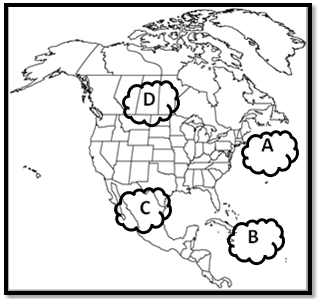
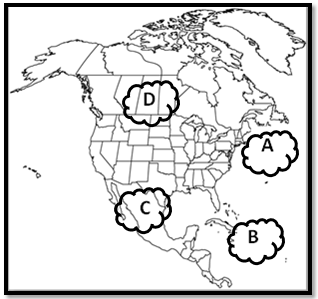
Which type of air would you find at air mass A?
a)
cold, dry
b)
warm, humid
c)
warm, dry
d)
cold, humid
13.
Which type of air would you find at air mass B?
a)
cold, dry
b)
warm, humid
c)
warm, dry
d)
cold, humid
14.

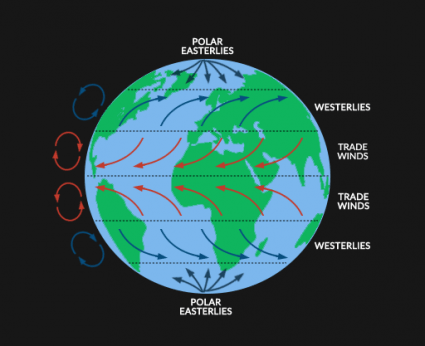
The Coriolis Effect is caused by what?

a)

The wind blowing

b)

Earth's gravity pulling things down

c)

The rotation of the Earth

d)

The pull of the Moon

15.

what is the coriolis effect?

a)

change in location of warm and cold surface water every 2-7 years

b)

tendency of objects moving large distances on Earth’s surface to bend to the right in the northern hemisphere & to the left in the southern hemisphere

c)

winds in northern Indian ocean that blow from the southwest in the summer & from the northeast in winter

d)

two layers of horizontal winds moving in opposite directions

16.

The temperature of an ocean current _____ affect the climate of the land nearby.

a)

does

b)

does not

17.

The higher the elevation of an area, the _______ the climate.

a)

warmer

b)

cooler

18.

As warm air moves up a mountain, it gets ________ and water vapor condenses and precipitation falls.

a)

warmer

b)

cooler

19.

When water vapor cools and ______, precipitation falls.

a)

evaporates

b)

condenses

c)

precipitates

d)

humidifies

20.
Earth’s climate system is powered mainly by energy from:
a)
Tilt
b)
The sun
c)
Latitude
d)
The rain shadow
21.
Movements of ocean water in a continuous flow are called?
a)
ocean currents
b)
global winds
c)
air mass
d)
front
22.
The _______ of  a mountain range is the side that receives a lot of precipitation.
a)
dry side
b)
leeward/dry side
c)
windward/wet side
d)
cloudy side
23.
What is the day to day changes in the air?
a)
Weather
b)
Climate
c)
Storms
d)
Earth's Rotation
24.
Two types of ocean currents are
a)
local and global
b)
sea and land
c)
surface and deep
d)
warm and cold
25.
Temperature and salinity differences in ocean water cause:
a)
Mid-ocean ridges
b)
Deep Currents
c)
Surface Currents
d)
High tide and low tide
26.
In addition to salinity, what factor affects the density of seawater?
a)
depth
b)
latitude
c)
temperature
d)
salt content
27.
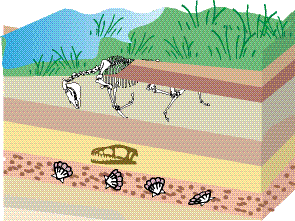
The Law of Superposition helps scientists to determine what?
a)
The absolute age of rock layers
b)
The age of fossils
c)
The relative age of rock layers
d)
the super powers of rocks
28.
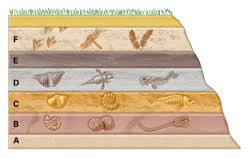
According to the law of superposition, the oldest fossils are found 
a)
At the top of the rock layers
b)
Near the bottom of the rock layers
c)
In the middle of the rock layers
d)
Somewhat near the surface
29.
Which rock layer in the diagram seems to be the oldest?
a)
F
b)
E
c)
B
d)
A
30.
The rock formation labeled "P" is a(n)...
a)
fault
b)
intrusion
c)
inclusion
d)
unconformity
31.
Letter "F" is a....
a)
inclusion
b)
intrusion
c)
fault
d)
unconformity 
32.
In this rock layer diagram there are two unconformities, a fault at E and an intrusion at D. Which unconformity occurred first?  How do you know?
a)
Intrusion D occurred first because the instrusion has been moved by the fault.
b)
The fault occurred first because it has moved the intrusion D.
c)
Intrusion D occurred first because it can be seen in all of the rock layers.
d)
Fault E occurred first because it is a normal fault.
33.
Which Rock layer or intrusion is the youngest?
a)
A
b)
B
c)
C
d)
D
34.
An archaeologist made the following diagram of a dig site. What can be said about the pottery as compared to the skull found in the site?
a)
The rock layer with the pottery is more recent than the rock layer with the skull.
b)
The rock layer with the skull is more recent than the rock layer with the pottery.
c)
The rock layer with the skull is approximately the same age as the rock layer with the pottery.
d)
The rock layer with the skull has an absolute date of 17,000 years.
35.
An organism that no longer exists on Earth is called
a)
Decayed
b)
Evolved
c)
Extinct
d)
Preserved
36.
The best index fossils have which two traits?
a)
widespread geographically, long lifespan
b)
widespread geographically, short lifespan
c)
specific place, long lifespan
d)
specific place, short lifespan
37.
Index fossils help determine relative age through correlating rock layers.
a)
True
b)
False
38.
Which fossil makes the best index fossil?
a)
Fossil 1
b)
Fossil 2
c)
Fossil 3
d)
None follow all of the rules
39.

What is the best reason that fossil #4 is NOT a good index fossil?

a)

It is not widespread

b)

it is not short-lived (in numerous layers)

c)

It is in half of the outcrops

40.
Scientists compare the limbs of organisms to look for evidence of common ancestry. These limbs provide evidence of common ancestry because they -
a)
perform the same function
b)
are the same size
c)
have the same basic structure
d)
are parts of the same animal
41.
The picture shows the members of the Camelidae family. The physical features and the geographical origin of these animals provide evidence that - 
a)
they live in the same type of environment.
b)
have slowly evolved to become herbivores.
c)
have a common ancestor.
d)
exchanged DNA in the past.
42.
Which period are we currently in?
a)
Quaternary
b)
Holocene
c)
Jurassic
d)
Tertiary
43.
The geologic time scale is a record of....
a)
the history of fossils only
b)
the history of rocks
c)
the history of rock layers and fossils
d)
geologist notes
44.

Dinosaurs, small mammals, and birds are found in this time period.

a)

Precambrian

b)

Paleozoic

c)

Mesozoic

d)

Cenozoic

45.

The end of the Mesozoic Era was most likely caused by?

a)

An asteroid or comet

b)

Too much oxygen

c)

Lowering sea levels

d)

An ice age

46.

Which fossil would make the best index fossil?

a)

Beetle

b)

Flower

c)

Frog

d)

Fish

47.
Mushrooms are an example of this Kingdom?
a)
Animalia
b)
Protista 
c)
Archea 
d)
Fungi
48.
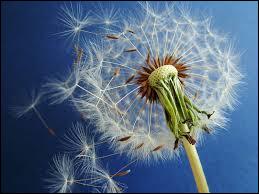
Dandelion, What kingdom does it belongs to?
a)
Plant Kingdom
b)
Animal Kingdom
c)
Fungi Kingdom
d)
Protista Kingdom
49.
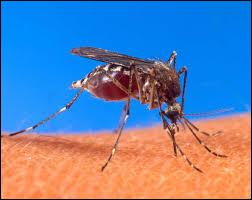
Mosquito  belongs to what kingdom?
a)
Animal Kingdom
b)
Plant Kingdom
c)
Fungi Kingdom
d)
Protista Kingdom
50.
All living organisms are made up of ____.
a)
Cells
b)
Bacteria
c)
Organs
d)
Tissue
51.

Which location has guppies with medium spot size as the adaptive trait?

a)

Population in Brazil

b)

Population in Venezuela

52.

What changed in the environment to cause evolution?

a)

The water temperature increased.

b)

The water temperature decreased.

c)

The water temperature did not change.

53.

Which location had short giraffes as the

non-adaptive trait?

a)

Population in Niger

b)

Population in Somalia

54.

How did the cactuses evolve from 1970 to 2015?

a)

Medium spine size became an adaptive trait.

b)

Medium spine size became a non-adaptive trait.

c)

Small and large spine sizes became adaptive traits.

55.

The environment is constantly changing due to weather patterns, geological events, and human activity.


If a species cannot adjust to these changes in order to successfully reproduce, then it is MOST likely that the species will

a)

Develop new adaptations to accommodate for the environmental changes

b)

Become extinct.

c)

Form a new symbiotic relationship with another species

d)

Migrate to a new environment that will meet its needs.

56.

Natural selection

a)

Happens in nature without human involvement

b)

Humans control the process to obtain desirable traits

57.
_____________  is the study of embryos to see how their similarities and differences indicate an evolutionary relationship.
a)
Paleontology
b)
Common ancestry
c)
Homologous structure
d)
Embryology
58.
The most recent ancestral form or species from which two different species evolved is known as ________________________.
a)
a common ancestor.
b)
an embryonic stage.
c)
development.
d)
evolution.
59.
Common ancestry relates to evolution because
a)
evolution only happens when there are common ancestors.
b)
Common ancestors make evolution happen more quickly.
c)
evolution can never take place with common ancestors.
d)
the more two organisms have in common, the more recent is their common ancestor during their evolution.
60.
In the the third embryonic stage (bottom row), mammal embryos _____
a)
have more characteristics in common with each other than with reptiles or birds.
b)
are still hard to tell from reptiles and birds.
c)
have the same features as fish, reptiles, and birds.
d)
do not have tails.
61.

Loggerhead sea turtles are large turtles that live in the ocean and nest on the Florida coast. The female loggerhead sea turtle lays more than 100 eggs in the beach sand. How is laying so many eggs an important adaptation that helps these turtles to survive?

a)

Large nests of eggs help keep the eggs warm enough to allow more turtles to hatch.

b)

If many turtles hatch, they can help defend each other against predators in large numbers.

c)

The more eggs that are laid, the greater the chance that more turtles will live to become adults.

d)

A large number of eggs in one place makes it possible for the mother to lie on the eggs until they hatch.

62.

What is variation?

a)

The same trait or characteristic in all individuals of a population.

b)

The process of natural selection.

c)
Differences or changes in a particular trait or characteristic within a population.
d)

Variation is only observed in plants, not animals.

63.

Why did we see an increase in the poison trait for the poisonous newts?

a)
Natural selection favoring higher toxicity levels as a defense mechanism against predators.
b)
Climate change affecting the toxicity of the environment
c)
Genetic mutation causing a decrease in toxicity levels
d)
Increased availability of non-toxic prey, leading to a shift in diet
64.

An example of a behavioral adaptation is

a)

the long neck of a giraffe.

b)

a camel's hump used to store water.

c)

a polar bear's white fur used for camouflage.

d)

a squirrel storing nuts for the winter.

65.
The praying mantis looks very much like a blade of grass. What is it called when animals look like other animals or plants?
a)
camouflage
b)
mimicry
c)
locomotion
d)
hibernation