wayground logo

Free Printable Worksheets

NEW

Font size

S
M
L
XL
Worksheets

Atoms, Ions, Isotopes, Elements Study Guide

Total questions: 76

Worksheet time: 50mins

Name
Class
Date
1.
Adding or subtracting neutrons (charge = 0, mass = 1) makes the element change into an...
a)
ion
b)
mixture
c)
isotope
d)
neutral atom
2.
The atomic number is equal to _.
a)
the number of protons and electrons
b)
the number of neutrons only
c)
the total number of protons and neutrons
d)
the number of protons neutrons and electrons
3.
What is the charge on a lithium atom that looses 1 electron?
a)
+1
b)
0
c)
-1
d)
-2
4.
Is the element shown in this image an ion, isotope or normal atom?
a)
atom
b)
isotope
c)
cation (+ ion)
d)
anion (- ion)
5.
Helium (He atomic number 2) has 2 protons, 2 neutrons, and 2 electrons) is the He element shown above an atom, an element, or an isotope?
a)
atom
b)
cation  (+ ion)
c)
isotope
d)
anion (-)
6.
The atomic mass is equal to _.
a)
the number of protons only
b)
the number of neutrons only
c)
the total number of protons and neutrons
d)
the number of protons, neutrons, and electrons.
7.
What is the net charge on the element shown above? 
(Calcium - atomic number 20)
a)
cation +1 charge
b)
cation +2 charge
c)
anion -1 charge
d)
anion -2 charge
8.
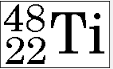
How many protons does this isotope of titanium have? Hint titanium has an atomic number of 22.
a)
48
b)
22
c)
26
d)
70
9.
What element is this?  What is the mass number of this atom?
a)
sodium, 23
b)
magnesium, 23
c)
magnesium, 12
d)
sodium, 11
10.
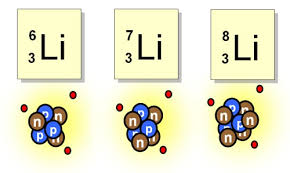
Which atom has  4 neutrons?
a)
Li-6
b)
Li-7
c)
Li-8
d)
they have the same # of neutrons
11.
What is the atomic number of Fe? (click to see image)
a)
26
b)
55.845
c)
56
d)
None of these
12.
How many neutrons does B (Boron) contain?
a)
5
b)
11
c)
6
d)
10.811
13.
Carbon has an atomic number of 6 and an atomic mass of 12. Which elements are considered isotopes of carbon?
a)
Carbon-12
b)
Carbon-13
c)
Carbon-14
d)
Both Carbon-13 and Carbon-14
14.
How many neutrons does Lithium have (atomic mass = 6.94)
a)
3
b)
4
c)
6.94
d)
24.94
15.

What charge does an atom have when it GAINS electrons?

a)

Positive

b)

Negative

c)

Neutral

16.

What is a representation of an ion?

a)

Li

b)

Na-22

c)

O-2

17.

What is the mass number of bromine?

a)

35

b)

45

c)

80

d)

79.904

18.

How many neutrons does this bromine atom have?

a)

35

b)

45

c)

80

19.

What type of atom is this?

a)

Neutral atom

b)

Cation

c)

Anion

d)

Isotope

20.

What two particles determine the mass number?

a)

Protons and electrons

b)

Electrons and neutrons

c)

Protons and neutrons

21.

What type of atom is this?

a)

Normal Atom

b)

Cation

c)

Anion

d)

Isotope

22.

What is the mass number of this Neon atom?

a)

10

b)

11

c)

21

d)

20

23.

How many electrons does this magnesium ion have?

a)

24

b)

12

c)

10

d)

14

24.

What does it change in an ion?

a)

The number of electrons

b)

The number of protons

c)

The number of neutrons

25.

What is the representation of an isotope?

a)

N-3

b)

Al+3

c)

Si

d)

P-33

26.

How many neutrons does this Neon atom have?

a)

21

b)

11

c)

10

d)

12

27.

What does it happen to this atom?

a)

It LOSES electrons

b)

It GAINS electrons

c)

It GAINS protons

d)

It LOSES protons

28.

What is the atomic number of this element?

a)

12

b)

24

c)

23

29.

What type of atom is element C?

a)

Normal atom

b)

Ion

c)

Isotope

30.

What is the mass number of this element?

a)

12

b)

24

c)

23

d)

11

31.
Two atoms of different elements will definitely have different numbers_____
a)
Nuclei
b)
Protons
c)
Neutrons
d)
Electrons
32.
An ion forms when an atom gains or loses
a)
Protons
b)
Neutrons
c)
Electrons
33.
A neutral atom would become an ion that has a charge of 2+ by 
a)
Losing two protons
b)
Losing two neutrons
c)
Losing two electrons
34.
Isotopes are atoms that have different
a)
Mass numbers
b)
Element names
c)
Atomic Numbers
35.
A positively charged ion is formed when
a)
A neutron is lost
b)
An electron is lost
c)
A neutron is gained
d)
An electron is gained
36.
Two atoms that have different numbers of protons are 
a)
Different ions
b)
Different isotopes
c)
Different elements
37.
If neutral copper atom (atomic number 29) becomes an ion that has a charge of 2+, how many electrons does the resulting ion have?
a)
27
b)
28
c)
29
d)
31
38.
Two neutral atoms that have the same atomic number and different mass numbers are
a)
Ions
b)
Isotopes
c)
Alpha particles
d)
Different elements
39.
Which phrase describes two atoms that are isotopes
a)
Same mass number, same atomic number
b)
Same mass number, different atomic number
c)
Different mass number, same atomic number
d)
Different mass number, different atomic number
40.
An ion that has a negative charge is formed when an atom 
a)
Loses neutrons
b)
Loses electrons
c)
Gains neutrons
d)
Gains electrons
41.
What information would allow you to determine whether two atoms are of the same or different elements
a)
The charge on each atom
b)
The number of neutrons each has
c)
The number of protons in their nuclei
d)
The location of the electrons in their electron clouds
42.
Define Atom
a)
It is the smallest piece of an element that still represents that element
b)
Is an element has the electrons in their electron cloud
c)
A positively charged isotope
43.
How are Protons and Neutrons similar
a)
Both are in the nucleus of the atom and they both have the relative mass of 1
b)
They both have alpha particles and have the relative mass of 2
c)
They both have 1 high-energy electron and different elements
44.

The number of protons + neutrons in an atomic nucleus is referred to as what?

a)

Atomic number

b)

Isotope number

c)

Mass number

45.

Atoms of the same element with differing number of electrons are called ________.

a)

elements

b)

atoms

c)

ions

d)

isotopes

46.

Which subatomic particle is used to identify the atom, as it never changes?

a)

protons

b)

neutrons

c)

electrons

47.

How many neutrons are found in this isotope? 3115P3-

a)

31

b)

15

c)

16

d)

3

48.

What is the complete isoic notation a cobalt atom with a mass number of 60

a)

A

b)

B

c)

C

d)

D

49.

An ion with a positive charge is a(n) __________________.

a)

Anion

b)

Cation

50.

Which of the following describes an anion

a)

protons = 8 neutrons = 8 electrons = 8

b)

protons = 8 neutrons = 8 electrons = 10

c)

protons = 8 neutrons = 10 electrons = 8

d)

protons = 10 neutrons = 8 electrons = 8

51.

Which of the following is an isotope with 38 protons and 50 neutrons

a)

Strontium-88

b)

Strontium-50

c)

Tin-88

d)

Tin-50

52.

How many electrons are found in the following ion?

a)

3

b)

7

c)

10

d)

14

53.

How many electrons does the following have?

a)

2

b)

22

c)

10

d)

12

54.

How many neutrons are in the isotope Carbon-14

a)

6

b)

8

c)

14

d)

12

55.

How many protons are found in the following isotope?

a)

207

b)

82

c)

125

d)

289

56.

How many neutrons are in the following isotope?

a)

108

b)

47

c)

61

d)

155

57.

Atoms of the same element with differing numbers of neutrons are _______________.

a)

isotopes

b)

ions

c)

elements

d)

nucleus

58.

Which of the following describes a cation?

a)

protons = 8 neutrons = 8 electrons = 8

b)

protons = 8 neutrons = 8 electrons = 10

c)

protons = 8 neutrons = 10 electrons = 8

d)

protons = 10 neutrons = 8 electrons = 8

59.

An ion with a negative charge is a(n) __________________.

a)

Anion

b)

Cation

60.

If a neutral atom of Carbon gains or loses electrons it is now classified as

a)

an ion

b)

an isotope

c)

an atom

d)

an electron

61.

Identify the number of protons, neutrons and electrons in a neutral atom of Oxygen.

a)

Protons = 8, Neutrons = 16, Electrons = 8

b)

Protons = 8, Neutrons = 8, Electrons = 8

c)

Protons = 8, Neutrons = 8, Electrons = 16

d)

Protons = 16, Neutrons = 8, Electrons = 8

62.

Identify the number of protons, neutrons and electrons of Mg+2

a)

Protons = 12, Neutrons = 12, Electrons = 12

b)

Protons = 14, Neutrons = 12, Electrons = 12

c)

Protons = 12, Neutrons = 12, Electrons = 10

d)

Protons = 12, Neutrons = 12, Electrons = 14

63.

What is the difference between an ion and an isotope?

a)

An ion has a change in number of electrons, an isotope has a change of number in protons.

b)

An ion has a change in number of protons, an isotope has a change in number of electrons.

c)

An ion has a change in number of neutrons, an isotope has a change in number of electrons.

d)

An ion has a change in number of electrons, an isotope has a change in number of neutrons.

64.
Adding or subtracting neutrons (charge = 0, mass = 1) makes the element change into an...
a)
ion
b)
mixture
c)
isotope
d)
neutral atom
65.
The atomic number is equal to _.
a)
the number of protons and electrons
b)
the number of neutrons only
c)
the total number of protons and neutrons
d)
the number of protons neutrons and electrons
66.
Negative ions are called
a)
Cations
b)
Electrons
c)
Anions
d)
Neutrons
67.
When an atom loses a valence electron, it becomes a(n) _____________ ion.
a)
positive
b)
negative
c)
neutral
d)
polyatomic
68.
Positive ions form when atoms _________ valence electrons.
a)
lose
b)
gain
c)
share
d)
gain or share
69.
What charge does an atom have if it LOSES an electron? 
a)
Positive (+)
b)
Negative (-)
70.
When an atom LOSES an electron it is a
a)
cation
b)
anion
71.
Ions are: 
a)
atoms with a positive or negative charge
b)
atoms with no charge
c)
atoms with ONLY a positive charge
d)
atoms with ONLY a negative charge
72.
A negative ion is a 
a)
cation
b)
anion
73.
What charge does an atom have if it GAINS an electrons?
a)
Positive (+)
b)
Negative (-)
74.
What is the number of protons?
a)
34
b)
16
c)
18
d)
S
75.
If you have 10 protons and 9 neutrons, what would the mass number be?
a)
19
b)
9
c)
10
d)
1
76.
What is the definition of isotope?
a)
atoms of an element with different numbers of neutrons.
b)
materials break down over time at a very consistent rate