wayground logo

Free Printable Worksheets

NEW

Font size

S
M
L
XL
Worksheets

Plate Tectonics

Total questions: 40

Worksheet time: 24mins

Name
Class
Date
1.
Identify the Major Plate labeled B
a)
African Plate
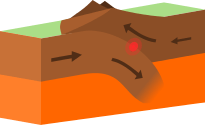
b)
Antarctic Plate
c)
Pacific Plate
d)
Eurasian Plate 
2.
Identify the Major Plate labeled I
a)
African Plate
b)
Antarctic Plate
c)
Pacific Plate
d)
Eurasian Plate 
3.
Identify the Major Plate labeled J
a)
African Plate
b)
Antarctic Plate
c)
Pacific Plate
d)
Eurasian Plate 
4.
Identify the Major Plate labeled L
a)
Indo-Australian Plate
b)
North American Plate
c)
South Americana Plate
d)
Eurasian Plate 
5.
Identify the Major Plate labeled G
a)
Indo-Australian Plate
b)
North American Plate
c)
South Americana Plate
d)
Eurasian Plate 
6.
This boundary is described by two plates moving away from eachother along the edges and separating. The resulting gap allows magma to rise and create new crust, forming new lithosphere. 
a)
Convergent Boundary 
b)
Divergent Boundary  
c)
Transform Boundary
7.
This boundary is described as two plates moving past eachother ALONG THE EDGES horizontally.  These boundaries will get stuck or lock against eachother causing earthquakes when they slip and release. 
a)
Convergent Boundary
b)
Divergent Boundary
c)
Transform Boundary
8.
This boundary is described as moving toward one another  When the plates are both continental plates the will crumple up and form a mountains. When they are continental and oceanic plates, subduction occurs  and earthquakes and volcanoes form. 
a)
Convergent Boundary
b)
Divergent Boundary
c)
Transform Boundary
9.
Trenches, deep underwater canyons on the sea floor are created at this type of boundary 
a)
Divergent
b)
Convergent, Subduction Zone
c)
Transform 
10.
New crust is created at this type of  boundary.
a)
Divergent
b)
Convergent, Subduction Zone
c)
Transform 
11.
Mountains are created at this type of  boundary.
a)
Divergent 
b)
Convergent
c)
Transform 
12.
Mid Ocean Ridge Formation  is created at this type of  boundary.
a)
Divergent 
b)
Convergent
c)
Transform 
13.

Earth's plates meet at ____________.

a)

plate tectonics

b)

plate boundaries

c)

continental drift

d)

oceans

14.

Plates slide past each other at _________________ boundaries.

a)

divergent

b)

convergent

c)

transform

d)

universal

15.

________________ currents drive Earth's plate movement.

a)

ocean

b)

atmosphere

c)

wind

d)

convection

16.

What is the motion of Earth's plates like?

a)

fast and in stages

b)

slow and in stages

c)

fast and constant

d)

slow and constant

17.

Which feature forms at convergent boundaries?

a)

trench

b)

rift valley

c)

mountain range

d)

mid-ocean ridge

18.
Which of the following causes Earth's tectonic plates to move?
a)
Energy from the Sun
b)
Magnetic Pole Reversal
c)
Convection currents in the mantle
d)
Faults in Mountain Ranges
19.
What type of event will occur at this boundary?
a)
Earthquake
b)
Volcano Eruption
c)
Tornado
d)
Mountain Building
20.
What type of plate boundary is this?
a)
Plate
b)
Divergent
c)
Convergent
d)
Transform
21.
A divergent boundary occurs when plates ....
a)
Pull apart
b)
Come together
c)
Slide past each other
d)
subducting
22.

Which of the following is the name of the ancient supercontinent formed 280 Million Years ago.

a)

Pangea

b)

Gondwanda

c)

Laurasia

d)

Neverland

23.
Which of the following is NOT evidence to support the theory of plate tectonics?
a)
Fossils
b)
Mountains
c)
Glaciers
d)
Sand Erosion
24.
What geologic feature/event you be most likely to find at a transform boundary?
a)
Earthquakes
b)
Volcanoes
c)
Mountains
d)
Rift Valleys
25.
What geologic feature/event would you most likely to find at a divergent boundary between two pieces of oceanic crust?
a)
Rift Valley
b)
Mid-Ocean Ridge
c)
Island Arc
d)
Flat land
26.
What geologic feature/event would you most likely to find at a convergent boundary between two pieces of continental crust?
a)
Volcano
b)
Mountain
c)
Rift
d)
Island Arc
27.
This is the plastic layer of the mantle on which pieces of the lithosphere move.
a)
Lithosphere
b)
Asthenosphere
c)
Mesosphere
d)
Crust
28.
This layer is divided into pieces called tectonic plates.
a)
Mesosphere
b)
Asthenosphere
c)
Mantle
d)
Lithosphere
29.
Which piece of evidence did Wegener use to prove continental drift?
a)
The shape of the continents
b)
Similar fossils found on separate continents
c)
Tree fossils found in odd places
d)
All of the above
30.
As you travel from the inner core to the crust, how would temperature, pressure and density of the material change?
a)
The would all increase
b)
The would all decrease.
c)
Nothing, the layers are made of the same material throughout
d)
Temperature would decrease, but pressure and density would increase
31.
A ______ is a section of the lithosphere that slowly moves over the asthenosphere, carrying large slabs of continental and oceanic crust.
a)
wedge
b)
plate
c)
chunk
d)
fault
32.
What is the process by which oceanic crust sinks beneath a deep-ocean trench and back into the mantle at a convergent plate boundary?
a)
Subduction
b)
Induction
c)
Abduction 
d)
Reduction
33.

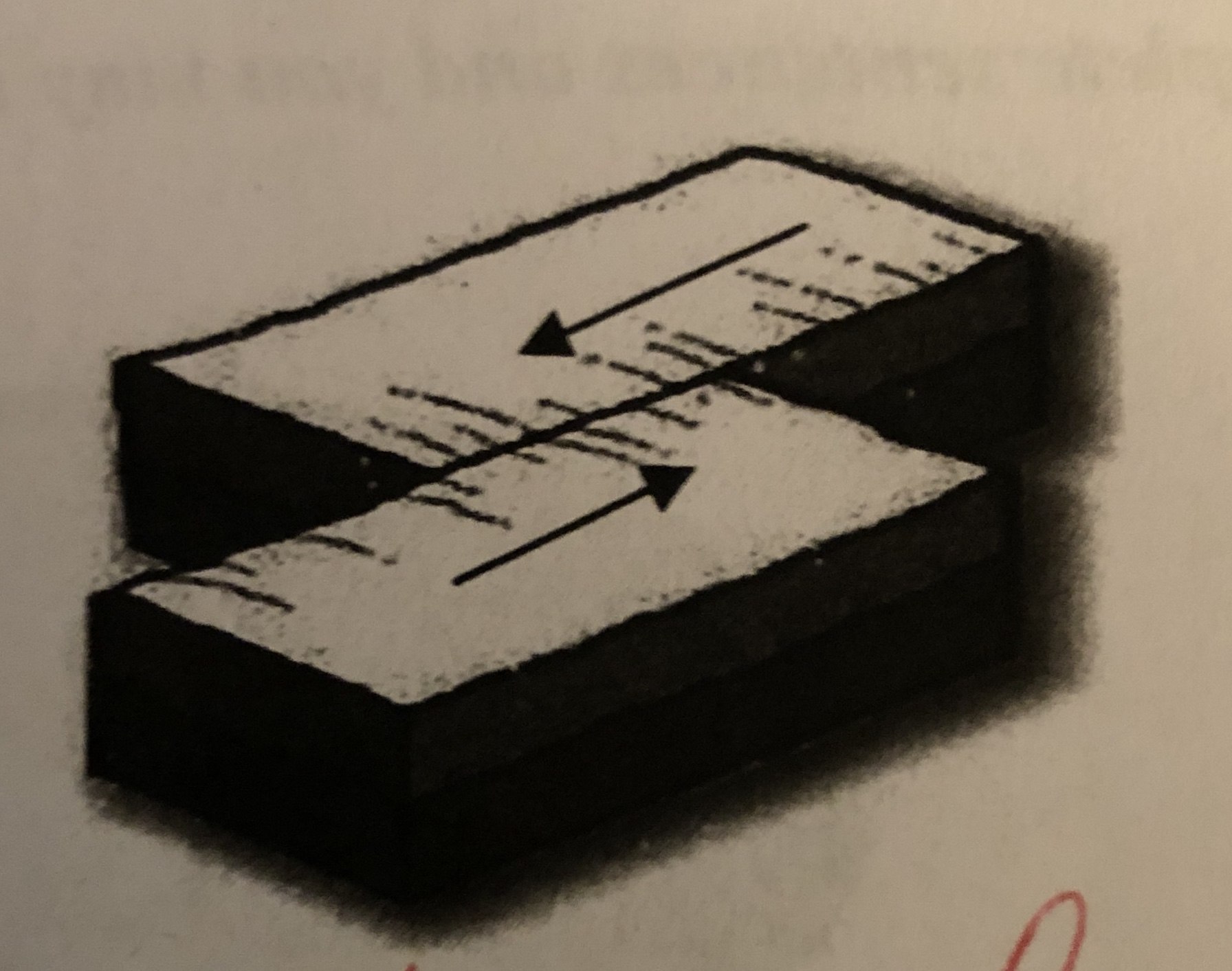
What type of boundary is this?

a)

convergent

b)

divergent

c)

transform

34.

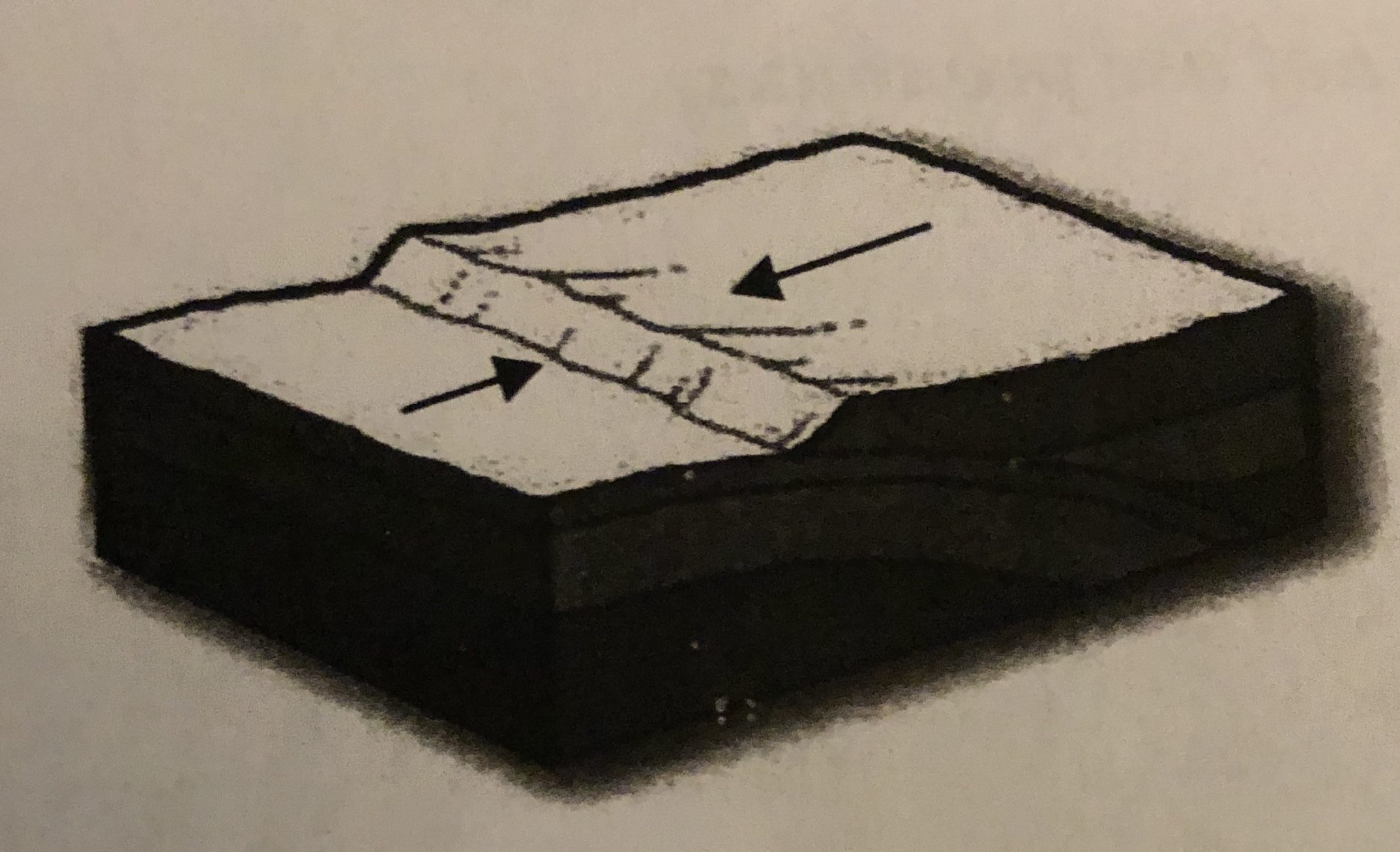
What type of boundary is this?

a)

convergent

b)

transform

c)

divergent

35.

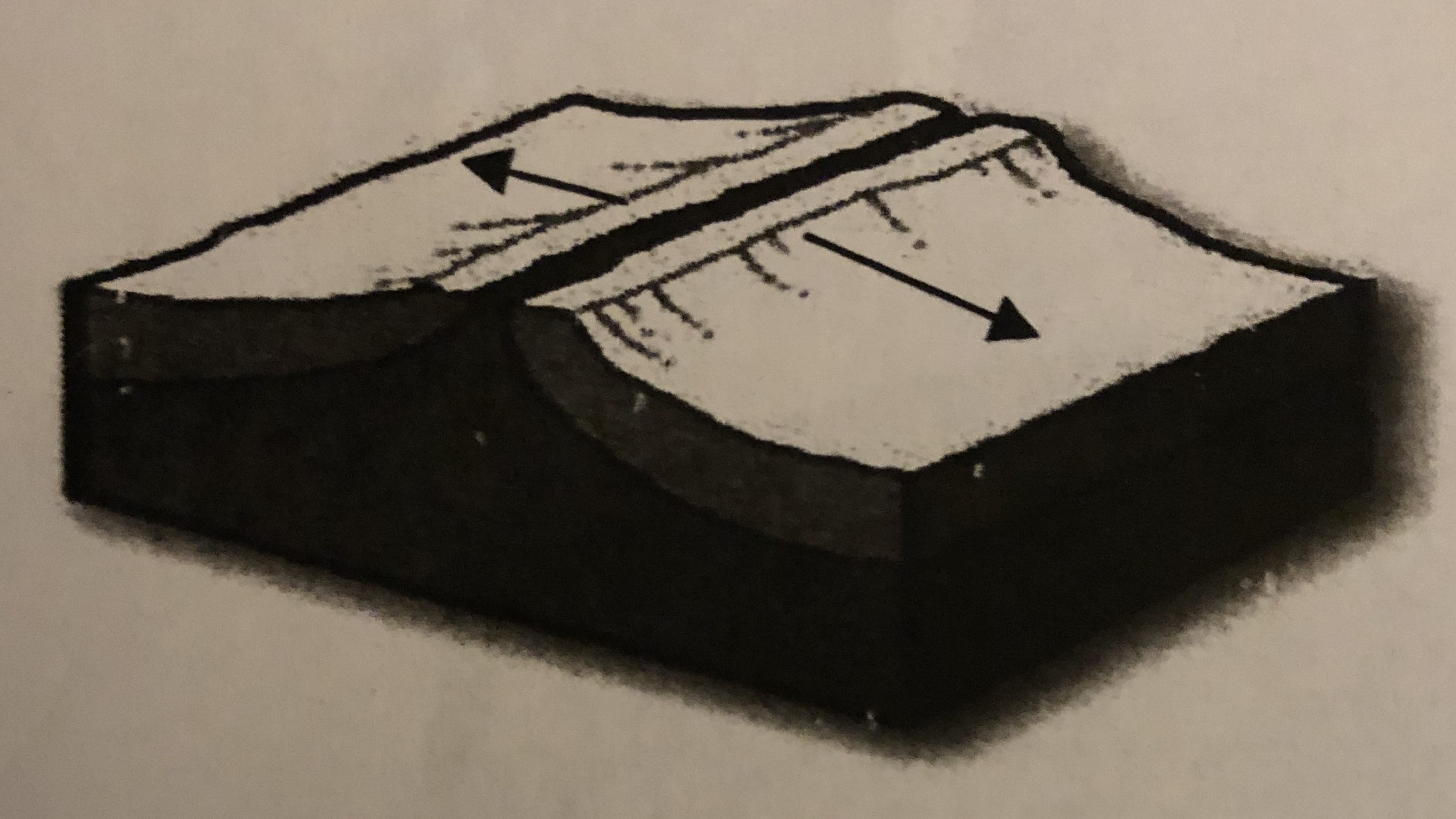
What type of boundary is this?

a)

convergent

b)

divergent

c)

transform

36.

What evidence was NOT used by Wegener as proof of continental drift?

a)

land features

b)

erosion

c)

climate

d)

fossils

37.

What is the process that continually adds new crust to the ocean floor along both sides of the mid-ocean ridge?

a)

subduction

b)

continental drift

c)

convergent

d)

sea floor spreading

38.

What is the process by which the ocean floor sinks beneath a deep ocean trench and back into the mantle?

a)

continental drift

b)

mid-ocean ridge

c)

faults

d)

subduction

39.

What is Wegener's idea that continents are slowly moving over Earth's surface called?

a)

divergence

b)

faults

c)

plates

d)

continental drift

40.

The geological theory that states that pieces of Earth's plates are in constant, slow motion, driven by convection currents is the theory of

a)

subduction

b)

plate tectonics

c)

deep ocean trenches

d)

sea floor spreading