wayground logo

Free Printable Worksheets

NEW

Font size

S
M
L
XL
Worksheets

Chapter 4/8/9 Quiz Review

Total questions: 36

Worksheet time: 18mins

Name
Class
Date
1.

What is the process by which rock is broken into fragments called sediments?

a)

Deposition

b)

Compaction

c)

Weathering

d)

Igneous Rock

2.

Rock that forms when pressure and heat change existing rock.

a)

Igneous Rock

b)

Sedimentary Rock

c)

Metamorphic Rock

d)

Rock Cycle

3.
An igneous rock can become ______.
a)
metamorphic
b)
sedimentary
c)
igneous
d)
all of these
4.
_______ rock forms from magma/lava
a)
Metamorphic
b)
Sedimentary
c)
Igneous
5.

The process by which sediment is moved from one place to another.

a)

weathering

b)

Uplift

c)

Deposition

d)

Erosion

6.

This process changes rocks to magma.

a)

melting

b)

cooling and crystallizing

c)

weathering and erosion

d)

heat and pressure

7.

This process takes sediments and changes them to sedimentary rock.

a)

weathering and erosion

b)

compacting and cementing

c)

heat and pressure

d)

melting

8.

What is the energy source for igneous rocks to form?

a)

Earth's hot interior

b)

the sun

c)

gravity

d)

magnetism

9.

Where do igneous rocks form?

a)

underwater

b)

deep underground

c)

in the air

d)

near volcanoes

10.

Where do metamorphic rocks form?

a)

underwater

b)

near volcanoes

c)

deep underground

d)

in the air

11.
Igneous rock that forms from lava on Earth's surface
a)
Organic Rock
b)
Intrusive Rock
c)
Clastic Rock
d)
Extrusive Rock
12.
Igneous rock that forms when magma hardens beneath Earth's surface
a)
intrusive Rock
b)
compaction
c)
Chemical Rock
d)
Clastic Rock
13.

The most destructive type of earthquake wave is a

a)

P-wave

b)

S-wave

c)

Surface wave

d)

transverse wave

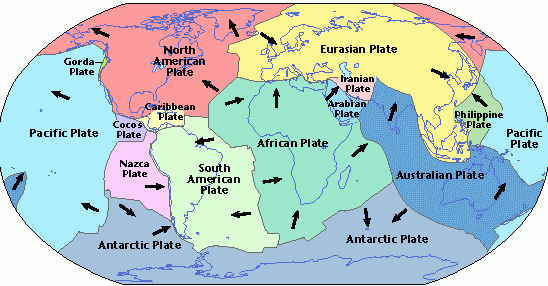
14.
Many earthquakes happen along the borders of...
a)
Countries
b)
Tectonic Plates
c)
Climate Zones
d)
None of the above.
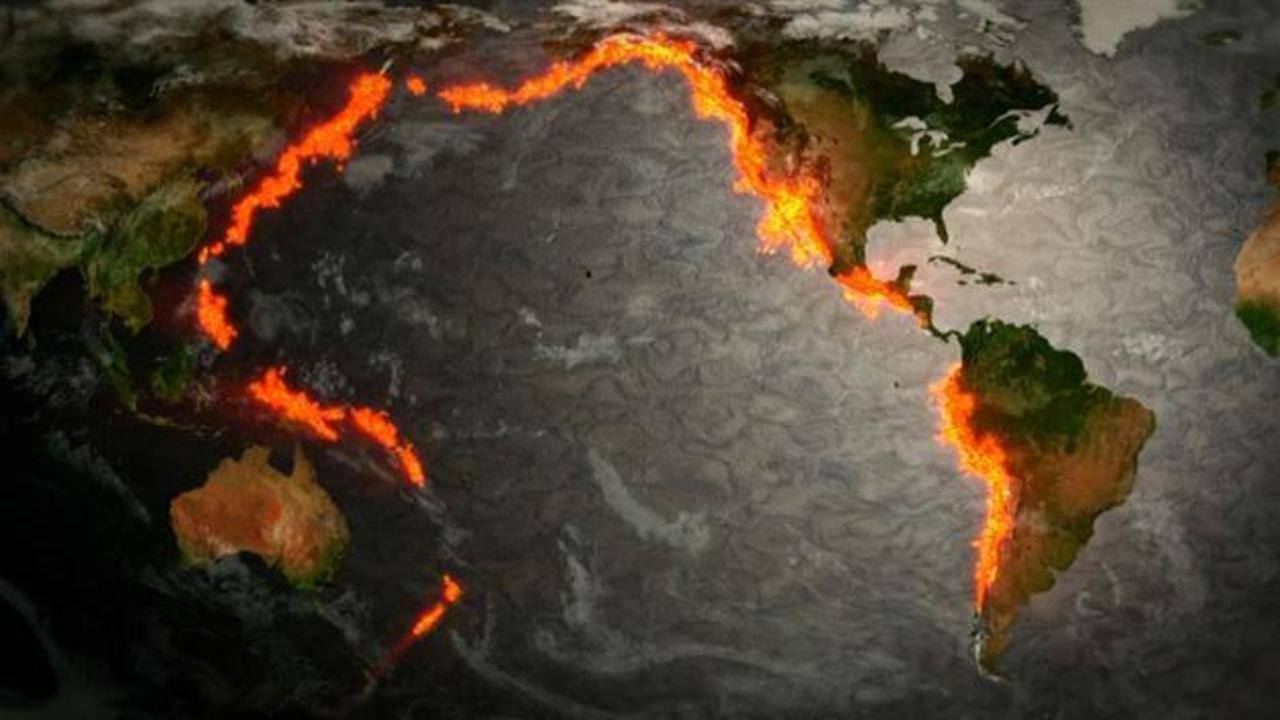
15.

The "Ring of Fire" surrounds which of our oceans?

a)

Atlantic

b)

Indian

c)

Arctic

d)

Pacific

16.
Earthquakes happen every day. Most are too small for humans to notice.
a)
True
b)
False
17.

Which image models secondary waves?

a)

Top

b)

Bottom

c)

Both

18.

The type of seismic waves that arrive at a seismic station FIRST and move by compressing and expanding the ground like an accordion are called

a)

secondary waves

b)

surface waves

c)

tsunami waves

d)

primary waves

19.
Which type of seismic waves cause the most damage?
a)
P waves
b)
S waves
c)
surface waves
d)
tsunami waves
20.

The place where an earthquake originates inside the Earth's surface is called...

a)

Epicenter

b)

Focus

c)

Underground

d)

Crust

21.

The place on the Earth's surface, above the origin of the earthquake.

a)

Epicenter

b)

Focus

c)

Surface

d)

Crust

22.

The shaking and trembling that results from movement of rock beneath Earth’s surface is called an

a)

relapse

b)

seismograph

c)

seimometer

d)

earthquake

23.

What is a volcano?

a)

A weak spot in Earth’s crust where magma can come to the surface.

b)

A mix of rocks, minerals, gases, and water from the mantle.

c)

Hot semifluid rock that becomes solid rock as it cools off.

d)

A special kind of mountain.

24.
A subduction zone is...
a)
plates pull apart.
b)
the continental plate slides under the oceanic plate.
c)
where the oceanic plate slides under the continental plate.
d)
plates slap each other a high five.
25.
Why does magma tend to rise to the surface?
a)
It has large amounts of silica.
b)
It contains very little silica.
c)
It is denser than the surrounding material.
d)
It is less dense than the surrounding material.
26.
Where are most volcanoes found?
a)
Southern Hemisphere
b)
Ring of Fire
c)
Mid-Atlantic Ridge
d)
Hot Spots
27.
Volcanoes are found...
a)
on land
b)
under water
c)
on islands
d)
all of the above
28.
Most volcanoes occur at which 2 types of plate boundaries? 
a)
convergent w/ subduction and divergent
b)
divergent and transform
c)
divergent and hot spots
d)
convergent w/ subduction and hot spots
29.

What plate boundary is shown in the picture?

a)

convergent

b)

divergent

c)

transform

d)

neither

30.

What type of plate boundary is shown in the picture

a)

convergent

b)

divergent

c)

transform

d)

faults

31.

What type of plate boundary is shown in the picture?

a)

folded mountains

b)

transform

c)

convergent

d)

divergent

32.

What is happening in the picture?

a)

layers of the Earth are changing positions

b)

the inner and outer core are solid

c)

convection currents are causing the tectonic plates to move

d)

the mantle is growing

33.
What would you be most likely to find at a convergent boundary between a continental and oceanic plate?
a)
Mountains
b)
Volcanoes
c)
Mid-Ocean Ridge
d)
Rift
34.
What would you be most likely to find at a divergent boundary between two pieces of oceanic crust?
a)
Rift
b)
Mid-Ocean Ridge
c)
Island Arc
d)
Flat land
35.
What would you be most likely to find at a convergent boundary between two pieces of continental crust?
a)
Volcano
b)
Mountain
c)
Rift
d)
Island Arc
36.
When two oceanic plates converge, this eventually forms.
a)
glaciers
b)
volcanic island arc
c)
mountain range
d)
divergent boundary