

wayground logo

Free Printable Worksheets

Font size

S
M
L
XL
Worksheets

Kelly - Water Cycle & Climate Review

Total questions: 50

Worksheet time: 49mins

Name
Class
Date
1.
Water on Earth moves through the water cycle because of energy that comes from the --
a)
Earth's core
b)
Sun's heat
c)
Moon's gravity
d)
Wind's movement
2.
How will the Sun’s energy affect the ocean, rivers, and lakes? 
a)
The ocean water will increase due to the runoff of the rivers. 
b)
The rivers and lakes will increase because of more precipitation
c)
Heat from the Sun will cause liquid water to condense and form water vapor. 
d)
Heat from the Sun will cause liquid water to evaporate and form water vapor. 
3.
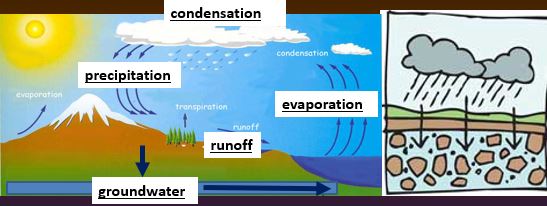
What part of the water cycle does this picture show?
a)
condensation
b)
precipitation
c)
evaporation
4.
What is the weather conditions in an area over a long period of time?
a)
climate
b)
temperature
c)
elevation
d)
precipitation
5.
What is water doing when it is changed to water vapor?
a)
evaporating
b)
condensing
c)
transpiring
d)
freezing
6.

Oceans receive freshwater from precipitation and rivers. Yet ocean levels do not change very much from these actions. Why are ocean levels not greatly affected?

a)

Water is constantly seeping underground in the ocean.

b)

Water is constantly evaporating over the ocean's surface.

c)

Water is constantly flowing back into rivers from the oceans.

d)

Water is constantly deposited back on the land through ocean wave action.

7.
Which statement best fits in the third box? 
a)
Liquid water cools.
b)
Liquid water turns into water vapor. 
c)
Liquid water turns into a solid.
d)
Liquid water begins to freeze 
8.
What is it called when plants give off water vapor as a waste product?
a)
condensation
b)
evaporation
c)
sublimation
d)
transpiration
9.
Which of the following best describes what happens during precipitation? 
a)
Water from the land is returned to the ocean 
b)
Ocean water is evaporated into the atmosphere 
c)
Water from the atmosphere is returns to Earth's surface 
d)
Water vapor in the atmosphere is condensed into clouds. 
10.
Condensation creates-
a)
rain 
b)
clouds
c)
ice
d)
groundwater 
11.

What is infiltration?

a)

The process by which water sinks into the ground

b)

The zone where there are still air spaces left between the particles.

c)

The process by which water vapor turns into liquid water and forms fog or clouds.

d)

The process by which water does not sink into the ground, but rather travels along the surface.

12.

Which soil would have the greatest permeability rate after a rainstorm?

a)

sand (0.02 cm)

b)

silt (0.002 cm)

c)

clay (0.0002 cm)

13.

Which soil would have the greatest capillarity?

a)

sand (0.02 cm)

b)

silt (0.002 cm)

c)

clay (0.0002 cm)

14.

What is capillarity?

a)

When water cannot infiltrate a substance

b)

Water being held onto by rock or sediment

c)

The ability of water to move upward against gravity in a material

d)

The percentage of empty space in a material

15.

These containers have the same volume of beads which are representing soil particles. What is the relative porosity and permeability of each?

a)

The container on the left has the higher permeability and porosity

b)

The container on the right has the higher permeability and porosity

c)

The container on the left has the higher permeability, but they both have the same porosity

d)

The container on the right has the higher permeability, but they both have the same porosity

16.

How would the porosity of the poorly sorted sediment compare to the well sorted sediment?

a)

It would be greater in the poorly sorted sediment

b)

It would be less in the poorly sorted sediment

c)

It would be the same in both

17.

Which surface would have the most runoff from it after a rainstorm?

a)
b)
c)
d)
18.

Which surface would be impermeable?
a)
b)
c)
d)
19.

Water that is found underground in the cracks and spaces in soil, sand and rock is called:

a)

Groundwater

b)

River

c)

Surface water

d)

Snow

20.

Water collects in an aquifer because the layer below it is

a)

permeable (water can pass through it)

b)

impermeable (water can not pass through it)

c)

transparent

21.

True/false: Almost everything that happens on land, has an impact on surface water and groundwater.

a)

true

b)

false

22.

How can air pollution from cars and factories end up in our water??

a)

Oil drips from cars onto roads

b)

Air pollutants can dissolve in rain water

c)

We use soap to wash cars

23.

How can you help reduce water pollution?

a)

Use less fertilizer and pesticides

b)

Take paint, cleaners, and old medication to safe disposal sites

c)

Clean up pet waste and litter

d)

All the above

24.

Organize the materials in order from best able to hold water to least able to hold water.

a)

A, B, C

b)

B, C, A

c)

C, A, B

d)

A, C, B

25.

In the diagram, letter A best represents:

a)

Runoff

b)

Impermeable Rock

c)

Water Table

d)

Aquifier

26.
What is the relationship between groundwater and surface water?
a)
Surface water percolates (moves) through the soil to form groundwater.
b)
There is no relationship between surface and groundwater.
c)
Groundwater filters through the soil to form surface water.
d)
Surface water is found in lakes directly above underground water sources.
27.

Where is the water table located?

a)

at the top of the saturated zone

b)

between layers of impermeable rock

c)

in the unsaturated zone

d)

below layers of clay

28.
How does latitude influence climate?
a)
The closer you are to the equator the higher the temp
b)
Winds bring rain to the coast from the seas
c)
The higher the altitude the colder the temperature
d)
Ocean Currents affect precipitation
29.

What factor is influencing the temperature of these two cities

a)

Latitude

b)

Elevation

c)

Distance from Large Body of Water

d)

Ocean Currents

30.

Which BEST describes why latitudes closest to the equator have warmer climates?

a)

they are at lower elevations

b)

they receive high angle sunlight

c)

they are nearer to ocean currents

d)

they get more winds that carry energy in the form of heat

31.
How does the average annual surface temperature compare from latitude to latitude?
a)
As latitude increases, the average annual surface temperature decreases.
b)
As latitude increases, the average annual surface temperature increases.
c)
As latitude increases, the average annual surface temperature remains the same. 
d)
Well, it's not this one. 
32.
What is the best explanation for these two statements?
1. Some mountains located near the Earth's Equator have snow-covered peaks. 
2. Icecaps exist at the Earth's poles.
a)
High elevation and high latitude have a similar effect on climate. 
b)
Both mountain and polar regions have arid climates.
c)
Mountain and polar regions receive more energy from the Sun than other regions.
d)
An increase in snowfall and an increase in temperature have a similar effect on climate. 
33.
Climates are classified according to two major factors:
a)
elevation and precipitation
b)
latitude and temperature
c)
elevation and latitude
d)
precipitation and temperature
34.

This side of the mountain will be the wet side.

a)

leeward

b)

windward

c)

Insolation

d)

high latitude

35.

This side of the mountain will be the dry side.

a)

windward

b)

leeward

c)

low latitude

d)

warmer

36.

Water heats up and cools down _________ slowly than land.

a)

more

b)

less

37.

Latitude has a great effect on climate. The amount of ____________ received on Earth decreases from equator to poles because of latitude.

a)

solar radiation

b)

temperature

c)

air mass

d)

coolness

38.

a)

capillarity

b)

porosity

c)

infiltration rate

d)

water retention

39.

a)

30o North

b)

0o

c)

15o North

d)

60o North

40.

Compared to an inland location of the same elevation and latitude, a coastal location is likely to have

a)

warmer summers and cooler winters

b)

cooler summers and warmer winters

c)

warmer summers and warmer winters

d)

cooler summers and cooler winters

41.

The main human activity that releases greenhouse gases is

a)

riding bicycles

b)

burning fossil fuels

c)

texting on cellphones

d)

eating meat

42.
What are greenhouse gases?
a)
gases that cause climate change
b)
gases that emit green smoke
c)
gases that are used to make green colored glass
43.
Visible light reaches Earth’s surface while infrared light is trapped as heat. Which characteristic of Earth’s atmosphere causes this to happen?
a)
the hole in the ozone
b)
the greenhouse effect
c)
atmospheric pressure
d)
the inversion layer
44.
The average temperature of the surface of Earth has increased approximately 1°C in the past century. Which reason best explains this increase in temperature?
a)
lower levels of ozone in the atmosphere
b)
lower levels of nitrogen in the atmosphere
c)
higher levels of carbon dioxide in the atmosphere
d)
higher levels of oxygen in the atmosphere
45.
Which of the following is the best conclusion that can be made from this graph?
a)
atmospheric carbon dioxide levels have been decreasing since 1960
b)
Hawaii has a lot of carbon dioxide
c)
humans have been working hard to decrease carbon dioxide levels
d)
atmospheric carbon dioxide levels have increased steadily since 1960
46.
Which of the following is contributing to an increase in carbon dioxide in the atmosphere?
a)
deforestation
b)
photosynthesis
c)
oceans
d)
all of the above
47.
The warming of the atmosphere by the trapping of heat being radiated to space is called
a)
evaporation
b)
condensation
c)
the greenhouse effect
d)
radiation
48.

______________________ carry warm waters away from the equator that distribute mild humid climates across the Earth's surface.

a)

Sea birds

b)

Rubber ducks

c)

Ocean currents

d)

Mountains

49.
What decreases as you go up in the atmosphere?
a)
Altitude
b)
Atmosphere
c)
Meteors
d)
Air Pressure
50.

What affect does particle size have on permeability

a)

No effect

b)

The larger the particles the lower the permeability

c)

The larger the particles the higher the permeability

d)

The smaller the particles the higher the permeability