
 Worksheets
Unit 2 Astronomy Review (Stars, Moon, Ellipses)
Total questions: 55
Worksheet time: 1hrs 8mins

Which statement best explains why different phases of the Moon can be observed from the Earth?
The size of the Earth's shadow falling on the Moon changes.
The Moon moves into different parts of the Earth's shadow.
Differing amounts of the Moon's sunlit surface are seen because the Moon revolves around the Earth.


Which phase of the Moon will be observed in New York State when the Moon is at position 8?


The symbols above represent star masses and distances. Which diagram shows two stars that have the greatest gravitational force between them?


Which phase of the moon could be observed from Earth when the moon is at location 4? Remember to think of the observe on earth looking at the moon and their "viewing lines" - remember they only see the half of the moon closest to them!)
Waxing Gibbous
Waxing Crescent
Waning Gibbous
Waning Crescent

Compared to the luminosity and surface temperature of red main sequence stars, blue supergiants are
less luminous and have a lower surface temperature
less luminous and have a higher surface temperature
more luminous and have a lower surface temperature
more luminous and have a higher surface temperature
Spring ocean tides occur when the difference in height between high tide and low tide is greatest. At which two positions of the Moon will spring tides occur on Earth?
1 and 5
2 and 6
3 and 7
4 and 8
The gravitational attraction between two objects in the solar system is greatest when their masses are
(1) small, and the objects are close together
(2) small, and the objects are far apart
(3) large, and the objects are far apart
(4) large, and the objects are close together

The graph shows the change in tide heights of the Hudson River at Newburgh, New York. According to the graph, the time difference between high tide and the next low tide is approximately
2 hours
3 hours
6 hours
12 hours

Base your answer to the following question on the diagram and on your knowledge of Earth science. The diagram represents eight numbered positions of the Moon in its orbit around Earth. A solar eclipse might be observed from Earth when the Moon is at which position?
1
5
3
7

The diagram below shows a model of the Moon’s orbit around Earth. Numbers 1, 2, 3, and 4 represent four positions in the Moon’s orbit.
What is the approximate length of time the Moon takes to travel from position 4 to position 2?
1 day
30 days
15 days

This image is showing us a.....
solar eclipse
lunar eclipse
phases of the moon
earth eclipse

If you look up at the sky and see this, you are witnessing a....
solar eclipse
total eclipse
lunar eclipse
jupiter

If you are looking up at the sky and see this, you are looking at a....
solar eclipse
total eclipse
lunar eclipse
jupiter

Which diagram correctly represents the relative positions of the Sun (S), Earth (E), and the Moon (M) in space during a total solar eclipse? [The diagrams are not drawn to scale.]


Earth does not experience lunar and solar eclipses monthly becuase
we are not always in the path of the eclipse
the Earth's orbit is on an incline to the Moon
The Moon rotate and revolves at the same rate.
The Moon's orbit is on a 5° incline relative to Earth's orbit.


Which sequence of stars is listed in order of increasing luminosity?
Spica, Rigel, Deneb, Betelgeuse
Polaris, Deneb, 40 Eridani B, Proxima Centaurri
Barnards Star, Alpha Centauri, Rigel, Spica
Procyon B, Sun, Sirius, Betelgeus

Which star is cooler and less luminous than the Sun?
Proxima Centuri
Pollux
Rigel
40 Eridani B

Which star has a surface temperature most similar to the surface temperature of Alpha Centauri?
Polaris
Betelgeuse
Procyon B
Sirus

Which two stars are most similar in luminosity?
Betelgeuse and Bernard's Star
Procyon B and Proxima Centauri
Polaris and the Sun
Alpha Centauri and Sirius

Which statement describes the general relationship between the temperature and the luminosity of main sequence stars?
As temperature decreases, luminosity increases
As temperature decreases, luminosity remains the same.
As temperature increases, luminosity increases.
As temperature increases, luminosity remains the same.

Compared with our Sun, the star Betelgeuse is
smaller, hotter, and less luminous
smaller, cooler, and more luminous
larger, hotter, and less luminous
larger, cooler, and more luminous

Barnard's Star has a surface temperature of about
300ºC
3000ºC
5000ºC
10,000ºC

What color are the hottest stars?
red
yellow
orange
blue

All stars begin their life in a
Main Sequence
Nebula
Protostar
Black Dwarf

A gigantic explosion that causes the death of a MASSIVE star is called
planetary nebula
red giant
supernova
black hole
Our sun is a ____________ star.
main sequence
massive star
supernova
red giant

Average size stars on the main sequence, like the Sun, will turn into a _____ star next.
protostar
red giant
supergiant
black hole
A massive star can end it's life as a ______ or ___________.
neutron star/black hole
main sequence star/ nebula
supernova
nebula
red giant
supergiant
About 90 percent of the stars in the universe, including the sun, are main sequence stars. What do all main sequence stars have in common?
All main sequence stars are yellow like our sun.
All main sequence stars are as bright as our sun.
They are all undergoing fusion of helium into carbon within their cores
They are undergoing fusion of hydrogen into helium within their cores

Planets orbit the Sun in a shape called a(n)
perfect circle
ellipse (slightly)
focus
perihelion

An ellipse is drawn around two points called
aphelion
perihelion
foci
axis
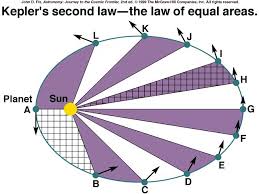
Where is the planet moving the FASTEST?
Position A
Position B
Position G
Position L

The CLOSER a planet is from the sun, the _______ it takes it to orbit the sun once.
longer
shorter

Which object would have an eccentricity closest to 0?
Red
Green
Blue
Yellow
Pink
Which object would have an eccentricity closest to 1?
Red
Green
Blue
Yellow
Pink
What is eccentricity?
a measurement of how elliptical (oval) an orbit is.
a measurement of the distance between the planet and the sun
a measurement of how long the planet takes to rotate around the sun
none of these

Of the following planets, which planet has the most elliptical orbit? (Hint ESRT pg 15)
Earth
Mercury
Venus
Mars

Of the following planets, which planet has the least elliptical orbit? (ESRT pg 15)
Saturn
Mercury
Juptier
Uranus
The distance between the foci is 6.0 cm and the length of the major axis is 10.0 cm. What is the eccentricity?
1.667
6.0
60
.600
Ocean tides are the result of
the rotation of Earth.
the sun’s gravitational pull on Earth.
changes in Earth’s orbital position around the sun.
differences in both the sun’s and moon’s gravitational pull on Earth.
What is the formula for calculating eccentricity?
Eccentricity=Distance between foci/length of major axis
Eccentricity=length of major axis/Distance between foci
Eccentricity=distance between foci
Eccentricity=length of major axis
What is .0034 rounded to the nearest thousandth?
.004
.003
.03
.034
An asteroid travels around a star in an elliptical orbit. The distance between foci 1 and foci 2 is 40.0 cm. The length of the major axis across the orbit is 378.0cm. Calculate the eccentricity of the asteroid, then choose the best description:
less than the eccentricity of Earth
less than the eccentricity of Mars
greater than the eccentricity of Mars
greater than the eccentricity of Mercury
Which statement best explains why the same side of the Moon is viewed from Earth as the Moon goes through its phases?
The Moon does not rotate as it revolves around Earth
The Moon’s period of rotation equals Earth’s period of rotation
The Moon’s period of rotation equals Earth’s period of revolution around the Sun.
The Moon’s period of rotation equals the Moon’s period of revolution around Earth

