
 Worksheets
Science 9 Topics 5 6
Total questions: 59
Worksheet time: 1hrs 10mins
Persistent pollutants are dangerous because they __________.
Are considered carcinogens
Are corrosive and toxic
Contribute to an increase in greenhouse gases
Remain in the environment, bioaccumulate in organisms, and bio-magnify throughout the food chain
High levels of variety in micro-invertabrates= healthy aquatic
ecosystem
true
false
Organisms that can reveal more about water quality in an environment
Macroinvertebrates
Bioindicators
Hydrosphere
Abiotic
Organisms lacking a backbone that are large enough to be seen with the naked eye
Invertebrates
Biotic
Vertebrates
Macroinvertebrates
An algal bloom is the rapid growth of a population of
fungi
protozoans
algae

In general, algal blooms occur when
toxins accumulate in shellfish.
nutrients decrease in the water.
nutrients increase in the water.
The rapid growth of algae, called an algal bloom, can lead to the formation of dead zones that cannot sustain aquatic life. This is mainly because the algal bloom lowers the amount of –
chemical pollutants
dissolved oxygen
freshwater runoff

Which organism shown in the food chain above would contain the greatest concentration of chemical pollutants?
phytoplankton
krill
tuna
shark
The higher the temperature, the more dissolved oxygen in water.
True
False
Which of these can do photosynthesis?
Algae
Seaweed
Trees
All of the above
All of the following add Dissolved Oxygen to the water except....
From Photosynthesis by underwater plants
Movement of the water
Air in the atmosphere
Underground Oxygen deposits
How do bacteria affect Dissolved Oxygen (DO) in water bodies?
increase DO through decomposition
decrease DO through decomposition
DO stays the same
bacteria multiply DO by 8
Colder water.....
hold MORE dissolved oxygen
holds LESS dissolved oxygen
Why does the amount of dissolved oxygen increase during the day?
The sunlight allows photosynthesis to occur
The warmer temperatures allow the water to hold more oxygen
The fish are more active so they are respiring more
What can REMOVE dissolved oxygen from the water?
cellular respiration
decomposition
warming waters
All of the above
Algae blooms will ____________ the amount of dissolved oxygen in an aquatic system.
Decrease
Increase
Can be traced back to the point of origin.
Point Source Pollution
Non-point source pollution
Cannot easily be traced to the source of the pollution.
Point Source Pollution
Non-point source pollution
Sewage leaking from a pipe.
Point Source Pollution
Non-point source pollution
Chemicals dumped into a river from an unknown source.
Point Source Pollution
Non-point source pollution
toxic waste leaking from a barrel buried underground.
Point Source Pollution
Non-point source pollution
Fertilizer farm runoff
Point Source Pollution
Non-point source pollution

Nonpoint source pollution comes from different sources.
True
False
Maybe
Oil, Grease and toxic chemicals from the roadways runoff into a nearby lake
Point Source Pollution
Nonpoint Source Pollution
Pollution that comes from MANY different sources that are difficult to identify is called ___________.
Indutrialization
Point-source
Nonpoint-source
Human activity
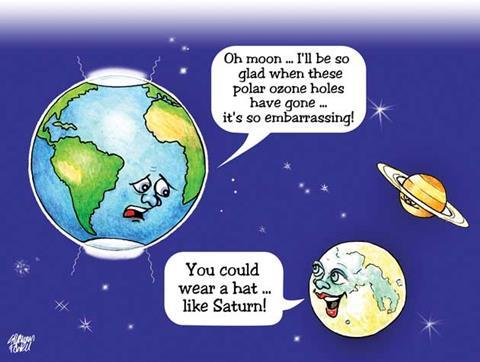
The thinning of the ozone layer is also known as the
ozone hole
ozone gap
ozone space
ozone void

The concentration of ozone is measured in _____ units. The blue and purple colors represent ____ levels of ozone. (check your note)
Dobson , Low
Dobson , High
Decibel , Low
Decibel , High

How many oxygen atoms does a molecule of ozone contain?
1
2
3
4
What is the name of the international agreement committing parties to phasing out ozone depleting substances and phasing out chlorofluorocarbons (CFCs)?
Vienna Protocol
Paris Agreement
Montreal Protocol
Antarctic Convention
The depletion in the Ozone layer is caused by:
Carbon dioxide
Nitrous oxide
Methane
Chlorofluorocarbon

Which of these sets of three items produce CFCs
cars, factories, and cardboard
spray cans, cardboard, insulation
spray cans, refrigerant, cardboard
spray cans, refrigerant, styrofoam
The ozone layer protects us from
Increased atmospheric heat
CFCs
UV rays
Decreased atmospheric heat
Which are effects of UV radiation on living organisms? select ALL that are true.
It can cause cataracts.
It can cause mutation in DNA.
It can disrupt food chains by causing harm to photosynthetic organisms.
It can cause organisms to overheat.
Though CFC production has been curtailed, the threat to upper atmospheric ozone continues because CFCs
become harmless quickly.
destroy ozone for only a short time.
persist but stop destroying ozone.
persist and continue to destroy ozone for decades.
Waste water is best described as:
Water that you can cook with.
Water that goes down your drain or toilet.
Water in a local pond.
River water.
Precipitation or snow melt that runs off of roofs, roads, and sidewalks/paths, is considered:
Storm water runoff
Waste water
Grey water
Black water
The use of living bacteria to break down solid waste from water is called:
desalination
flocculation
denitrification
bio-remediation
What is the first step in the water treatment process?
coagulation
filtration and removal of debris, sand, grit, etc.
flocs
concentation
Preliminary treatment
prevents toxic chemicals.
removes large objects.
is unnecessary.
is useless.
Which substance is used in a sewage treatment system to kill harmful bacteria?
ammonia
chlorine
sand
soap
The final step of the water treatment process is...
Coagulation
Disinfection
Filtration
Sedimentation
Flocculation


Which one is the example of Biodegradable waste?


The picture above is the example of...
Biodegradable waste
Non-Biodegradable waste

Biodegradable
Non-biodegradable
Which of the following are environmental problems often associated with sanitary landfills?
Generating vast quantities of carbon dioxide gas
Contamination of groundwater with landfill leachate
Release of disease organisms
Production of methane from anaerobic decomposition

Typical everyday garbage goes to a
sanitary landfill
Secure landfill
hazardous wastes go to a
sanitary landfill
Secure landfill

