wayground logo

Free Printable Worksheets

Font size

S
M
L
XL
Worksheets

ROHS ESS Final Review

Total questions: 96

Worksheet time: 1hrs 1mins

Name
Class
Date
1.
Stars can take different paths due to having different _____________
a)
temperature
b)
mass
c)
brightness
d)
color
2.
All stars start as gas and dust in a(n)
a)
nebula
b)
black hole
c)
red giant
d)
black dwarf
3.
After the main sequence, a low mass star becomes a
a)
black dwarf
b)
protostar
c)
red giant
d)
supergiant
4.
After the main sequence, a high mass star becomes a
a)
black dwarf
b)
protostar
c)
red giant
d)
supergiant
5.
The final stage of a low mass star is a 
a)
neutron star
b)
nebula
c)
black hole
d)
black dwarf
6.
After a supergiant, a high mass star explodes and forms a
a)
supernova
b)
red giant
c)
black hole
d)
planetary nebula
7.
A high mass star can end as this stage, which is so dense that not even light can escape!
a)
black dwarf
b)
white dwarf
c)
supernova
d)
black hole
8.
Helium is the result of ______ atoms combining in nuclear fusion.
a)
nuclear fusion
b)
gravity
c)
hydrogen
d)
iron
9.
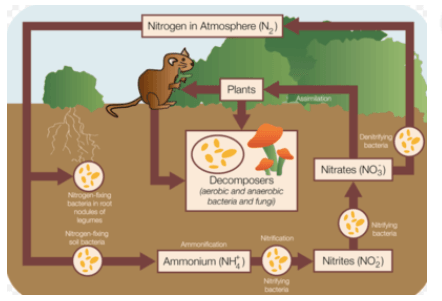
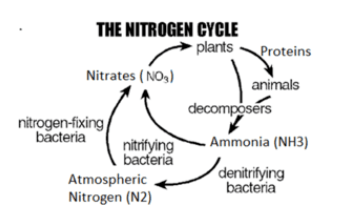
______ is a force that causes dust particles to stick together in a nebula.
a)
nuclear fusion
b)
gravity
c)
hydrogen
d)
iron
10.
A star is born and lit up  when ______ happens and provides the star with energy that it will use for millions of years.
a)
nuclear fusion
b)
gravity
c)
hydrogen
d)
iron
11.
A super giant grows bigger and bigger until it climbs up the periodic table to _____.
a)
silicon
b)
oxygen
c)
hydrogen
d)
iron
12.
Our sun and most stars are in what stage of their life cycle?
a)
Planetary Nebula
b)
White Dwarfs
c)
Main Sequence
d)
Giants
13.
The main element used to fuel a star during the majority of its life is:
a)
Helium
b)
Iron
c)
Light
d)
Hydrogen
14.

Where does fusion occur naturally?

a)

Underwater

b)

All around us

c)

In the radioactive waste

d)

In the core of stars, like our sun

15.
Most stars are made of which elements?
a)
Hydrogen only
b)
Hydrogen and Lithium
c)
Hydrogen and Sodium
d)
Hydrogen and Helium
16.

The products of the nuclear reaction inside the star are:

a)

Helium, energy (Photon) and a neutron

b)

Carbon and Helium

c)

Hydrogen-2 and Hydrogen-3

17.
In nuclear fusion, smaller atoms are forced together to create larger atoms. Does this process release, absorb or maintain energy?
a)
Absorb energy
b)
Maintain energy
c)
Release energy
18.
the smallest particles of matter that still retain the characteristics of that element are called
a)
atoms
b)
nuclei
c)
dust 
d)
molecule
19.

Define nuclear fusion.

a)

Nuclear fusion – combining lighter atoms to make heavier ones – is what makes it possible.

b)

Nuclear fusion – splitting lighter atoms to make heavier ones – is what makes it possible.

c)

Nuclear fusion – combining heavier atoms to make lighter ones – is what makes it possible.

d)

Nuclear fusion – splitting heavier atoms to make lighter ones – is what makes it possible.

20.

Which of the following statements about fusion is false?

a)

The larger the elements being fused, the less energy is produced.

b)

During nuclear fusion, mass is converted (changed) into energy.

c)

The only places where nuclear fusion happens naturally is in the cores of stars or supernovas.

d)

Nuclear fusion is when larger elements get changed into smaller ones.

21.

During a stars life time, the mass gradually decreases because:

a)

mass is being converted (changed) into energy due to fusion in the core

b)

everything loses mass over time

c)

helium atoms don't weigh as much as hydrogen atoms

d)

the outer layers are blown away when the star supernovas

22.

A star is considered 'dead' when:

a)

it can no longer do fusion.

b)

it stops giving off light.

c)

it reaches a temperature of 0 Kelvin.

d)

all of these

23.

The stages that a star goes through depends on:

a)

how much mass it starts with

b)

where it is located in space

c)

what elements it is made of

d)

the constellation it is in

24.
Mountains form from ...
a)
plates sliding past one another
b)
collision of plates
c)
plates moving away from each other
25.
During sea floor spreading, molten material rises up from the mantle...
a)
along the continents
b)
at the mid ocean ridges
c)
deep ocean trenches
d)
at north and south poles
26.
Which of the following is where one plate slides under another plate?
a)
submarine zone
b)
divergence zone
c)
subduction zone
d)
lower zone
27.
Associated with transform boundaries.
a)
Volcanoes
b)
mountains
c)
trenches
d)
earthquakes
28.
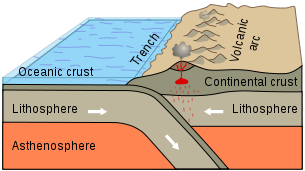
Name the boundary
a)
convergent boundary
b)
divergent boundary
c)
transform boundary
d)
sergent boundary
29.
What is represented by the picture? 
a)
Sea-floor spreading
b)
Pangea
c)
How the continents are arranged today
d)
Volcanoes
30.
Name the boundary
a)
convergent boundary
b)
divergent boundary
c)
transform boundary
d)
sergent boundary
31.
Name the boundary
a)
convergent boundary
b)
divergent boundary
c)
transform boundary
d)
sergent boundary
32.
Which type of crust is more dense and thinner?
a)
Continental
b)
Asthenosphere
c)
Oceanic
d)
Byers
33.
A ______ is a section of the lithosphere that slowly moves over the asthenosphere, carrying large slabs of continental and oceanic crust.
a)
wedge
b)
plate
c)
chunk
d)
fault
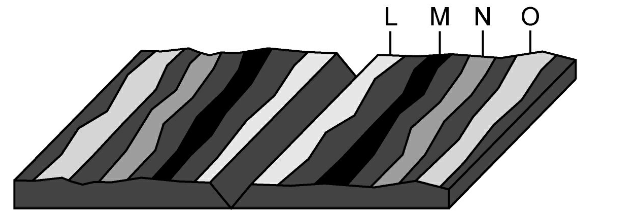
34.
Where would the oldest rock be found?
a)
L
b)
M
c)
N
d)
O
35.
Subduction zones occur on Earth where dense oceanic crust dives under more buoyant continental crust. These boundaries are characterized by a deep ocean trench next to a high continental mountain range, large numbers of earthquakes and volcanoes. All of this is further evidence for the
a)
big bang theory.
b)
theory of plate tectonics.
c)
origin of the species.
d)
theory of natural selection.
36.

Which process would be most effective in determining the age of fossils embedded in rock?

a)

relative dating

b)

absolute dating

c)

use of index fossils

d)

use of core sampling

37.

What role do faults play in the Law of Superposition?

a)

Faults create new types of rock.

b)

Faults are younger than the layers they cut through.

c)

Faults are the same age as the layers they cut through.

d)

Faults are older than the layers they cut through.

38.
According to the law of superposition, which layer is the youngest?
a)
A
b)
B
c)
C
39.
The Law of Superposition helps scientists to determine what?
a)
The absolute age of rock layers
b)
The age of fossils
c)
The relative age of rock layers
d)
the super powers of rocks
40.

According to the law of superposition, the oldest fossils are found

a)

At the top of the rock layers

b)

Near the bottom of the rock layers

c)

In the middle of the rock layers

d)

Somewhat near the surface

41.

The age of a rock compared to other rocks around it is:

a)

Superposition

b)

Absolute age

c)

radioactive decay

d)

relative age

42.

Certain fossils can be used to help determine the age of the rock layer in which the fossils are found. Which type of fossil is BEST to use when making this determination?

a)

marine mammal fossil

b)

swamp fern fossil

c)

trace fossil

d)

index fossil

43.
Current scientific evidence shows that the Earth is estimated to be: 
a)
Less than 1 millions years old
b)
Between 3 and 4 billion years old
c)
More than 4 billions years old
d)
Less than 2 billion years old
44.
Scientists use radioactive decay to measure...
a)
relative time
b)
absolute time
c)
half-lives
d)
time of day
45.
The length of time required for half of the radioactive atoms in a sample to decay is its...
a)
era
b)
age
c)
half-life
d)
eon
46.
How does absolute age differ from relative age?
a)
only absolute dating indicates which rock is older than another
b)
only absolute dating finds the age in years
c)
only relative dating finds the age in years
47.
Radiometric dating is possible because the rates of decay of radioactive isotopes _____.
a)
change over time
b)
change from place to place
c)
are constant
d)
vary widely
48.
If the half-life of a radioactive group of atoms is 100 years, then how old is the rock if there have been two half-lives?
a)
25 years
b)
200 years
c)
400 years
d)
800 years
49.
The original element that undergoes radioactive decay is known as the...
a)
daughter element
b)
half-life
c)
parent element
d)
carbon-14
50.

The element that is the product of radioactive decay is known as the...

a)

daughter element

b)

half-life

c)

parent element

d)

carbon-14

51.

How many grams of Carbon-14 will remain after 17,100 years- C-14 has a half life 5,730 so 17,100 is about 3 half lives?

a)

32 g

b)

16 g

c)

8 g

d)

4 g

52.
Who is the person credited with developing the theory of continental drift?
a)
Harry Hess
b)
Galileo
c)
Alfred Wegener
d)
Newton
53.
What does the theory of continental drift state?
a)
The continents were once joined in a super-continent and have moved over time
b)
Continents are stationary and do not move
c)
The Earth is broken into lithospheric plates that move due to convection currents
d)
none of the above
54.

What type of evidence was used by Alfred Wegener to support his continental drift hypothesis? (Select 3)

a)

evidence from landforms / geology

b)

evidence from fossils

c)

evidence from human remains

d)

evidence from climate

55.

What evidence did Wegener use to support his theory?

a)

Continents and fossils fitting together/matching-up like puzzle pieces

b)

glacier scars and other climate evidence from temperature

c)

mountain ranges and rocks line up across continents

d)

all of the above

56.
What two elements make up water?
a)
Helium and oxygen
b)
Hydrogen and oxygen
c)
helium and carbon
d)
oxygen and carbon
57.
What word describes when water is attracted to other substances?
a)
cohesion
b)
adhesion
c)
capillary action
d)
surface tension
58.
Why does ice float?
a)
As water freezes, it expands and its density decreases.
b)
As water freezes, it takes up more hydrogen from the atmosphere, causing it to have a greater buoyancy.
c)
As water freezes, air becomes trapped between the hydrogen bonds of water molecules.
d)
As water freezes, it takes up more oxygen from the atmosphere, causing it to have a greater buoyancy.
59.
Water is a universal solvent because it...
a)
It can be found anywhere
b)
It freezes when it gets cold
c)
floats when frozen
d)
Dissolves most substances
60.
Large bodies of water, such as lakes and oceans, do not quickly fluctuate in temperature. What is the reason for this phenomenon?
a)
Water is an acid.
b)
Water is a versatile solvent.
c)
Water has a high heat capacity.
d)
 Water acts as a buffer.
61.
 Small insects can walk across the surface of calm water. Their feet push the surface of the water down slightly, somewhat like a person walking across a trampoline, but they do not break the surface. What is the best explanation for why this happens?
a)
The insects are light enough so that they do not break the hydrogen bonds holding the water molecules together
b)
The insects actually use their wings to hover slightly above the water's surface and they only skim it with their feet
c)
The insects' feet are non-polar, so they are repelled by the polar water molecules and are pushed away from the water's surface
d)
The insects are small enough to see the individual water molecules, so they are able to step carefully from one molecule to the next
62.
Large bodies of water do not quickly fluctuate in temperature. Why?
a)
Water is a solvent.
b)
Water has a high heat capacity.
c)
Water acts as a buffer.
d)
Water is non-polar.
63.
The tightness across the surface of water that enables paper clips to float is ____________.
a)
adhesion
b)
capillary action
c)
surface tension
d)
polarity
64.
When water molecules stick easily to other water molecules, this is called what?
a)
cohesion
b)
adhesion
c)
solution
d)
polar molecule
65.
Which of the following is the best conclusion that can be made from this graph?
a)
atmospheric carbon dioxide levels have been decreasing since 1960
b)
Hawaii has a lot of carbon dioxide
c)
humans have been working hard to decrease carbon dioxide levels
d)
atmospheric carbon dioxide levels have increased steadily since 1960
66.

Which of the following have been changed or altered due to climate change ?

a)

droughts

b)

flooding

c)

melting of polar ice caps

d)

all of the above

67.

The main human activity that releases greenhouse gases is

a)

using public transportation and there by reduce the affects of greenhouse gases.

b)

burning fossil fuels

c)

texting on cellphones

d)

eating meat

68.
 What is the greenhouse effect?
a)
The warming of a planet due to trapped radiation.
b)
The cooling of Earth due to air pollution.
c)
The heating of a solid, such as a rock.
69.
What gas from the list below is a cause for global warming?
a)
Urethane
b)
Oxygen
c)
Carbon Dioxide
70.
Which is a green-house gas?
a)
Methane
b)
Oxygen
c)
Hydrogen
d)
Ammonium
71.
Increased carbon dioxide may cause global warming by trapping more ____________ in the atmosphere.
a)
water
b)
gases
c)
heat
d)
water vapor
72.

How is the greenhouse effect produced?

a)

When solar energy trespasses the atmosphere.

b)

When some energy is reflected back to earth.

c)

When the green house is burned.

d)

When the sun doesn't emit radiation.

73.
______ affects weather and climate because it heats the Earth unevenly.
a)
latitude
b)
altitude
c)
atmosphere
d)
sunlight
74.
______ is the average pattern for weather over a long period of time.
a)
climate
b)
weather
c)
forecast
d)
sunlight
75.

Theory that Earth's crust is divided into plates & the plates move around on the mantle

a)

Seafloor spreading

b)

Plate tectonics

c)

Continental drift

d)

Earthquakes

76.

Fastest seismic waves, first to reach a location after an earthquake, also called P waves

a)

Secondary waves

b)

Seismic waves

c)

Primary waves

d)

Surface waves

77.

The 2nd seismic waves to arrive at any particular location after an earthquake, also called S waves

a)

Surface waves

b)

Primary waves

c)

Secondary waves

d)

Tidal waves

78.

It is the energy radiated in all directions from the focus due to earthquake.

a)

seismic waves

b)

epicenter

c)

body waves

d)

surface waves

79.

TRUE or FALSE: Volcanoes form along the mid-ocean ridges, where two plates move together.


If false change the underlined word to make it true.

a)

TRUE

b)

FALSE: apart

c)

FASLE: past each other

80.
Which letter represents the movement created by the P Wave?  
a)
A
b)
B
c)
C
81.
Which seismogram represents a city that is far from the epicenter of an earthquake?  
a)
New York, NY
b)
Nome, Alaska
c)
Guadalajara, Mexico
82.
What word describes when water is attracted to other substances?
a)
cohesion
b)
adhesion
c)
capillary action
d)
surface tension
83.
Attractions between the negative Oxygen atom of one water molecule and the positive Hydrogen atom of another water molecule are called
a)
Covalent bonds
b)
Ionic bonds
c)
Polar bonds
d)
Hydrogen bonds
84.
Water is a universal solvent because it...
a)
It can be found anywhere
b)
It freezes when it gets cold
c)
floats when frozen
d)
Dissolves most substances
85.
How much of Earth's water is salt water?
a)
50%
b)
66%
c)
75%
d)
97%
86.
The tightness across the surface of water that enables paper clips to float is ____________.
a)
adhesion
b)
capillary action
c)
surface tension
d)
polarity
87.
What is A?
a)
Evaporation
b)
Condensation
c)
Precipitation
d)
Runoff
88.

What is another name or synonym for the water cycle?

a)

Geologic cycle

b)

Hydrologic cycle

c)

Geosphere

d)

Carbon cycle

89.
What does not produce carbon dioxide?
a)
Photosynthesis
b)
Burning Fossil Fuels
c)
Animal respiration
d)
Plants decaying
90.
How do living organisms return carbon to the atmosphere in the carbon cycle?
a)
respiration and photosynthesis
b)
 decomposition and respiration
91.
Which of the following removes carbon from the atmosphere?
a)
Combustion
b)
Respiration
c)
Photosynthesis
d)
Death
92.
What process occurs when coal (fossil fuel) is used for energy?
a)
Decomposition
b)
Combustion
c)
Pressurization 
d)
Respiration 
93.
How is the burning of fossil fuels related to global warming?
a)
Magic
b)
Fuels are hot
c)
Greenhouse effect
d)
Photosynthesis
94.
Which of the following is the best conclusion that can be made from this graph?
a)
atmospheric carbon dioxide levels have been decreasing since 1960
b)
Hawaii has a lot of carbon dioxide
c)
humans have been working hard to decrease carbon dioxide levels
d)
atmospheric carbon dioxide levels have increased steadily since 1960
95.

A correct path that nitrogen could take would be

a)

air -> animals -> plants -> bacteria

b)

animals -> air -> bacteria -> plants

c)

bacteria -> air -> plants -> animals

d)

air -> bacteria -> plants -> animals

96.

According to this diagram, plants use nitrogen to make _________________________

a)

bacteria

b)

animals

c)

proteins

d)

decomposers