
Font size
 Worksheets
Ecology Test Review
Total questions: 60
Worksheet time: 45mins
In a garden ecosystem, the first step in the food chain is always the ____________.
Consumer
Producer
Energy
Energy and Building Materials
Why are there arrows on a food web or food chain in the Amazon Rainforest?
Flow of Energy
Path of destruction
No arrows needed, only lines


True or False: Introducing a new predator, such as a wolf, into a forest ecosystem will not affect the populations of other organisms
False
True

In a study about local ecosystems, Mason identified several factors affecting plant growth. Which of the following is not an abiotic factor?
soil nutrients
sunlight
insects
temperature
Spiders eat flies. If the spider population decreased, what do you think happened to the fly population?
Fly population increased.
Fly population decreased.
Fly population stayed the same.
Any organism that needs to eat another organism in order to live is called a __________.
consumer
producer
prey
Which of the following would cause the greater change to a population?
removing a bush from your yard
removing a bird nest from under your deck
cutting down a forest behind your house
adding a bird feeder to your yard


In a forest ecosystem, the connection of food chains involving plants, insects, birds, and mammals that creates multiple paths for food energy to flow is a ____________.
ecosystem
food web
environment
population
In a forest ecosystem, a ____________ breaks down fallen leaves and dead animals to recycle nutrients.
consumer
producer
decomposer
omnivore
Which is the best description of an ecosystem?
all of the living and nonliving things in an area
all of the individuals of one species in an area
all of the populations of living things in an area
all of the abiotic factors in an area
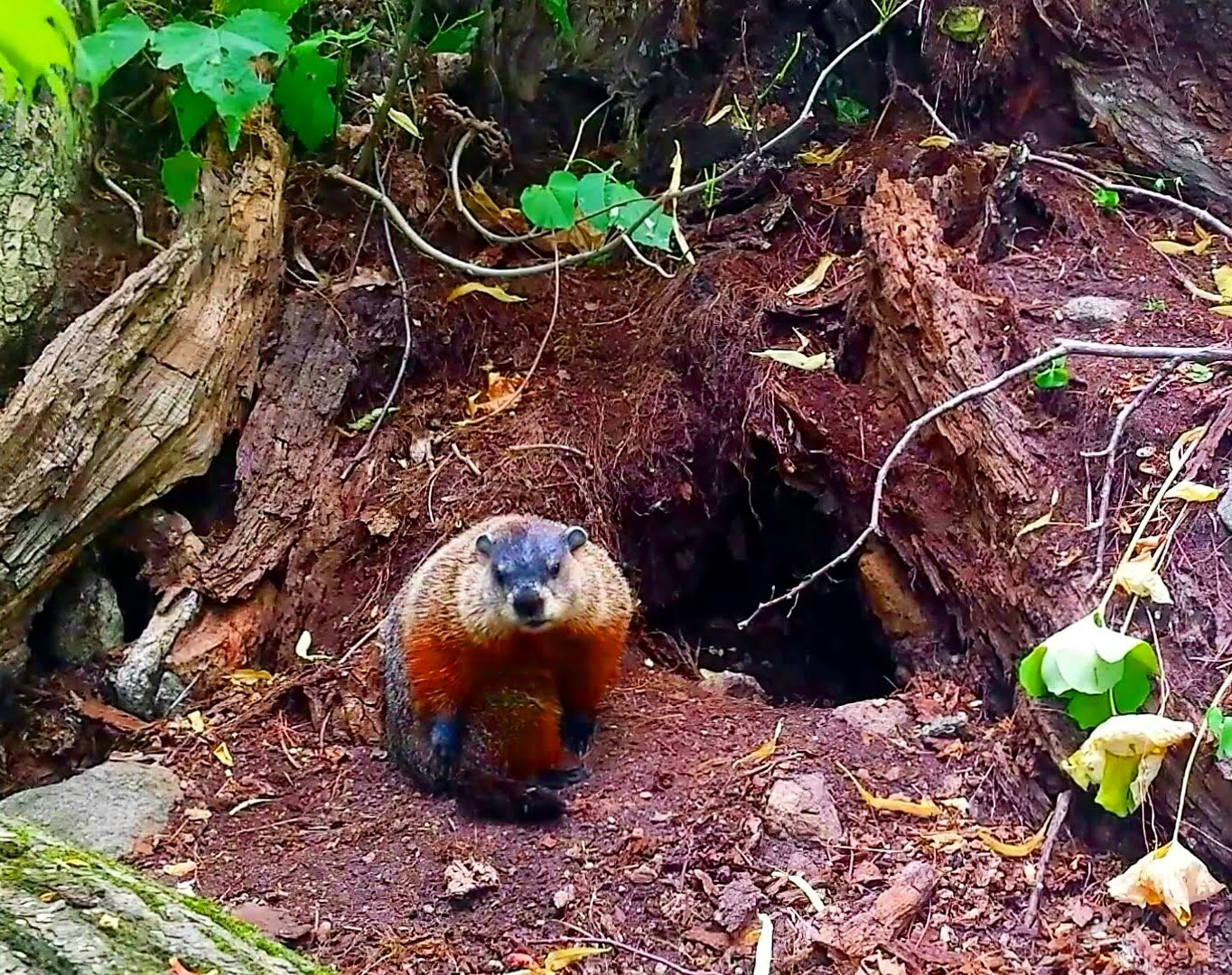
In a science project, Emma and Ethan observed that sunlight, pH of water, temperature, rocks, soil, and air in their experiment would all be ____________.
Biotic
Abiotic
Ecosystems
Habitats
During a science project, Priya explains that the original source of almost all energy in their model ecosystem is what?
carbohydrates
sunlight
water
carbon

Mockingbirds will push the eggs out of a blue bird's nest, lay their own eggs in the nest, and trick the parent blue birds into raising the mockingbird babies.
commensalism
parasitism
mutualism
predation


The stork uses its saw-like bill to cut up the dead animals it eats. As a result, the dead animal carcass is accessible to some bees for food and egg laying. The relationship neither harms nor benefits the stork.
parasitism
commensalism
mutualism
During a field trip, Zoe observed a food chain in the forest. Which of the following did she identify as a primary consumer?
Lion
Grass
Rabbit
Fungi
Which of the following best describes the ecosystem of a forest?
A community of animals, plants, and insects interacting with each other
A single species of tree in its natural forest habitat
A collection of rocks, water, and soil in a forest area
A community of animals, plants, and insects along with the forest's physical environment

In a forest ecosystem, where Elijah observes various animals, what type of consumer is the shrew that he notices? (check all that apply)
secondary consumer
primary consumer
tertiary consumer
quaternary consumer
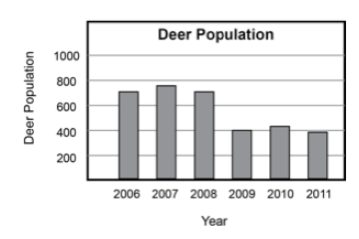
The population of deer in a certain area is monitored over a period of six years. The data is represented in the graph provided. Which of the following is the most likely explanation for the change in population in 2009?
Wild dogs, which prey on deer, were being hunted more than usual.
Snowfall in the previous spring was higher than the yearly average.
Humans introduced grazing animals that feed on the same plants as the deer.
More insects that pollinate flowering plants move into the ecosystem.

The number of pythons found throughout Everglades National Park has increased in recent years. These huge snakes are not native to Florida and are believed to have been released into the wild by pet owners. Wildlife biologists have initiated attempts to capture and remove these pythons. Which statement best explains the biologists’ reason for removing these pythons from the Everglades?
The pythons could upset the territorial boundaries of native organisms.
The pythons could adapt to overcome diseases common to native snakes.
The pythons could prey on native organisms and cause native populations to decline.
The pythons could begin to interbreed with native snakes and produce a more successful species.
A new species of snake was introduced to a tropical region. Scientists then noticed a steady decline in the presence of field mice and an increase in the number of snakes. Which of these is the most likely explanation about why the population size of each animal changed?
The snakes introduced to the region dominated the habitat, forcing the mice to find another place to live.
The mice became prey to the introduced snakes, allowing the snake population to increase but decreasing the mice population.
The snakes introduced to the region competed with the mice for food, allowing the snake population to increase but decreasing the mice population.
The people in the surrounding area set traps that killed the mice, allowing the snakes to live without any predators and therefore to increase in number.
Scientists found, that over a period of 200 years, a mountain pond was transformed into a meadow. During that time, several communities of organisms were replaced by different communities. Which of these best explains why new communities were able to replace older communities?
The original species became extinct.
Species in the older community died from old age.
The abiotic characteristics of the habitat changed.
Diseases that killed the older organisms disappeared.

Mice might grow in population and destroy the community by eating all of the berry bushes if
wolves and snakes were removed from the food web
another predator migrated in to the community
the snake population grew
none of these
A population of tigers lives in Bangladesh. Over 50 years, the size of the tiger population increased. What best explains the increase in the size of the tiger population?
A lot of tigers were born and none of them died.
The tiger population is always increasing because no animal eats tigers.
Fewer tigers were born than died.
More tigers were born than died.
Scientists have been studying the size of three populations in a grassland. In this ecosystem, lizards eat fireflies, and fireflies eat gnats (a type of insect). The data showed that all three populations were stable. Then the lizard population decreased suddenly. What will most likely happen to the size of the firefly population as a result? The firefly population will . . .
increase.
stay the same.
decrease.
In Australia, both opossums and foxes eat rats. The sizes of the populations have been stable for the last 12 years, but recently the size of the opossum population increased. What will likely happen to the fox population? The size of the fox population will . . .
increase.
stay the same.
decrease.
An ecosystem is made up of ______ .
living things and their offspring
nonliving things such as rocks and soil
living things and nonliving things
many types of animals
What causes a population size to increase?
The number of births is greater than the number of deaths.
The number of deaths is greater than the number of births.
The number of births and the number of deaths is equal.
If the population size stays stable, does this mean that no organisms have been born or died?
Yes, because if organisms were born or died that would change the number of organisms in the population.
No, because if some organisms are born and the same number of organisms die, then the total population size can stay constant.
Yes, because some organisms never die, so they don't need to reproduce.
No, because all organisms will give birth and then die.

Based on this graph, what must be true about the US honeybee population?
There are more births than deaths occurring.
There are more deaths than births occurring.
There is an equal number of deaths and births occurring.
People don't like honeybees.


If mice were removed from this ecosystem, which of the following would also be expected to occur?
A decrease in the cricket population
A decrease in the corn population
A decrease in the hawk population
A decrease in the moth population

Which of the following would cause a decline in the lizard population?
A decrease in the cricket population
An increase in the corn population
A decrease in the mice population
An increase in the moth population.

A decrease in which of the following populations would have the greatest effect on the rest of the organisms in the ecosystem?
Hawks
Corn
Crickets
Birds

Which of the following are the producers in this ecosystem?
Humpback whales
Sea turtles
Phytoplankton
Sharks

Which of the following could be a long-term result of reducing the herring population in this ecosystem?
An increase in the puffin population
A decrease in the shark population
An increase in the codfish population
A decrease in the humpback whale population.

Which of the following would be a result of increasing the krill population in this ecosystem?
A reduction in the jellyfish population
An increase in the jellyfish population
An decrease in the codfish population
An increase in the phytoplankton population.

Over hunting of humpback whales would result in which of the following changes to this ecosystem?
A decrease in the puffin population
An increase in the phytoplankton population
An increase in the population of krill
Increased competition between top predators.

A reduction in the population of mice in this food web could cause which of the following changes to occur?
A decrease in the grass population
An increase in the snake population
An increase in the grasshopper population
A decrease in the grain population

An ecologist observes that the frog population in this ecosystem is increasing. Which change below is most likely to cause an increase in the number of frogs?
An increase in the mice population
An increase in the rabbit population
A decrease in the grasshopper population
A decrease in the snake population

Insecticides are used by a farmer to decrease the grasshopper population in this area. This reduction in the grasshopper population would also cause which set of change?
The grain population to decrease and the frog population to decrease
The grain population to decrease and the frog population to increase
The grain population to increase and the frog population to increase
The grain population to increase and the frog population decrease
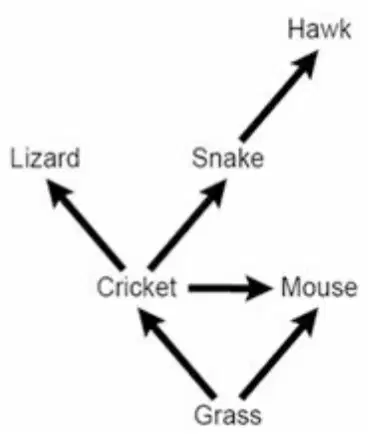
Which organism in this food web would be classified as an omnivore?
Cricket
Mouse
Snake
Hawk
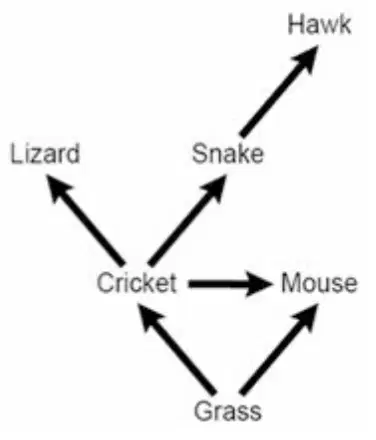
Which of these changes would cause an increase in the cricket population?
A reduction in the mouse population
An increase in the snake population
A decrease in the hawk population
A rise in the lizard population
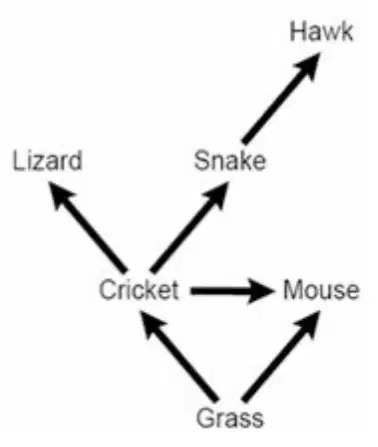
Which population in this food web would contain the lowest amount of chemical energy and biomass?
Grass
Mouse
Lizard
Hawk

For what are the wildcat and the fox competing?
Goat
rabbit
owl
hawk

Do the owl and the bird compete for resources?
Yes, for the grasshopper
Yes for the mice
No they do not compete

In North America, both bears and eagles eat trout. The sizes of the populations have been stable for the last 9 years, but recently the size of the eagle population decreased. What will likely happen to the bear population?
The size of the bear population will . . .
increase
decrease
stay the same

What two organisms are competing for the same resource population?
The Weebugs and Clawcats are competing for Scalebeaks
The Scalebeaks and the Stingwings are competing for the Clawcats
Weebugs and Furbils are competing for the Weebugs
The Stingwings and Furbils are competing for the weebugs
If the furbil population increases the stingwings will likely ______________.
increase
decrease
stay the same
If the furbil population decreases the stingwings will likely ______________.
increase
decrease
stay the same
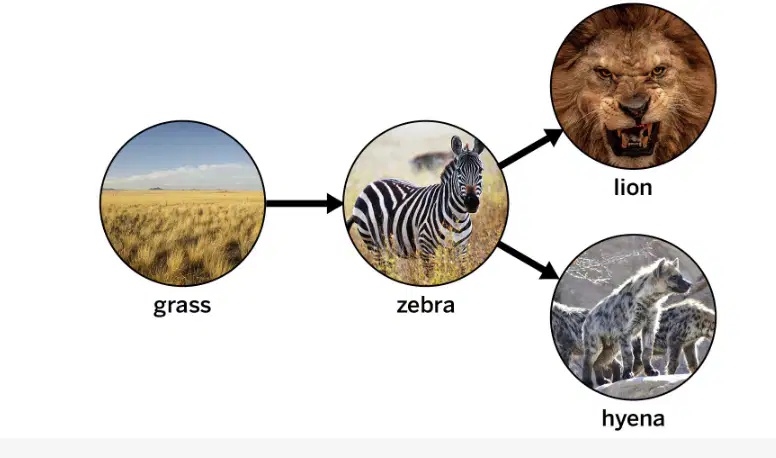
What will happen to the hyena population if the lion population increases?
Increase
Decrease
Stay the same
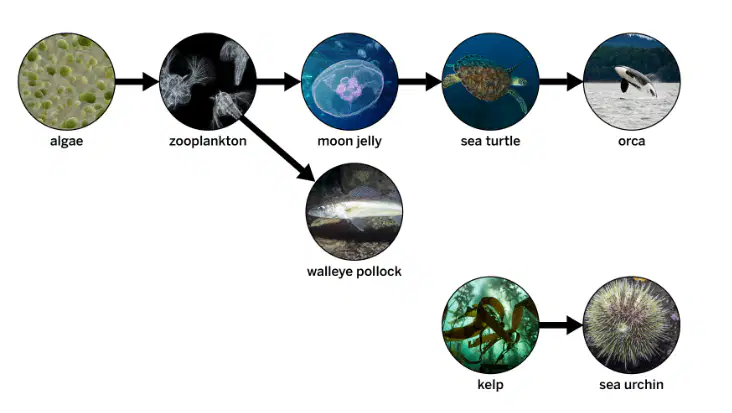
What will happen to the walleye pollock population if the moon jelly population decreases?
increase
decrease
stay the same
What will happen to the moon jelly population if the algae increases?
increase
decrease
stay the same

