Wayground logo

Free Printable Worksheets

Font size

S
M
L
XL
Worksheets

Microscope components, types and Images

Total questions: 40

Worksheet time: 30mins

Name
Class
Date
1.
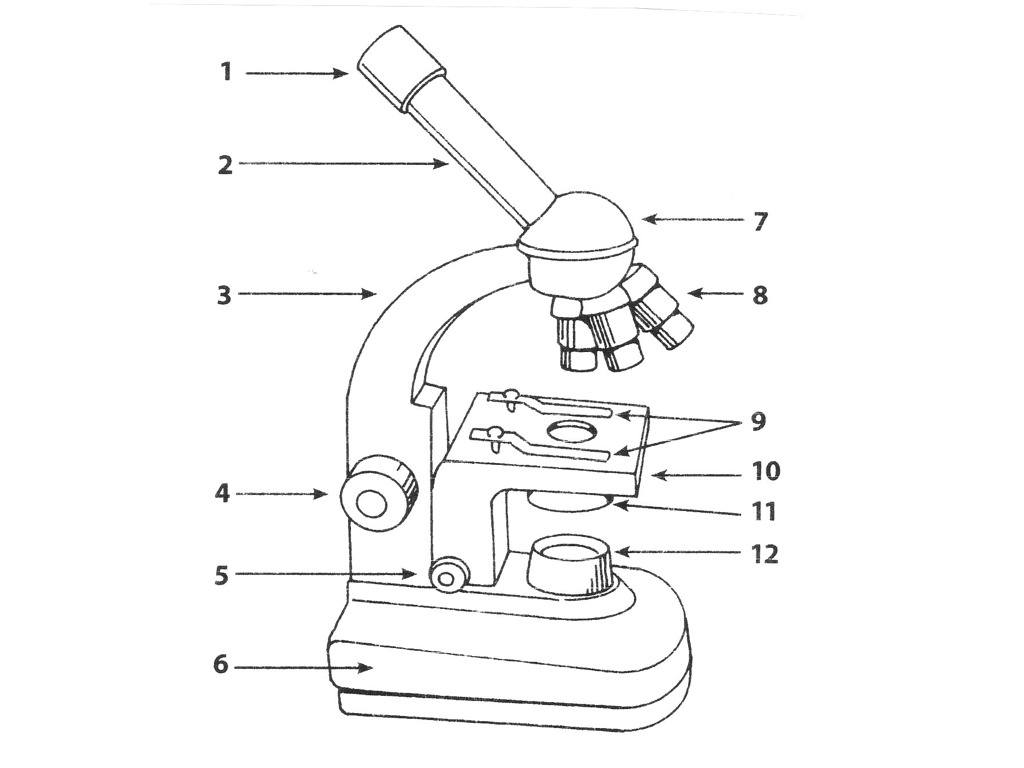
Holds objective lenses; Rotatates to change objectives
a)
Arm
b)
Base
c)
Revolving Nosepiece
d)
Diaphragm
2.
Hold the slide in place on the stage
a)
Stage
b)
Stage Clips
c)
Aperature
d)
Light Source
3.
Moves the stage slightly to sharpen the image
a)
Body Tube
b)
Course Focus Knob
c)
Aperature
d)
Fine Focus Knob
4.
Regulates the amount of light on the specimen
a)
Diaphragm
b)
Aperature
c)
Ocular Lens
d)
Objective Lenses
5.
Long tube; holds ocular lens and revolving nosepiece
a)
Base
b)
Arm
c)
Diaphragm
d)
Body Tube
6.
Lens used to view specimen; also called eyepiece
a)
Scanning Lens
b)
Objective Lens
c)
Ocular Lens
d)
Illuminator
7.
Handle used to support the microscope when carried
a)
Base
b)
Revolving Nosepiece
c)
Light Source
d)
Arm
8.
Supports the microscope and located at the bottom
a)
Base
b)
Arm
c)
Body Tube
d)
Stage
9.
Lenses consist of low 4X, medium 10X, and high 40X
a)
Eyepiece
b)
Ocular Lens
c)
Objective Lenses
d)
Illuminators
10.
Place where slide is placed on while being viewed
a)
Base
b)
Stage Clips
c)
Diaphragm
d)
Stage
11.
Moves stage up and down for focusing; large amounts
a)
Fine Focus Knob
b)
Large Focus Knob
c)
Course Focus Knob
d)
Small Focus Knob
12.
Projects and provides light upward to view specimen; illuminator
a)
Aperature
b)
Light Source
c)
Stage
d)
Stage Clips
13.
What will be the total magnification if the ocular lens is 10X and the objective lens is 40X?
a)
40X
b)
10X
c)
100X
d)
400X
14.
What will be the total magnification if the ocular lens is 10X and the objective lens is 10X?
a)
10X
b)
100X
c)
1000X
d)
1X
15.

What type of microscope requires light passing through a specimen?

a)

TEM

b)

Light

c)

SEM

d)

NBA

16.

Instead of light, a TEM and SEM utilize ____________ to create an image

a)

a colored pencil

b)

neutrons

c)

protons

d)

electrons

17.

True or False? SEM images look 3D and are colorful.

a)

True

b)

False

18.

What type of microscope took this image?

a)

TEM

b)

SEM

c)

Compound Light

d)

Scanning Probe

19.

What type of microscope took this image?

a)

Compound Light

b)

SEM

c)

TEM

d)

Scanning Probe

20.

What type of microscope took this image?

a)

SEM

b)

TEM

c)

Scanning probe

d)

Compound light

21.
This image shows the detailed structure of the tiny mitochondria organelle.  Which microscope most likely took this image?
a)
Compound Light
b)
Scanning Electron
c)
Dissecting
d)
Transmission Electron
22.
Which microscope would you use to see a bed bug in 3D, with a magnification of about 500,000X?
a)
Compound Light
b)
Scanning Electron
c)
Dissecting
d)
Transmission Electron
23.
Which microscope has a magnification range between 40X-1000X?
a)
Compound Light
b)
Transmission Electron
c)
Dissecting
d)
Scanning Electron
24.
Which electron microscope provides details of a cell's internal structures?
a)
Scanning Electron Microscope (SEM)
b)
Transmission Electron Microscope (TEM)
c)
Light Microscope
d)
Dissecting Microscope
25.
Which microscope took a 3D image of this fly's head?
a)
Compound Light
b)
Transmission Electron
c)
Dissecting
d)
Scanning Electron
26.
Which type of microscope would you use to see the outside of a paramecium at 1000X magnification?
a)
Compound Light
b)
Scanning Electron 
c)
Dissecting
d)
Transmission Electron
27.
Which microscope delivers the highest overall magnification possible?
a)
Scanning Electron (SEM)
b)
Transmission Electron Microscope (TEM)
c)
Light Microscope
d)
Dissecting Microscope
28.
Light microscopes
a)
Are generally not used to view bacteria
b)
Work by reflecting electrons off the surface of an object being studied
c)
Typically provide more resolution than an electron microscope
d)
Use light and glass lenses to magnify an image
29.

What type of microscope requires light passing through a specimen?

a)

TEM

b)

Light

c)

SEM

d)

NBA

30.

What type of microscope took this image?

a)

TEM

b)

SEM

c)

Compound Light

d)

Scanning Probe

31.

What is this?

a)

Amoebas

b)

Fish eggs

c)

Earthworms

d)

Frog eggs

32.

What is this?

a)

A dragon

b)

A deer tick

c)

A dust mite

d)

An alien species

33.

What is this?

a)

Chick embryo

b)

Fish egg

c)

Shark egg

d)

Pig embryo

34.

What type of microscope took this image?

a)

SEM

b)

Compound Light

c)

Scanning Probe

d)

TEM

35.
A microscope is an instrument that.
a)
makes faraway objects look closer.
b)
makes small objects appear larger.
c)
decreases the size of small objects.
d)
increases the size of small objects.
36.
Which microscope delivers the highest overall magnification possible?
a)
Scanning Electron (SEM)
b)
Transmission Electron Microscope (TEM)
c)
Light Microscope
d)
Dissecting Microscope
37.
Which electron microscope provides details of a cell's internal structures?
a)
Scanning Electron Microscope (SEM)
b)
Transmission Electron Microscope (TEM)
c)
Light Microscope
d)
Dissecting Microscope
38.
Which microscope would you use to see a bed bug in 3D, with a magnification of about 500,000X?
a)
Compound Light
b)
Scanning Electron
c)
Dissecting
d)
Transmission Electron
39.
Which microscope has a magnification range between 40X-1000X?
a)
Compound Light
b)
Transmission Electron
c)
Dissecting
d)
Scanning Electron
40.
Which of the following is a disadvantage of both the TEM and SEM?
a)
Low magnification
b)
Cannot observe living specimens
c)
High resolution