wayground logo

Free Printable Worksheets

NEW

Font size

S
M
L
XL
Worksheets

DNA,RNA, Protein

Total questions: 69

Worksheet time: 46mins
Name
Class
Date
1.
Which of the following best describes a DNA molecule?
a)
double helix
b)
contains ribose
c)
made of amino acids
d)
contains Uracil
2.
Which of the following units are repeatedly joined together to form a strand of DNA?
a)
amino acids
b)
nucleotides
c)
fatty acids
d)
polysaccharides
3.
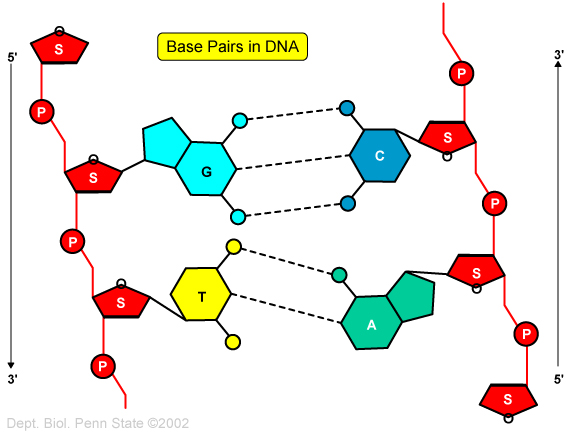
Guanine bonds with ______________.
a)
Adenine
b)
Guanine
c)
Cytosine
d)
Thymine
4.
In a molecule of double-stranded DNA, the amount of Adenine present is always equal to the amount of
a)
cytosine
b)
guanine
c)
thymine
d)
uracil
5.
Why is DNA important?
a)
it is very small and very complicated
b)
it's in everything
c)
it serves as the blueprint for traits of all living things
d)
because we eat it every day for energy
6.
What determines the code, or information, of a DNA molecule?
a)
the shape (structure) of the nitrogen bases
b)
the order (sequence) of the nitrogen bases
c)
the color of the nitrogen bases
d)
the frequency (number) of nitrogen bases
7.
Which 2 molecules form the sides (backbone) of the DNA ladder?
a)
deoxyribose sugar and adenine
b)
deoxyribose sugar and a hydrogen bond
c)
deoxyribose sugar and the nucleus
d)
deoxyribose sugar and phosphate
8.
A process in which DNA has the unique ability to make an exact copy of itself.
a)
Replication
b)
Translation
c)
Transcription
9.
Nitrogenous bases are joined by which type of bond?
a)
polar bonds
b)
ionic bonds
c)
covalent bonds
d)
hydrogen bonds
10.
A portion of mRNA is coded CUG. The corresponding DNA is coded
a)
GAC
b)
GTC
c)
CTG
d)
CAG
11.
A portion of DNA reads GAG. The corresponding mRNA would be
a)
GUG
b)
GTG
c)
CTC
d)
CUC
12.
DNA polymerase and RNA polymerase are similar in that they
a)
are both enzymes
b)
both are involved in making new polymers
c)
both can be found doing work in the cell nucleus
d)
all of these things are true
13.
The process of creating RNA using DNA as the template is
a)
translation
b)
transcription
c)
translocation
d)
Transylvania
14.
In RNA, uracil takes the place of the DNA nitrogen base called
a)
guanine
b)
cytosine
c)
thymine
d)
adenine
15.

Molecule 3 is synthesized in

a)

ribosomes

b)

chloroplasts

c)

the cell membrane

d)

the nucleus

16.

There are 3 types of

a)

DNA

b)

RNA

17.
What is the term for a three-nucleotide sequence that codes for an amino acid?
a)
base
b)
codon
c)
amine
d)
serine
18.
The diagram shows the process of
a)
Transcription
b)
Translation
c)
Replication
d)
Mitosis
19.
Which process is happening in this picture?
a)
Transcription
b)
Translation
c)
Replication
20.

Which explains how the second strand of DNA compares with the first strand of DNA?

a)

The second strand is a complement of the first strand.

b)

There is no relationship between the two strands

c)

The second strand is a single helix, and the first strand is a double helix.

d)

Both strands are exactly the same

21.

What are the components of each nucleotide?

a)

a phosphate group, a sugar molecule, and a nitrogen base

b)

glycerol and 3 fatty acids

c)

amino acids and proteins

d)

carbohydrates, fatty acids, and amino acids

22.

What is the role of mRNA?

a)

Transfers anticodons

b)

Makes a copy of DNA in the nucleus then travels from nucleus into the cytoplasm to deliver messages to the ribosome

c)

It has no role in protein synthesis

d)

It creates carbohydrates and transforms them into proteins

23.

What enzyme helps unwind the DNA strands during DNA replication?

a)

Ligase

b)

RNA Polymerase

c)

Glucose

d)

Helicase

24.
What type of sugar makes up RNA?
a)
deoxyribose
b)
glucose
c)
fructose
d)
ribose
25.
What type of bond holds amino acids together in order to make a protein?
a)
hydrogen bond
b)
peptide bond
26.
What is made from a DNA strand during transcription?
a)
tRNA
b)
mRNA
27.
If a DNA strand reads ATT CGT CTA, what would the mRNA strand read?
a)
TAA GCA GAT
b)
CGA TGA GUT
c)
UAA GCA GAU
d)
TAA GCA GUT
28.
Transfer RNA or tRNA reads the mRNA in groups of three bases called...
a)
codons
b)
codes
c)
anticodons
d)
bases
29.
How many bases code for one amino acid?
a)
three
b)
four
c)
twenty-three
d)
eight
30.
After DNA replication, the two DNA molecules that are made
a)
are opposite
b)
are identical
c)
leave the nucleus
d)
cannot replicate again
31.
Cytosine and Thymine are
a)
pyrimidines
b)
phosphates
c)
purines 
d)
nucleic acids
32.
The two strands of a DNA double helix are 
a)
purines
b)
pyrimidines
c)
complementary
d)
identical
33.
How many amino acids are coded for in the following sequence of mRNA nucleotides? 
CGAUACAGUAGC
a)
3
b)
4
c)
6
d)
12
34.
Which is not one of the three types of RNA?
a)
mRNA (messenger)
b)
rRNA (ribosomal)
c)
tRNA (transfer)
d)
nRNA (nitrogen)
35.
The "central dogma" states that genetic information flows from 
a)
Protein-->mRNA-->DNA
b)
Protein-->DNA-->mRNA
c)
mRNA-->DNA-->Protein
d)
DNA-->mRNA-->Protein
36.
Protein molecules around which DNA is tightly coiled in chromatin
a)
Histones
b)
Whey
c)
Casein
d)
Hemoglobin
37.
The difference between DNA code and the epigenome is that the DNA code is
a)
flexible, while the epigenome is fixed for life
b)
fixed for life, while the epigenome is flexible
c)
determined by the environment, while the epigenome is not
d)
determined by one's stress level, while the epigenome is not
38.
Which factor can affect the epigenome?
a)
nutrition
b)
exercise
c)
stress 
d)
all of these factors can affect the epigenome
39.

Gene Expression is

a)

The mutation of DNA to create specialized cells

b)

The turning on and off of genes by environmental factors

c)

The transforming of stem cells into specialized cells

d)

All of these

40.

Epigenetics is

a)

The turning off and on of genes by mutations

b)

A stemcell transforming into a specialized cells

c)

Changes in an organisms traits that does not result from changes to DNA

d)

None of these

41.
This type of substitution codes for a stop codon
a)
Missense
b)
Nonsense
c)
Silent
d)
Deletion
42.
If you are missing or have an extra base  at the end of your mutated DNA . What type of mutation occurred?
a)
Substitution
b)
Frameshift
c)
Duplication 
d)
Insertion
43.
A type of substitution in which no  amino acids change is called 
a)
Missense
b)
Nonsense
c)
Silent
d)
Deletion
44.
Which of the following would result in a frameshift mutation?
a)
Insertions only
b)
Substitution only
c)
Deletion only
d)
Insertions and Deletions
45.
DNA molecule segment is : TTACGCAAG
The mutated DNA segment is TTCGCAAG. This is an example of ___ mutation.
a)
Substitution
b)
Deletion
c)
Insertion
d)
Inversion
46.
Normal-
GAG-CTC-GAC-AGA
Mutant
GAG CTC-CAC-AGA
a)
no mutation
b)
substitution
c)
insertion
d)
deletion
47.
Are all mutations bad?
a)
Yes
b)
No
48.
A frameshift mutation can occur with either _________ or __________ mutations.
a)
Addition, division
b)
Deletion, substitution
c)
Addition, substitution
d)
Addition, deletion
49.

Which type of mutation is MOST LIKELY to cause the greatest disruption?

a)

Frameshift

b)

Silent

c)

Point

50.

The coding sequences that remain in the final mRNA sequences are called ___________________.

a)

Introns

b)

Exons

c)

Ozaki Fragments

d)

tRNA

51.

Sequences of DNA that are not present in the final DNA sequence are called.

a)

Exons

b)

Mutations

c)

Introns

d)

Ozaki Fragments

52.

In an operon, a sequence of DNA where RNA polymerase binds prior to transcription.

a)

promoter

b)

initiator

c)

exon

d)

intron

53.

Intervening sequence found between exons in mRNA that is removed before translation.

a)

anticodons

b)

codons

c)

operons

d)

introns

54.

mRNA molecule formed during transcription that has a sequence of bases complimentary to a gene.

a)

promoter

b)

exon

c)

mRNA transcript

d)

operon

55.

Segment of mRNA containing the protein coding portion of the gene that remains within the mRNA after splicing has occurred.

a)

codons

b)

operons

c)

introns

d)

exons

56.

RNA molecules that can catalyze chemical reactions.

a)

splicozyme

b)

ribozymes

c)

nucleosome

d)

polyribsome

57.

Three base sequence in a transfer RNA molecule base that pairs with a complimentary base in mRNA.

a)

operon

b)

intron

c)

codon

d)

anticodon

58.

During the maturation process of mRNA different section can be put together in alternative ways to make slightly different proteins. The term for these different forms is called which of the following?

a)

isoforms

b)

protein coding region

c)

exon

d)

intron

59.

What is the level of protein structure that describes the binding of multiple proteins to form one functional protein?

a)

primary

b)

secondary

c)

tertiary

d)

quaternary

60.

The section of the DNA that controls when, where and how much of a specific mRNA is made in the cell. This is where enhancer and repressor are located.

a)

promoter

b)

switch

c)

exon

d)

intron

e)

protein coding region

61.

What is the name of the part of the ribosome that moves the mRNA along one codon at a time?

a)

RNA polymerase

b)

small subunit

c)

big subunit

d)

anticodon

62.

What is the name of the part of the ribosome that contain the rRNA and helps to catalyze the reaction of adhering amino acids together?

a)

RNA polymerase

b)

small subunit

c)

big subunit

d)

anticodon

63.

What is the name of the part of the tRNA that matches up with the mRNA to confirm it is exactly the correct match?

a)

RNA polymerase

b)

small subunit

c)

big subunit

d)

anticodon

64.

The section of the DNA that is where the cellular machinery gathers to start building the mRNA. The RNA polymerase is recruited to this site.

a)

promoter

b)

switch

c)

exon

d)

intron

e)

protein coding region

65.

What is the level of protein structure that begins the folding of the amino acids using hydrogen bonds?

a)

primary

b)

secondary

c)

tertiary

d)

quaternary

66.

Increasing the amount of methylation of a section of DNA will do which of the following to expression levels?

a)

increase

b)

decrease

c)

nothing

d)

no way to tell

67.

The section of the DNA that will provide the information for specific amino acids necessary to make a protein and will be sent to the ribosome.

a)

promoter

b)

switch

c)

exon

d)

intron

e)

protein coding region

68.

What is the level of protein structure that describes the order of the amino acids in a polypeptide?

a)

primary

b)

secondary

c)

tertiary

d)

quaternary

69.

What is the level of protein structure that a single polypeptide is fully folded?

a)

primary

b)

secondary

c)

tertiary

d)

quaternary