wayground logo

Free Printable Worksheets

Font size

S
M
L
XL
Worksheets

water & Metals and non metals 7 FB

Total questions: 93

Worksheet time: 56mins

Name
Class
Date
1.
What two elements make up water?
a)
Helium and oxygen
b)
Hydrogen and oxygen
c)
helium and carbon
d)
oxygen and carbon
2.
Why does ice float?
a)
As water freezes, it expands and its density decreases.
b)
As water freezes, it takes up more hydrogen from the atmosphere, causing it to have a greater buoyancy.
c)
As water freezes, air becomes trapped between the hydrogen bonds of water molecules.
d)
As water freezes, it takes up more oxygen from the atmosphere, causing it to have a greater buoyancy.
3.
Water is a universal solvent because it...
a)
It can be found anywhere
b)
It freezes when it gets cold
c)
floats when frozen
d)
Dissolves most substances
4.
Which of the following is LEAST likely to dissolve in water?
a)
nonpolar fats and oils
b)
polar sugar molecules
c)
salt made of a positive sodium ion and a negative chloride ion
d)
all of the substances will dissolve easily in water
5.
Large bodies of water, such as lakes and oceans, do not quickly fluctuate in temperature. What is the reason for this phenomenon?
a)
Water is an acid.
b)
Water is a versatile solvent.
c)
Water has a high heat capacity.
d)
 Water acts as a buffer.
6.
 Small insects can walk across the surface of calm water. Their feet push the surface of the water down slightly, somewhat like a person walking across a trampoline, but they do not break the surface. What is the best explanation for why this happens?
a)
The insects are light enough so that they do not break the hydrogen bonds holding the water molecules together
b)
The insects actually use their wings to hover slightly above the water's surface and they only skim it with their feet
c)
The insects' feet are non-polar, so they are repelled by the polar water molecules and are pushed away from the water's surface
d)
The insects are small enough to see the individual water molecules, so they are able to step carefully from one molecule to the next
7.
Why does water move from the roots to the leaves of plants?
a)
Water is pushed by solutes
b)
Capillary action pulls the water molecules like a chain
c)
Water is pulled by gravity
d)
Water’s cohesion causes it to “pull” towards the leaves
8.

Pure water is good conductor of electricity.

a)

True

b)

False

9.

Distilled water should mixed with diluted acid to increase the conductivity of water when doing electrolysis process.

a)

True

b)

False

10.
In a water molecule the hydrogen and oxygen atoms hold together by sharing _________.
a)
protons 
b)
neutrons
c)
electrons
d)
nuclei
11.
How much of Earth's water is salt water?
a)
50%
b)
66%
c)
75%
d)
97%
12.
Large bodies of water help to keep nearby climates from being too hot or too cold  because they...
a)
absorb heat in the spring and slowly release that heat in the fall
b)
absorb heat in the fall and slowly release that heat in the spring
c)
absorb heat in the summer and slowly release that heat in the winter
d)
absorb heat in the winter and slowly release that heat in the summer
13.
Human waste that was dumped into rivers and caused diseases led to the development of what?
a)
storm drains to collect litter
b)
larger and wider drinking wells
c)
waste disposal landfils
d)
water and sewage treatment plants
14.

Which of the following makes up a molecule of water?

a)

one atom of oxygen, two atoms of hydrogen

b)

one atom of hydrogen, two atoms of oxygen

c)

one atom of chlorine, one atom of sodium

d)

one atom of hydrogen, one atom of oxygen

15.

When salt is dissolved in water, water is the

a)

solvent

b)

solute

c)

solution

d)

reactant

16.

A solution is a(an)...

a)

chemical reaction

b)

breaking of a chemical bond

c)

combination of two or more liquids

d)

evenly distributed mixture of two or more substances

17.

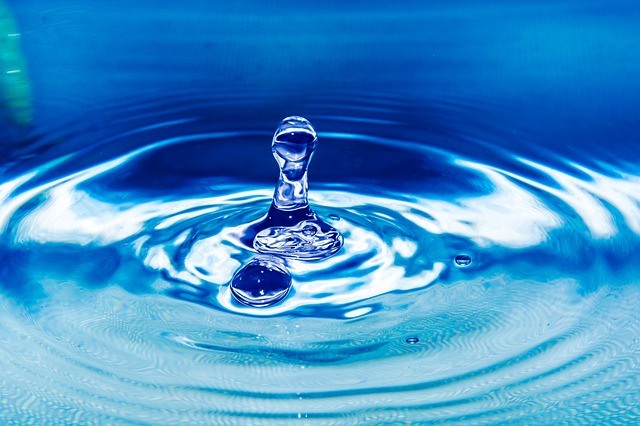
What property of water is in this picture?

a)

high specific heat

b)

surface tension

c)

greatest density at 4oC

d)

capillary action

18.

Water in a cup will help prevent the cup from burning up over a flame due to this property of water

a)

high specific heat

b)

capillary action

c)

surface tension

d)

greatest density at 4 oC

19.

During the winter when lakes freeze over the fish and other animals living in it survive. Which property of water?

a)

high specific heat

b)

capillary action

c)

greatest density at 4 oC

d)

surface tension

20.
What property of water allows it to be such a versatile solvent that it is often called the "universal solvent?"
a)
Purity
b)
Polarity and cohesion
c)
High heat capacity
d)
Expansion upon freezing
21.
Which is NOT a unique property of water?
a)
Frozen water floats on liquid water.
b)
Water covers most of the Earth’s surface and retains a large amount of heat.
c)
Water molecules stick to each other through hydrogen bonds.
d)
Water cools very rapidly.
22.
What property of water helps to moderate earth's temperature?
a)
adhesion
b)
chohesion
c)
Specific heat capacity
d)
Latent heat of vaporization
23.
Water is polar because...
a)
The unequal sharing of electrons gives the water molecule a slight negative charge near its oxygen atom and a slight positive charge near its hydrogen atoms.
b)
The molecule has two poles, at which the it is colder than other regions of the molecule.
c)
The unequal sharing of electrons gives the water molecule a slight negative charge near its hydrogen atoms and a slight positive charge near its oxygen atom.
d)
The water molecule is neutral.
24.
Which types of compounds dissolve easily in water?
a)
Polar and Nonpolar
b)
Polar and Ionic
c)
Nonpolar and Ionic
d)
Covalent and Nonpolar
25.

Water changes from a liquid to a gas

a)

Evaporation

b)

Condensation

c)

Precipitation

d)

Run off

26.
What is the physical change in matter from a liquid to a gas when heat is added?
a)
Melting Point
b)
Boiling Point
c)
Freezing Point
27.
The scale of temperature at which water freezes at 0 and boils at 100.
a)
Celsius Scale
b)
Fahrenheit Scale
28.
Why does ice stay at the top of oceans instead of sinking to the bottom?
a)
 Ice is colder than liquid water.
b)
Ice is less dense than liquid water.
c)
Ice is more dense than liquid water.
d)
Ice is warmer than liquid water.
29.
A florist places a bouquet of white carnations in water containing blue dye. After a time, the flowers turn blue. What process helped the carnations to change color?
a)
Specific heat 
b)
Surface tension
c)
Cohesion and adhesion of water molecules 
d)
Formation of covalent bonds between hydrogen and oxygen molecules
30.
Water makes up approximately 60% of the human body and plays a vital role in regulating body temperature. Which property of water makes it good at regulating temperature?
a)
Water is a good solvent.
b)
Water exhibits strong cohesion.
c)
. Water has an unusual crystalline structure.
d)
Water has a high capacity for heat.
31.
Water has a much higher specific heat than most other covalent compounds. What do you predict might happen if water had a low specific heat instead?
a)
Flooding would occur and animals would be forced to migrate
b)
 Harmful organisms living in water would reproduce at a rapid rate
c)
Organisms that are sensitive to changes in temperature would die
d)
Plants would not have enough water to effectively carry out photosynthesis
32.
 Many fish and aquatic plants can survive a cold winter because the layer of ice that forms at the top of the lake insulates the water below and prevents the lake from freezing solid. What unique property of water contributes to this effect? 
a)
Water absorbs heat when it evaporates and forms a gas 
b)
 Water expands and becomes less dense when it freezes.
c)
Water molecules completely separate into ions in solutions.
d)
 Water forms hydrogen bonds with ions and other polar substances. 
33.
What is water?
a)
An atom
b)
A molecule composed of 2 parts Oxygen and one part Hydrogen
c)
A molecular compound composed of 2 parts Hydrogen and one part Oxygen
d)
A pure substance composed of 2 parts Hydrogen and one part Oxygen
34.
What is the solid form of water called?
a)
Ice
b)
Frozen water
c)
Water ice
d)
Dry ice
35.

Why does water ice have a lower density than liquid water?

a)

Because it floats

b)

Because it is a crystal

c)

Because the molecules expand in volume as water freezes into a crystal

d)

Because ice is colder than water

36.
What is adhesion?
a)
Water's ability to stick to itself
b)
Water's ability to stick to other substances
c)
The strength of the cohesion of all the water molecules combined
d)
Tape, glue and other adhesives
37.
What is cohesion?
a)
Water's ability to stick to itself
b)
Water's ability to stick to other substances
c)
The strength of the cohesion of all the water molecules combined
d)
Tape, glue and other adhesives
38.
What is surface tension?
a)
Water's ability to stick to itself
b)
Water's ability to stick to other substances
c)
The strength of the cohesion of all the water molecules combined
d)
Tape, glue and other adhesives
39.

Hardness in water is caused by the presence of:

a)

Sodium chloride

b)

Sodium carbonate

c)

Calcium chloride

d)

Potassium nitrate

40.

Permanent hardness in water is caused by the presence of:

a)

Calcium bicarbonate

b)

Magnesium sulphate

c)

Both of them

d)

None of them

41.

The process of removing extra common salt from water is called:

a)

Ionization

b)

Softening

c)

Disinfections

d)

Desalination

42.

The ions that cause hard water are;

a)

Calcium and Manganese ions

b)

Calcium and Magnesium ions

c)

Carbon and Magnesium ions

d)

Carbon and Manganese ions

43.
Soft water is water that;
a)
Does not lather
b)
Lathers with difficulty
c)
Lathers easily
d)
Does not form bubbles
44.
Boiling can be used to make which type (s) of water soft.
a)
Temporary and  permanent hard water
b)
Soft water
c)
Permanently hard water
d)
Temporary hard water
45.

Which of these do not cause temporary hardness in water?

a)

Ca(HCO3)2

b)

Magnesium Bicarbonate

c)

Calcium Chloride

d)

Mg(HCO3)2

46.
Water that runs over limestone rock forms.....
a)
temporarily permanently soft water
b)
Soft water
c)
Permanently hard water
d)
Temporary hard water
47.

The property of metals by which they can be beaten in to thin sheets is called

a)

Sonority

b)

Malleability

c)

Ductility

d)

None of the above

48.

Phosphorus is very reactive

a)

Metal

b)

Non metal

c)

Metalloid

d)

None of the above

49.

More reactive metal displaces less reactive metal from its salt solution is known as

a)

Combination reaction

b)

Displacement reaction

c)

Neutral reaction

d)

None of the above

50.

Non-metal used in purple colour solutions which is applied on wounds as an antiseptic

a)

Iodine

b)

Oxygen

c)

Sulphur

d)

Phosphorus

51.

Metals react with water to produce

a)

Metal hydroxide

b)

Hydrogen gas

c)

Metal hydroxide and hydrogen gas both

d)

None of the above

52.

Zinc is more reactive than

a)

Copper

b)

Iron

c)

Copper and Iron both

d)

Only iron

53.

Sodium is very reactive metal because it reacts vigorously with oxygen and water and

a)

Generate heat

b)

Catches fire

c)

Stored in kerosene

d)

All of the above

54.

Red litmus paper turns blue when it is dipped in

a)

Acidic solution

b)

Basic solution

c)

Neutral solution

d)

None of the above

55.
Describe what luster means
a)
How an object reflects light
b)
How soft an object is
c)
If an object floats
d)
If an object can be dug out of the earth.
56.

By looking at the element illustrated here, how might you classify it by appearance?

a)

Metal

b)

Non-Metal

c)

Metalloid

57.

This picture illustrates copper's

a)

brittleness

b)

malleability

c)

ductility

58.
What two conditions make iron rust
a)
Water only
b)
air only
c)
water and air
d)
Hydrochloric acid
59.

What is just so typical of NON-metals?

a)

They don't know what colours go well together.

b)

Malleable.

c)

Form acidic oxides.

d)

Good conductors of electricity.

e)

High melting points.

60.

The process of depositing a layer of zinc on iron articles is called (a)   .

61.

A metal high in the reactivity series.....

a)

Forms unstable compounds.

b)

Can be obtained by the reduction of the ore with the carbon.

c)

Readily gains electrons.

d)

Burns to form basic oxides.

e)

Reacts readily with cold water to form Hydrogen.

62.
Different forms of the same element that have different properties because of different atom arrangements are called ________________.
a)
halogens
b)
allotropes
c)
carbons
d)
graphites
63.

Zn, Fe, Al and Mg. When we arrange these elements in the ascending order of their

reactivity series we get

a)

Mg < Al < Zn < Fe

b)

Al < Mg < Fe < Zn

c)

Zn < Al < Mg < Fe

d)

Fe < Zn < Al < Mg

64.

Alloys are the

a)

Heterogenous mixture of metals and non-metals

b)

Heterogenous mixture of two or more metals

c)

Homogenous mixture of metals and non-metals

d)

Homogenous mixture of two or more non-metals

65.

Identify the correct group of soft metals from the following

a)

Sodium, Alluminium and Copper

b)

Sodium, Potassium and Lithium

c)

Copper, Manganese and Magnesium

d)

Zinc, Barium and Lithium

66.

Observe the given information with respect to some elements and choose the correct name of the elements


Elements A B C D

Electrons K 2 2 2 2

L 8 8 6 8

M 1 8 0 4

N 0 1 0 0

a)

A is Silicon, B is Sodium, C is Potassium

and D is Oxygen

b)

A is Potassium, B is Oxygen, C is Sodium

and D is Silicon

c)

A is Oxygen, B is Silicon, C is Potassium and

D is Sodium

d)

A is Sodium, B is Potassium, C is Oxygen and D is Silicon

67.

NaCl and CuSO4 compounds have high melting and boiling points. This is because

a)

These are easily soluble in water and makes aqueous solutions

b)

A considerable amount of energy is required to break the strong inter-ionic bond

c)

They form positive and negative ions by the process of ionization

d)

Their ions move freely and conduct electricity

68.

A type of rock that contains minerals and metals

a)

ore

b)

metal

c)

malleable

d)

gem

69.

Which of these objects are manufactured from metals?

a)
b)
c)
d)
e)
70.

Which of these objects are manufactured from non-metals?

a)
b)
c)
d)
e)
71.

Which objects are manufactured from metals and non-metals?

a)
b)
c)
d)
72.

Non-metal used in water purification process

a)

Oxygen

b)

Nitrogen

c)

Chlorine

d)

Iodine

73.

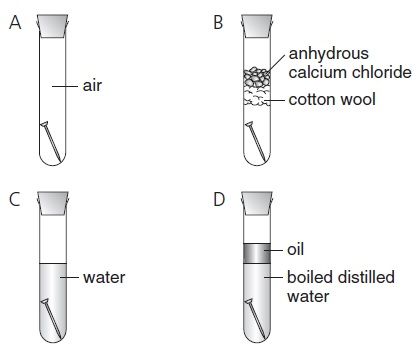
Which diagram shows the most favourable conditions for rust to appear on the nail?

a)

A

b)

B

c)

C

d)

D

74.

What is the correct equation for reaction between Sodium hydroxide and aluminium?

a)

NaOH + Al ----> NaAlO2 + H2

b)

NaOH + Al --------> NaAl + H2O

c)

NaOH + Al -------> Na3Al + O2

d)

None of these

75.

Arrange the metals copper, zinc and iron in their increasing order of their reactivity.

a)

copper,iron,zinc

b)

iron,copper,zinc

c)

copper,zinc,iron

d)

iron,zinc,copper

76.

What will happen when we add Iron nails in copper sulphate solution .Choose the correct option

a)

CuSO4 + Fe -----> FeSO4 + CuSO4

b)

CuSO4 + I ------> ISO4 + Cu

c)

CuSO4 + Fe ------> FeSO4 + Cu

d)

All of the above

77.

Reaction between X and Y forms compound Z. X loses electron and Y gains electron. Which of the following properties is not shown by Z?

a)

Has high melting point

b)

Has low melting point

c)

Conducts electricity in molten state

d)

Occurs as solid

78.

Aluminium is used for making cooking utensils. Which of the following properties of aluminium are

responsible for the same?

(i) Good thermal conductivity

(ii) Good electrical conductivity

(iii) Ductility

(iv) High melting point

a)

(a) (i) and (ii)

b)

(b) (i) and (iii)

c)

(c) (ii) and (iii)

d)

(d) (i) and (iv)

79.

What happens when calcium is treated with water?

(i) It does not react with water.

(ii) It reacts violently with water.

(iii) It reacts less violently with water.

(iv) Bubbles of hydrogen gas formed stick to the surface of calcium.

a)

(a) (i) and (iv)

b)

(b) (ii) and (iii)

c)

(c) (i) and (ii)

d)

(d) (iii) and (iv)

80.

Which of the following metals exist in their native state in nature?

(i) Cu

(ii) Au

(iii) Zn

(iv) Ag

a)

(a) (i) and (ii)

b)

(b) (ii) and (iii)

c)

(c) (ii) and (iv)

d)

(d) (iii) and (iv)

81.

Alloys are homogeneous mixtures of a metal with a metal or non-metal. Which among the following

alloys contain non-metal as one of its constituents?

a)

(a) Brass

b)

(b) Bronze

c)

(c) Amalgam

d)

(d) Steel

82.

Generally, non-metals are not conductors of electricity. Which of the following is a good conductor of

electricity?

a)

(a) Diamond

b)

(b) Graphite

c)

(c) Sulphur

d)

(d) Fullerene

83.

The atomic numbers of four elements A, B, C and D are 6, 8, 10 and 12 respectively. The two elements

which can react to form ionic bonds (or ionic compound) are:

a)

(a) A and D

b)

(b) B and C

c)

(c) A and C

d)

(d) B and D

84.

 X+X^+  

The atomic number of an element X is 19. The number of electrons in its ion will be:

a)

(a) 19

b)

(b) 18

c)

(c) 20

d)

(d) 21

85.

Which words best describe NON-METALS?

a)

ductile, shiny, brittle

b)

malleable, dull, brittle, ductile

c)

brittle, dull, insulators

86.

Identify the given metal which melts on the palm of our hand

a)

Mercury

b)

Sodium

c)

Potassium

d)

Gallium

87.

An element oxide, X undergoes the following reactions:


X + Acid -> Salt + Water

X + Base -> Salt + Water


Is the oxide X an amphoteric oxide?

a)

Yes

b)

No

88.

Which of the following are examples of Amphoteric Oxides?


(Select all that apply)

a)

ZnO

b)

MgO

c)

Al2O3

d)

Na2O

89.

Cu is less reactive than sodium. Which of the following reactions will occur?


( Select 2 answers)

a)

A

b)

B

c)

C

d)

D

90.

Which of the following is NOT a chemical property of a metal?

a)

Metals generally have basic oxides.

b)

Metals react with dilute acids to liberate hydrogen gas.

c)

Metals are electropositive in nature, i.e. they donate electrons

d)

Metals are electronegative in nature, i.e. they accept electrons.

91.

Which of the following are the properties of Ionic Compounds?


(Select all that apply)

a)

Ionic Compounds have high melting points

b)

Ionic Compounds conduct electricity in aqeous or molten form.

c)

Ionic Compounds are soluble in petrol and kerosene.

d)

Ionic Compounds generally have solid state.

92.

Calcium Flouride an ionic Compound is made up of two elements Ca and F. The atomic number of Calcium and Flourine is 17 and 9 respectively.


Identify the ions present in Calcium Flouride.

a)

A

b)

B

c)

C

d)

D

e)

E

93.

To form Sodium Oxide (Na2O), two sodium atoms combine with one oxygen atom. Pick the electron dot structure of the Na2O formed:

a)

A

b)

B

c)

C

d)

D