
 Worksheets
Heat of Fusion, Heat of Vaporization, and Specific Heat
Total questions: 45
Worksheet time: 2hrs 8mins
How much energy is required to heat up 12000 g of copper from 10 °C to 120 °C. The specific heat capacity is 0.390 J/g°C.
46800 J
561600 J
514800 J
How many Joules of energy are required to make 100 grams of ice at 0 οC completely melt? The specific latent heat of fusion of ice is 334 J/g
200 J
400 J
33,400 J
2,000,000 J
The heat absorbed by melting a solid is known as
latent heat of fusion
latent heat of solid
latent heat of liquid
latent heat of vaporisation
Water molecules have the greatest kinetic energy in
Ice at 0 ⁰C
Water at 90 ⁰C
Water at 373 K
Steam at 150 ⁰C
The amount of energy required to raise the temperature 1ºC for every gram is called____?
Thermal Energy
Specific Heat
Temperature
Kinetic Energy
How much energy is needed to raise the temperature of 5.0 grams of lead from 25°C to 35°C? [specific heat (c) = 0.129 J/(g•°C)]
6.45 J/(g•°C)
6.45 J
16.1 J/(g•°C)
d.16.1 J
Which of the following best explains why the sand at the beach is hotter than the water?
Sand has a higher specific heat than water.
Sand has a lower specific heat than water.
There is more water than sand at the beach.
There is more sand than water at the beach.
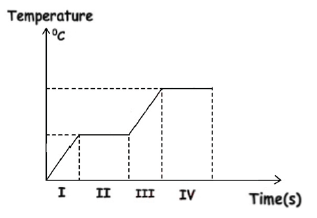
Consider the following temperature-time graph when a solid is heated. which part of the graph involves latent heat of vaporization?
Part I
Part II
Part III
Part IV
What is the formula to calculate heat energy required to raise the temperature of any substance?
Q = m c ∆T
Q = m c
Q = ½ m v
m = Q c
If the specific heat of water is 4.186 J/g∙°C, how much heat is required to increase the temperature of 1200g of water from 23 °C to 39 °C?
-80,371.2 J
44,938.6 J
80,371.2 J
-44,938.6 J

Using the heat equation, what would the formula look like if we were solving for change in temperature?
Q m = ∆T C
Q / (m C) = ∆T
Q m / C = ∆T
m c Q = ∆T
The symbol for specific heat is .......
C
Q
m
T
You have 20 g of water with specific heat of 4.18 J/g°C. The temperature changes from 25° C to 20° C. How much heat energy (Q) moves from the water to the surroundings?
- 418 J
209 J
83 J
418 J

Equal mass samples of Copper, Stainless Steel, Carbon Steel, and Zinc were all heated using 10,000 JOULES of thermal energy. What material would have the LARGEST change in temperature?
Copper
Carbon Steel
Zinc
Stainless Steel
Equal mass samples of Copper, Stainless Steel, Carbon Steel, and Zinc were all heated using 10,000 JOULES of thermal energy. Based on the chart, which material would be have the SMALLEST change in temperature?
Copper
Carbon Steel
Zinc
Stainless Steel
20 g of water. specific heat of water is 4.18 J/g°C. temperature changes from 25° C to 20° C, what will the value of q be?
positive
negative
equilibrium
q does not exist
The unit for specific heat is
J
J/gC
g
°C
The unit for heat energy is
°C
J
J/gC
g
What letter do we use to represent mass?
Q
m
c
ΔT
The unit for mass is
g
J
J/gC
°C
What does ΔT represent?
tf −ti
ti −tf
t - celsius
celsius - t
Consider the following temperature-time graph when a solid is heated. which part of the graph involves latent heat of fusion?
Part I
Part II
Part III
Part IV
When you place the metal in boiling water, heat flows from the _________ to the _______.
metal to the boiling water
bottom of the metal to the top half of the metal
bottom of the water to the top of the water
boiling water to the metal
Do molecules generally move faster at 45 C or 106 C?
45 C because molecules have more energy than in 106C
106 C because molecules have more energy than in 45C
106 C because molecules have less energy than in 45C
45C because molecules have less energy than in 106 C
DON'T RUSH, YOU HAVE TIME.
Water droplets condensing on the inside of a window on a cold day. Is this process exothermic or endothermic?
Gases condense to form liquids. Gases are moving faster than liquids, the air around the window has a higher temperature/kinetic energy. Releasing energy to get water droplets, which is is Exothermic
Gases condense to form liquids. Gases are moving faster than liquids, the air around the window has a higher temperature/kinetic energy. Releasing energy to get water droplets, which is is Endothermic
Gases condense to form liquids. Gases particles are moving slower than liquids. Releasing energy to get water droplets, which is is Endothermic
Gases condense to form liquids. Gases particles are moving slower than liquids. Releasing energy to get water droplets, which is is Exothermic
READ CAREFULLY! YOU HAVE TIME!
A substance with a low specific heat requires less energy to heat up and a substance with high specific heat require more energy to heat up and heats up slower
TRUE
FALSE
YOU HAVE TIME!
How much energy is needed to raise the temperature of a 20.0g piece of copper from 15.0 degrees Celsius to 25.0 degrees Celsius? (The specific heat of copper is 0.385 J/g C)
20 X (25-15) =70 J
20 X .385 X (25-15)= 77 J
20 X .385 X (15-25)= 62 J
20 X .385 X (15-0)= 77 J



