Worksheets
20/21 DCP #3 Review 2
Total questions: 85
Worksheet time: 1hrs 28mins

Organisms that sexually reproduce have __ _______ of each chromosome.
1 copy
2 copies
4 copies
1/2 copies

Pairs of chromosomes with equivalent genetic information are called _____________ _________________.
homologous centromeres
heterozygous chromosomes
unique chromosomes
homologous chromosomes

___________ is the process that creates __________ __________ like sperm and egg cells.
Meiosis, gamete cells
Meiosis, somatic cells
Mitosis, gamete cells
Mitosis, somatic cells

Meiosis ___________ the number of chromosomes in gamete cells. Gametes have ______ the chromosomes.
reduces, 1/4
reduces, 1/2
increases, double
increases, quadruple

During meiosis, homologous chromosomes recombine through a process called ____________ _______.
cell division
binary fission
crossing over
active transport

Meiosis ____________ _____________ _____________ in a species.
increases genetic similarities
decreases chromosome counts
increases chromosome counts
increases genetic variation

An increased ___________ ______________ can help animals adapt!
species similarity
species diversity
species amount
species impact

The law of __________________ ___________________ describes how chromosomes (and their genes) are randomly sorted into gamete cells.
independent assortment
independent placement
dependent assortment
dependent variation

Independent assortment insures that each gamete cell will have a ___________, ___________ set of genetic material.
different, similar
similar, unique
different, unique
similar, identical
Independent assortment insures that each gamete cell will have a ___________, ___________ set of genetic material.
different, similar
similar, unique
different, unique
similar, identical

During meiosis, the processes of recombination and independent assortment create _____________ _____________ gamete cells that can produce _____________ _____________ offspring!
genetically diverse, genetically unique
genetically diverse, genetically identical
genetically identical, genetically unique
genetically identical, genetically similar
All Viruses are made of cells
True
False
All Viruses do Not contain any organelles
True
False

Compared to a cell, a virus is
Small but the same
Larger with DNA and organelles
Not considered living, made of cells and contains organelles
Not considered living, Not made of cells, and do not have organelles.

Viruses have a protein shell called...
Capsid
Cell membrane
Protein markers
host
Which of the following statements is true about a virus
Cells and viruses can reproduce themselves
Viruses can go through cellular division on their own.
Cells can reproduce themselves, but viruses CANNOT replicate on their own, they require a host cell.
Viruses can reproduce themselves but cells can not reproduce with the help of a virus.

A virus needs a _____ ____ to replicate.
Host cell
Protein capsid
Sperm cell
gamete cells

Cells and viruses BOTH contain
Host cells
Protein capsid
Genetic Material
nucleus
What type of genetic material can be found in viruses and cells
DNA
RNA
DNA or RNA
What allows a virus to attach to a host cell
Surface markers
bacteria
flagella
they don't attach to a cell

A virus needs a Host cell to
Replicate
grow
Repair
infect cells

Viruses use the host cell’s own machinery to
Replicate more viruses
grow more viruses
Repair cells
infect cells

What happens to the host cell once a virus takes over
It replicates
Makes more copies of the cell
Repair cells
It is destroyed
In which cycle does the virus replicate quickly causing symptoms of the infection to appear?
lytic cycle
lysogenic
cell cylce
krebs cycle
In which cycle is the virus dormant and inactive?
lytic cycle
lysogenic cycle
cell cycle
krebs cycle
How do antiviral drugs work? (choose all that applies)
disrupt the ability of viruses to attach to cells
disrupts the homeostasis of the virus
destroys the virus
keep cells from replicating more viruses
Why do viruses spread quickly?
There is lack of new hosts for the virus.
People lack immunities to the new viral strains.
There is a lack of treatment options.
People do not come in contact with other people.
A vaccine contains_______ and causes the body's immune system to produce _______.
antibodies; weakened viruses
antiviral drugs; antibodies
weakened viruses; antibodies
weakened viruses; a fever
Vaccines allows people to become ________ to viruses.
endangered
exposed
vulnerable
immune
HIV attacks what kind of cells?
Helper T cells
Antibodies
Liver cells
Skin cells
What do people with HIV die from?
primary infections
secondary infection

Roots absorb __________ and ____________ for the plants.
water, carbon dioxide
water, nutrients
water, sunlight
water, glucose

Roots store ___________ made by the plant.
sugars
water
carbon dioxide
sunlight

Water and nutrients are absorbed by the roots then transported by the ______________ ______________ to the rest of the plant.
root system
circulatory system
lymphatic system
shoot system

_____________ ____________ carry water, nutrients, and hormones through the plant.
Shoot tissues
Root tissues
Vascular tissues
Stomata tissues

______________ transports _______________ and ________________ up through the plant.
Xylem, water, minerals
Xylem, water, sugars
Phloem, water, minerals
Phloem, water, sugars

_____________ carries _____________ from the shoot system down to the roots,
Xylem, sugars
Phloem, sugars
Xylem, water
Phloem, water

What are the reactants of photosynthesis?
water and oxygen
water and carbon dioxide
glucose and oxygen
glucose and water
What are the products of photosynthesis?
water and oxygen
water and carbon dioxide
glucose and oxygen
glucose and water

What do we call the process that allows plants to use water and carbon dioxide to produce sugars (glucose)?
Chemosynthesis
Lipogenesis
Photosynthesis
Active transport

Sugars are produced in the ______________ and stored in the __________ and ____________ of the plant.
xylem, phloem, root
phloem, root, fruit
leaves, stomata, phloem
leaves, root, fruit

True or False: If water is not available, plants will not be able to produce sugars through photosynthesis.
True
False
What organ is responsible for plant reproduction?
Root
Shoot
Leaf
Flower

Pollen is released from the _________ and transferred to the __________.
anther, stigma
anther, stamen
pistil, stigma
sepal, stigma

____________ attracts pollinators, like birds and bees, to the plant.
Stamen
Leaves
Sepals
Petals

_____________ grains contain the male gamete of the plant.
Ovule
Petiole
Pollen
Pistil

What form of plant response is pictured?
Phototropism
Gravitropism (Geotropism)
Thigmotropism

What form of plant response is pictured?
Phototropism
Gravitropism (Geotropism)
Thigmotropism

What form of plant response is pictured?
Phototropism
Gravitropism (Geotropism)
Thigmotropism

Plant ______________, like auxin, stimulate the growth of plants toward or away from stimuli.
fluid
hormones
water
pollen

Gravitropism (geotropism) is growth of the plant in response to _______________.
light
gravity
touch

Thigmotropism is growth of the plant in response to _______________.
light
gravity
touch

_______________ are the tiny openings in leaves that allow gases to enter and exit the leaves.
Stomata
Guard cells
Thylakoids
Chloroplasts

True or False: When water levels are low, the stomata open to allow water to evaporate from the leaves.
True
False

Carnivorous plants have specialized leaves that _____________ ____ ______ ____________ of insects that have landed on them.
eat all the legs
react to the air
respond to the stimuli
respond to the eyes

The insects consumed by carnivorous plants are digested by the plants to provide ___________ and other nutrients for the plants.
phosphorus
nitrogen
sugar
carbon

What do we call the science of classifying organisms into groups based on shared characteristics?
Osmosis
Taxonomy
Transcription
Metabolism

Every organism has a scientific name. The scientific name is composed of what two categories?
Kingdom and specific epithet (species)
Phylum and Class
Genus and specific epithet (species)
Class and Genus

Why is taxonomy important?
It allows scientists to avoid confusion when referring to specific species.
It allows scientists to use a common name for different species.
It allows scientists to become better at Latin.
It allows scientists to increase confusion among non-scientists.

Having a common system for classifying organisms can help scientists find ________________ __________________ between species.
evolutionary differences
evolutionary relationships
symbiotic relationships
symbiotic differences
What is true of most closely related species?
they belong to the same class
they belong to the same genus
they belong to the same family
they belong to the same order
What is true of the most closely related organisms?
They belong to the same family
They belong to the same genus
They belong to the same order
They belong to the same species
Which two organisms are the most closely related?
Gray wolf (Canis lupus)
Coyote (Canis latrans)
Dalmation (Canis familiaris)
German Shepard (Canis familiaris)
Organisms that share more taxonomic levels are more closely related.
True
False

Which of the following is the least specific level?
Domain
Kingdom
Phylum
Class

Which of the following is the most specific level?
Class
Order
Family
Species

Which of the following pairs of organisms from the table shown above would be the most closely related?
Desert iguana and Box turtle
Chuckwalla and Bush anole
Box turtle and Bush anole
Desert iguana and Chuchwalla
Species that share a more recent ancestor are more closely related.
True
False

Phylum Arthropoda
Phylum Annelida
Phylum Mollusca
Phylum Platyhelminthes

Phylum Chordata
Phylum Arthropoda
Phylum Annelida
Phylum Mollusca
Brown bears (Ursus arctos) are most closely related genetically to which of the following organisms?
Polar bear (Ursus maritimus)
Spectacled bear (Tremarctos ornatus)
Koala (Phascolarctos cinereus)
Giant panda (Ailuropoda melanoleuca)
ALWAYS start at the _______________ of a dichotomous key and follow the steps.
end
middle
last statement
beginning
Chordates are animals that have a backbone. Humans, horses, goldfish, sharks, and dogs are examples of the many types of chordates. Which of these chordates are most closely related?
Chordates of the same class
Chordates of the same family
Chordates of the same genus
Chordates of the same order
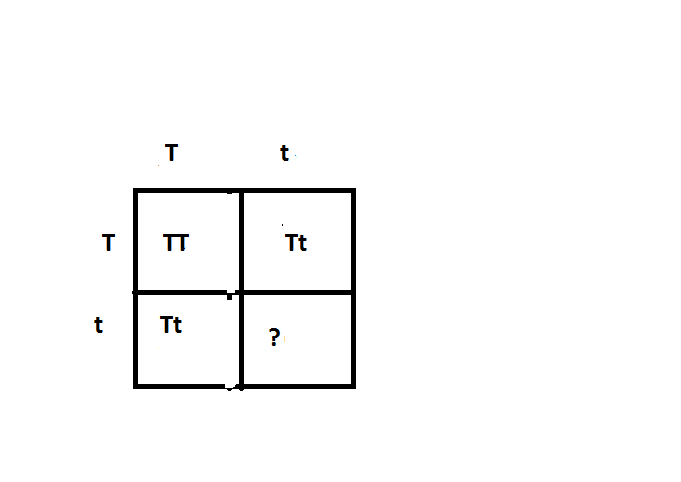
In the punnett square below, what belongs in the missing square