
 Worksheets
Chapter 7 Understanding the Atom
Total questions: 62
Worksheet time: 34mins
Which of the following determined that cathode rays are negatively charged?
Aristotle
Dalton
Rutherford
Thomson
In an atom, electrons ____.
are located in the nucleus
are paired with neutrons
travel outside the nucleus
are always in the same place in an atom

Who proposed this model of atoms?
Dalton
Democritus
Rutherford
Thomson

Which scientist developed this model for atoms?
Dalton
Democritus
Rutherford
Thomson
The energy levels of an atom are occupied by _____.
electrons
protons
neutrons
ions
The nucleus of an atom consists of _________________________.
electrons
neutrons
protons and neutrons
protons, neutrons, and electrons
The three basic components of an atom are _______________.
protons, neutrons, and ions
protons, neutrons, and electrons
protons, neutrinos, and ions
protium, deuterium, and tritium
If two atoms have the same number of protons but different numbers of neutrons, they will have the same ____.
half-life
mass number
atomic number
degree of stability
Which of the following statements about the atom is false?
Each atom has a tiny nucleus at its center.
All the protons and neutrons are located in the nucleus.
Electrons travel in definite circular pathways around the nucleus.
All atomic nuclei are positively charged.
What was on the photographic plate in Becquerel’s drawer with the uranium?
an image of the mineral
a sun spot
Becquerel's fingerprints
Nothing. It was clean.
Which item best represents Thomson’s mental image of an atom?
a sponge
a chocolate-chip cookie
a bowling ball
a beach ball
Which particles have almost the same mass?
proton and electron
proton and neutron
electron and neutron
all 3 particles
Which item best represents Dalton's mental image of an atom?
a cork
a candy bar with nuts
a marble
a balloon full of air
________ does not change an element into another element.
alpha decay
beta decay
gamma decay
omega decay
Which two particles would be attracted to each other?
electrons and neutrons
electrons and protons
protons and neutrons
all particles are attracted to each other
The particles that make up an atom are ____.
electrons, protons, and nuclei
elements, protons, and electrons
protons, neutrons, and nuclei
protons, neutrons, and electrons
Which of the following found that atoms have a nucleus?
Aristotle
Dalton
Rutherford
Thomson
When Rutherford performed his metal foil experiment, he was surprised that most of the alpha particles ____.
were deflected by the foil
bounced back from the foil
were absorbed by the foil
passed straight through the foil
In _____, the atomic number increases by one.
alpha decay
beta decay
gamma decay
omega decay
Based on his experiment, Rutherford concluded that atoms were ____.
dense positively charged particles
uniform throughout
mainly empty space
made of protons, neutrons, and electrons
Henri Becquerel accidentally discovered radiation while working with minerals containing _____.
polonium
radium
sodium
uranium
How many carbon atoms would fit in the period at the end of a sentence?
7.5 thousand
7.5 million
7.5 billion
7.5 trillion
Which of the following is NOT a developer of an atomic model?
Dalton
Planck
Rutherford
Thomson
Becquerel thought that _____ was necessary for minerals to give off energy that passed through paper.
water
sunlight
dirt
uranium
Which of the following was invented in 1981 and allowed scientists to first see individual atoms?
scanning tunneling microscope
atomic microscope
scanning telescope
visualizing microscope
A certain atom has 26 protons, 26 electrons, and 30 neutrons. It mass number is ____.
26
30
52
56

Which of the following statements best describes how the Bohr model of an atom is different from this one?
Bohr’s model had more electrons around the nucleus.
Bohr’s model shows electrons at certain distances from the nucleus.
Bohr’s model placed the electrons in the nucleus.
Bohr’s model did not distinguish positive and negative charges.
A single proton has which electrical charge?
no charge
positive charge
negative charge
either a positive or negative charge
In _______, the atomic number decreases by two.
alpha decay
beta decay
gamma decay
omega decay

Which scientists proposed this model for atoms?
Dalton
Democritus
Rutherford
Thomson
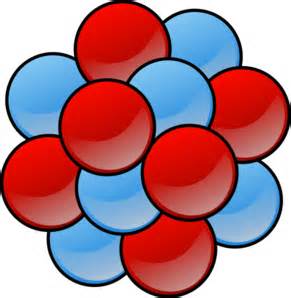
Which of the following methods would be most useful for describing atoms?
visualizing with a microscope
constructing a model
observing in a test tube
touching with bare hands
Democritus believed that the universe was made of empty space and __________ .
molecules
compounds
elements
atoms
What nineteenth century scientist designed the atomic theory of matter?
J.J. Thomson
Ernest Rutherford
John Dalton
Isaac Newton
Why did J.J. Thomson conclude that cathode rays were made up of small particles that had mass?
They were bent by a magnet.
The metal plates in his experiment had no net charge.
Some of the rays changed direction and bounced back.
He could see individual particles traveling from the negatively charged plate to the positively charged plate.
The small, negatively charged particles discovered by J.J. Thomson are called __________ .
protons
neutrons
electrons
alpha particles
James Chadwick named the uncharged particles in the atomic nucleus
protons
electrons
neutrons
alpha particles
Atoms of the same element that have different numbers of neutrons are called __________.
isotopes
metals
nonmetals
metalloids
An element's atomic number is the number of __________ in the nucleus of each atom of that element.
neutrons
protons
electrons
positrons
Most of an atom's mass is contained in __________.
the electron orbits
the electron cloud
its outer energy shell
its nucleus
A(n) __________ is an atom that has gained or lost an electron and is no longer neutral.
ion
isotope
molecule
compound
__________ is the release of nuclear particles and energy.
Transmutation
Atomic half-life
Nuclear decay
Carbon dating
Scientists have broken down protons and neutrons into smaller particles called __________ .
nuclei
quarks
vacuoles
isotopes
Aristotle and many ancient Greeks thought that all matter was made of how many elements?
1
4
8
12
Which researcher's experiments led to the discovery of the proton?
John Dalton
Neils Bohr
James Chadwick
Ernest Rutherford
A calcium ion has 20 neutrons, 20 protons, and 18 electrons. What is the ion's charge?
2+
1+
1-
2-
What part of an atom did Thomson discover?
the electron
the proton
the nucleus

