wayground logo

Free Printable Worksheets

Font size

S
M
L
XL
Worksheets

7th grade science review

Total questions: 53

Worksheet time: 35mins
Name
Class
Date
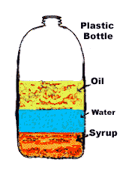
1.
Which liquid is the least dense?
a)
oil
b)
water
c)
syrup 
d)
plastic bottle
2.
The process of a LIQUID turning into a GAS is called?
a)
Boiling
b)
Evaporation
c)
Steam
d)
Sublimation
3.
Mixtures _________ combined chemically.
a)
ARE
b)
ARE NOT
4.
The processes of a solid turning directly into a gas is.....
a)
Sublimation
b)
boiling
c)
melting
d)
evaporation
5.

Density is mass divided by volume.

a)

True

b)

False

6.

The picture is an example of _______________.

a)

Heterogeneous Mixture

b)

Pure Substance

c)

Homogeneous Mixture

d)

Compound

7.
Where should you read the level of water on the graduated cylinder?
a)
Level "A"
b)
Level "B"
c)
Level "C"
d)
None of these
8.
What is the volume of water in this graduated cylinder?
a)
47 mL
b)
50 mL
c)
45 mL
d)
45.4 mL
9.
The parts of the experiment that must be kept the same.
a)
Constants
b)
independent
c)
Dependent
10.

The variable that is changed on purpose during an experiment is called the.....

a)

Constant

b)

Control

c)

Independent Variable

d)

Dependent Variable

11.
If I water the plant more often, then it will grow taller.  Name the dependent variable.
a)
The amount of water.
b)
The amount of soil.
c)
The height of the plant.
d)
The amount of water.
12.
If I water the plant more often, then it will grow taller.  Name the independent variable.
a)
The height of the plant
b)
The size of the pot
c)
The amount of water
d)
The amount of light.
13.

The majority of the periodic table is composed of...

a)

metals

b)

nonmetals

c)

metaloids

d)

halogens

14.

Check THREE physical properties of metals.

a)

ductile and malleable

b)

low melting point

c)

very dense

d)

good conductors of electricity

15.
In an exothermic reaction, heat is ...
a)
taken in
b)
given out
16.

In an endothermic reaction, heat is ...

a)

taken in

b)

given out

17.

This is an example of a

a)

Solution

b)

Mixture

18.

The substance that does the dissolving

a)

Solute

b)

Solvent

c)

Solution

d)

Miscibility

19.

The substance getting dissolved

a)

Solvent

b)

Solute

c)

Solution

d)

Mixture

20.

What are THREE examples of colloids?

a)

milk

b)

fog

c)

trail mix

d)

shaving cream

21.

In what type of mixture are the particles equally distributed throughout?

a)

colloid

b)

suspension

c)

homogeneous solution

d)

heterogeneous mixture

22.
What is a circuit?
a)
A constant flow of electricity 
b)
A path that a current can flow along
23.

Why is electrical wiring usually made from copper?

a)

Because copper is shiny

b)

Because copper conducts electricity

c)

Because copper is not magnetic

d)

Because copper insulate electricity

24.

If lamp 2 is unscrewed from its holder, what will happen to lamp1?

a)

It will stay lit

b)

It will go out

c)

It will get dimmer

d)

It will dissapear

25.

What type of circuit is this?

a)

Parallel Circuit

b)

Open Circuit

c)

Series Circuit

26.

What type of circuit is this?

a)

Parallel Circuit

b)

Open Circuit

c)

Series Circuit

27.

Which of the following best describes temperature?

a)

Number of molecules

b)

Motion of molecules

c)

Size of molecules

d)

Type of molecules

28.
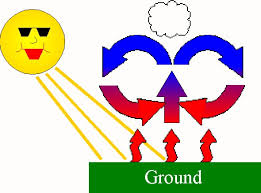
Warm air rises and the cool air sinks demonstrates this type of heat transfer. 
a)
conduction
b)
convection
c)
radiation
d)
Insolation 
29.
Transfer of thermal energy through "space"
a)
conduction
b)
convection
c)
radiation
30.
Hot coffee is stirred with a spoon; the spoon gets hot due to
a)
conduction
b)
convection
c)
radiation
31.
Near the ceiling of a room the air is warmer; the warm air rises because of
a)
conduction
b)
convection
c)
radiation
32.
Which box has a higher density?  
a)
Box A
b)
Box B
c)
cannot be determined
d)
they are the same
33.
What kind of energy is in a moving skateboard?
a)
Potential
b)
Kinetic
c)
Both potential and kinetic energy
d)
none of the above
34.
What kind of energy is in a rock at the edge of a cliff?
a)
Potential
b)
Kinetic
c)
Both potential and kinetic energy
d)
none of the above
35.
At which point is potential energy greatest?
a)
W
b)
X
c)
Y
d)
Z
36.
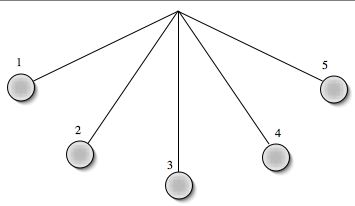
When a pendulum swings, at which point is potential energy at its greatest?
a)
1
b)
2
c)
3
d)
4
37.

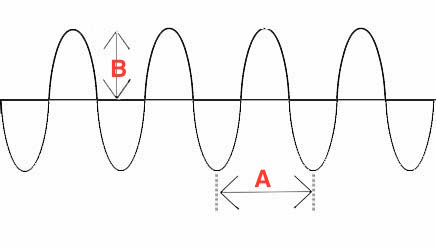
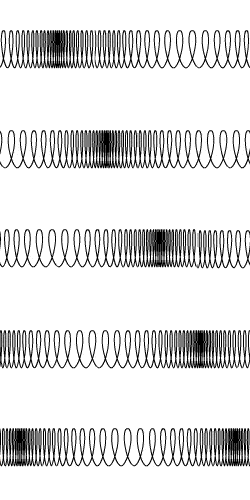
What kind of wave is pictured below?

a)

compressional wave

b)

transverse wave

c)

sound wave

d)

mechanical wave

38.
What property of this wave is represented by the letter "A"
a)
amplitude
b)
crest
c)
trough
d)
wavelength
39.
What property of the wave is represented by the letter "B"?
a)
amplitude
b)
crest
c)
trough
d)
wavelength
40.
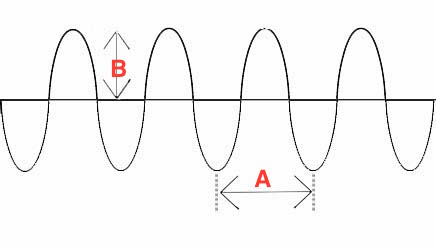
What type of wave is this?
a)
Longitudinal
b)
Transverse
41.
This sphere is composed of all the living things 
a)
Hydrosphere 
b)
Biosphere 
c)
Atmosphere 
d)
Geosphere 
42.
Composed of all the water on or near the earth
a)
Hydrosphere 
b)
Biosphere 
c)
Atmosphere 
d)
Geosphere 
43.
This sphere includes the continents, the ocean floor, all the rocks on the surface, and all of the sand in the deserts. 
a)
Hydrosphere 
b)
Biosphere 
c)
Atmosphere 
d)
Geosphere 
44.
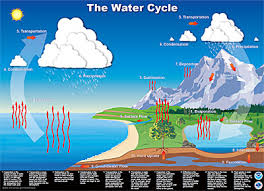
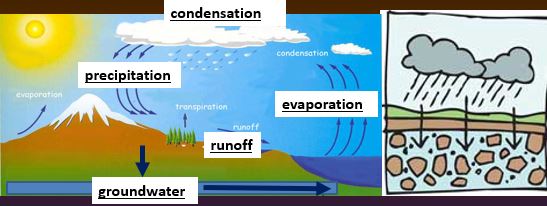
What is it called when plants give off water vapor as a waste product?
a)
condensation
b)
evaporation
c)
sublimation
d)
transpiration
45.
During which stage do clouds form?
a)
condensation
b)
evaporation
c)
precipitation
46.

Water that flows over the land to streams, rivers, and lakes

a)

Evaporation

b)

Condensation

c)

Precipitation

d)

Runoff

47.

Water that is found underground in the cracks and spaces in soil, sand and rock is called:

a)

Groundwater

b)

River

c)

Surface water

d)

Snow

48.

The land area that water moves across or under while flowing to a stream, spring, pond, lake or river is a/an:

a)

mountain

b)

watershed

c)

ocean

49.

To use water found in an aquifer people would

a)

build a dam

b)

drill a well to below the water table

c)

purify ocean water

50.

Which layer of the atmosphere contains the ionosphere?

a)

troposphere

b)

stratosphere

c)

mesosphere

d)

thermosphere

51.
Earth's current atmosphere is
a)
78% nitrogen, 21% oxygen, 0.9% argon and 0.037% carbon dioxide
b)
78% oxygen, 21%nitrogen, 0.9% argon, 0.037% carbon dioxide
c)
78% nitrogen, 21% argon, 1% oxygen
d)
78% oxygen, 21% nitrogen, 1% carbon dioxide
52.
The layer of the atmosphere containing the ozone layer is
a)
troposphere
b)
stratosphere
c)
thermosphere
d)
mesosphere
53.
The layer of the atmosphere where meteors burn up
a)
mesosphere
b)
thermosphere
c)
troposphere
d)
stratosphere