Wayground logo

Free Printable Worksheets

Font size

S
M
L
XL
Worksheets

Embryology & Evolution

Total questions: 39

Worksheet time: 47mins

Name
Class
Date
1.
A change in the inherited characteristics of an organism over time is ________
a)
evolution.
b)
development.
c)
growth.
d)
ancestry.
2.
Another word for specific parts that form an organ, system, or living thing is __________.
a)
structure.
b)
vertebrae.
c)
forelimb.
d)
organism.
3.
_____________  is the study of embryos to see how their similarities and differences indicate an evolutionary relationship.
a)
Paleontology
b)
Common ancestry
c)
Homologous structure
d)
Embryology
4.
The most recent ancestral form or species from which two different species evolved is known as ________________________.
a)
a common ancestor.
b)
an embryonic stage.
c)
development.
d)
evolution.
5.
In stage one (top row) of these embryos, most of the embryos________
a)
look very similar.
b)
have very different features.
c)
show different stages of development.
d)
have only a tail if they are non-human.
6.
In stage 2 (middle row) fish embryos _________
a)
are very different bird and mammal embryos.
b)
are still very similar to bird and mammal embryos.
c)
show arm and leg buds.
d)
are the only embryos with tails.
7.
In the the third embryonic stage (bottom row), mammal embryos _____
a)
have more characteristics in common with each other than with reptiles or birds.
b)
are still hard to tell from reptiles and birds.
c)
have the same features as fish, reptiles, and birds.
d)
do not have tails.
8.
Ostrich wings are examples of
a)
homologous structures
b)
vestigial structures
c)
adaptations
d)
traits
9.
Dolphins have the same arm structure as wolfs, what type of evidence for evolution does this represent?
a)
DNA
b)
vestigial structures
c)
homologous structures
d)
embryology
10.
What would indicate that a series of fossils represent evolution?
a)
the fossils were identical
b)
the fossils were found in the same layers of rock
c)
the fossils show similarities
d)
the fossils were completely different
11.
Why do embryologist study embryos?
a)
to see if they are related
b)
to understand adaptations
c)
to determine the age
d)
to learn what parents are vestigial
12.
Change over time is
a)
evolution
b)
generation
c)
growth
d)
biogenesis
13.
Natural selection is
a)
survival of the fittest
b)
humans change
c)
two species are the same
d)
more animals survive
14.
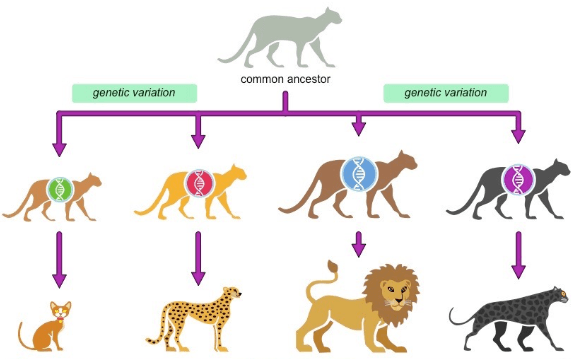
This makes an organism more suited to its enviornment
a)
species
b)
lifespan
c)
adaptation
d)
mutation
15.
What is one reason that strawberries are surviving in the winter season?
a)
they have larger leaves
b)
they have genetic variations allowing them to be resistant to cold
c)
they reproduce more
d)
the color is dark
16.
Who was Charles Darwin?
a)
A naturalist who came up with the theory of evolution
b)
A scientist who studied plants
c)
A geologist who looked at rocks and fossils
d)
A paleontologist who studied dinosaurs
17.

What type of evidence is represented in the picture above:

a)

Fossils

b)

Vestigial Structures

c)

DNA

d)

Homologous Structures

18.

What type of evidence is shown in the image above?

a)

Fossils

b)

Vestigial structures

c)

Homologous Structures

d)

DNA

19.

What type of evidence is shown in this picture?

a)

Fossils

b)

Homologous Structures

c)

Vestigial Structures

d)

DNA

20.

What type of evidence are shown in the picture above?

a)

Fossils

b)

Embryology

c)

Homologous Structures

d)

Vestigial Structures

21.

Adaptations are:

a)

physical or behavioral tendencies.

b)

physical or behavioral characteristics that help an organisms survive and reproduce.

c)

physical or behavioral characteristics that do not help the organism in any way.

d)

genetic mutations that have gone wrong.

22.
The similarities of the bones in the diagram provide evidence that---
a)
The organisms shown lived in the same natural envionrment
b)
The organisms shown may have developed from a common ancestor
c)
The organisms shown have the same genetic diseases
d)
All vertebrate species have identical forelimbs
23.

The process by which two populations of the same species become so different that they can no longer interbreed.

a)

natural selection

b)

artificial selection

c)

speciation

d)

fossilization

24.

body parts in organisms that have the same functions, but have different structures

a)

analagous structures

b)

homologous structures

c)

vestigal structures

25.

selective pressure exerted by humans on populations in order to improve or modify particular desirable traits

a)

natural selection

b)

artificial selection

26.

the process by which characteristics of population change over many generations as organisms with heritable traits survive and reproduce, passing their traits to offspring

a)

natural selection

b)

artificial selection

27.

When a species completely dies out, it is considered...

a)

adapted

b)

fossilized

c)

extinct

d)

mutated

28.

In finches (birds), what is the biggest advantage of having different shaped beaks?

a)

to look different from other species

b)

to protect itself from predators

c)

to be able to eat the food readily available in the environment

d)

to protect itself against prey

29.

Where those organisms that adapt best survive most

a)

embryology

b)

sedimentary rock

c)

natural selection

d)

variation

30.

A trait that makes some of the species different that others

a)

homologous

b)

embryology

c)

evolution

d)

variation

31.

Group of organisms with similar characteristics

a)

embryology

b)

variation

c)

species

d)

homologous

32.

When comparing different animal's bone structures and biological similarities, these similarities might suggest that?

a)

these animals have the same bone that is used to help them fly.

b)

these animals may have a common ancestor

c)

these animals were all born at the same time.

d)

these animals can only survive if they live together.
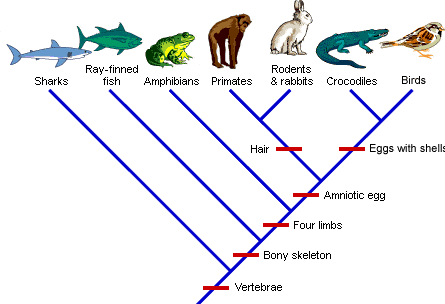
33.
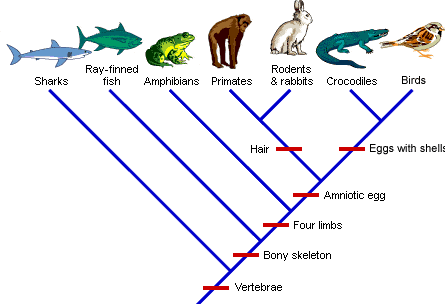
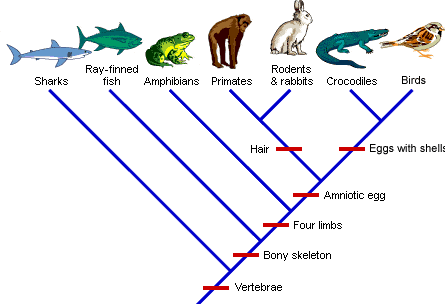
According to this cladogram, sharks are MOST closely related to which organism? 
a)
Amphibians
b)
Ray finned fish
c)
Crocodiles
d)
Birds
34.
Which two orgainsms have hair? 
a)
Sharks & Ray Finned Fish
b)
Primates & Rodents
c)
Birds & Crocodiles
d)
Rabbits & Birds
35.
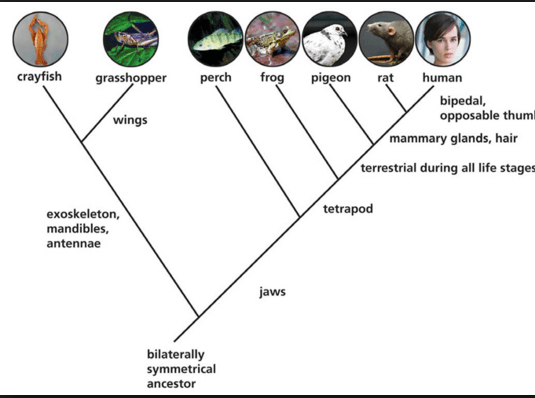
According to the cladogram, which organism is most distantly related to the human?
a)
crayfish
b)
grasshopper
c)
perch
d)
frog
36.
According to this cladogram, birds are LEAST related to: 
a)
Amphibians
b)
Sharks
c)
Ray Finned Fish
d)
Crocodiles
37.
This is an ecological relationship in which two or more organisms depend on the same limited resource.
a)
Adaptation
b)
Competition
c)
Evolution
d)
Natural selection
38.
Darwin wrote that organisms with traits that are best suited to the environment will ________________
a)
increase in number
b)
become extinct
39.
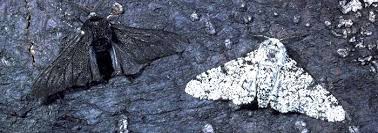
Predict which moth would increase in population
a)
light 
b)
dark