Wayground logo

Free Printable Worksheets

Font size

S
M
L
XL
Worksheets

2nd Midterm Exam PHYSICS

Total questions: 80

Worksheet time: 53mins

Name
Class
Date
1.

The highest part of a transverse wave is

a)

the crest

b)

the trough

c)

the wave point

d)

the hotel transylvania

2.

The lowest part of a transverse wave are the

a)

crests

b)

troughs

c)

wave points

d)

low nodules

3.

The distance between two corresponding parts of a wave is its

a)

amplitude

b)

frequency

c)

wavelength

d)

velocity

4.

The height of the wave from its resting point is called its

a)

wavelength

b)

amplitude

c)

velocity

d)

frequency

5.

A wave that needs a medium to travel is called a(n)

a)

electromagnetic wave

b)

mechanical wave

c)

ocean wave

d)

any way can do this

6.

A wave that can travel with or without a medium is called a(n)

a)

electromagnetic wave

b)

mechanical wave

c)

surface wave

d)

all waves can travel in any way

7.

Longitudinal waves have:

a)

crests and troughs

b)

crests and compressions

c)

compressions and rarefactions

d)

troughs and rarefactions

8.

Transverse waves have:

a)

crests and troughs

b)

troughs and rarefactions

c)

compressions and contractions

d)

rarefactions and crests

9.

How often a wave occurs is the wave's

a)

frequency

b)

amplitude

c)

wavelength

d)

velocity

10.

Transverse waves move mediums

a)

at a right angle

b)

in a circle

c)

and matter too

d)

at an acute angle

11.

Longitudinal waves move:

a)

at a right angle compared to the direction the wave is traveling

b)

in a circle compared to the direction the wave is traveling

c)

matter

d)

in the same direction as the wave is traveling

12.

Particles in water in an ocean wave move

a)

in a square

b)

in a right angle

c)

in a circle

d)

in a dodecahedron

13.

True or False: Amplitude can increase or decrease wavelength

a)

True, amplitude can increase or decrease wavelength

b)

False, frequency can increase or decrease wavelength

c)

False, crests can increase or decrease wavelength

14.

What is the amplitude of this wave?

a)

3

b)

-3

c)

6

d)

4

15.

What is the wavelength of this wave?

a)

3

b)

10

c)

4

d)

8

16.

What happens to the frequency of a wave when the amplitude is tripled?

a)

the frequency is tripled

b)

the frequency is a third of what it was

c)

amplitude does not affect frequency

17.

What would happen to the wavelength if the frequency was doubled?

a)

the wavelength would be halved

b)

the wavelength would be doubled

c)

the wavelength would stay the same

d)

frequency does not affect wavelength

18.
What part is the arrow pointing to?
a)
Crest
b)
Trough
c)
Amplitude
d)
Wavelength
19.
What part is the arrow pointing to?
a)
Crest
b)
Trough
c)
Amplitude
d)
Wavelength
20.
What part is represented by the blue lines?
a)
Crest
b)
Resting Point
c)
Wavelength
d)
Amplitude
21.
What is represented by the blue lines?
a)
Trough
b)
Crest
c)
Wavelength
d)
Amplitude
22.
What is represented by the letter 'x'?
a)
Crest
b)
Compression
c)
Rarefaction
d)
Wavelength
23.
What is represented by the  letter 'y'?
a)
Compression
b)
Rarefaction
c)
Wavelength
d)
Amplitude
24.
Distance from an 'x' to an 'x' is a________
a)
wavelength
b)
amplitude
c)
rarefaction
d)
compression
25.
Distance from 'y' to 'y' is a _______
a)
Wavelength
b)
Amplitude
c)
Compression
d)
Rarefaction
26.
Which wave has a higher frequency?
a)
A
b)
B
27.
Which wave has a longer wavelength?
a)
A
b)
B
28.
What type of wave is this?
a)
Transverse
b)
Longitudinal
29.
What type of wave is this?
a)
Transverse
b)
Longitudinal
30.
Which type of wave does light travel in?
a)
Transverse
b)
Longitudinal
31.
Which type of wave does sound travel in?
a)
Transverse
b)
Longitudinal
32.
What type of wave does an earthquake travel in?
a)
Seismic Waves
b)
Ocean Waves
c)
Big Waves
d)
Slow Waves
33.
What is the formula to calculate speed?
a)
S = t/d
b)
S = d/t
c)
S = d x t
d)
S = t x d
34.

A runner races in the 100 meter dash. It takes her 10 seconds to finish. What is her average speed?

a)

10 m/s

b)

1000 m/s

c)

100 seconds

d)

10 seconds

35.
Dave runs a 400 m race with a speed of 4 m/s. What time will it take him to finish the race?
a)
400 minutes
b)
100 minutes
c)
100 seconds 
d)
.25 seconds 
36.
Which of the following is a unit of time?
a)
sec
b)
mi
c)
m/s
d)
km
37.
Which of the following is a unit of speed ?
a)
sec
b)
mi
c)
m/s
d)
min
38.
Which of the following is a unit of distance ?
a)
miles/hr
b)
mi
c)
s
d)
min
39.
Which of the following is a unit of distance ?
a)
miles/hr
b)
hr
c)
km
d)
min
40.
Which of the following is a unit of time?
a)
km/hr
b)
hr
c)
km
d)
mi
41.
Which of the following is a unit of speed?
a)
km/hr
b)
hr
c)
km
d)
s
42.
A train travels 25 km in .5 hrs. How fast is the train going?
a)
25 miles/hr
b)
5 miles/hr
c)
125 km/hr
d)
50 km/hr
43.
What is speed?
a)
how far you go
b)
how much distance is covered over a period of time
c)
how fast you accelerate
d)
the change in the location of a object
44.
What is velocity?
a)
the quickness of an object
b)
the location of an object
c)
acceleration
d)
speed in a specific direction
45.
65 miles per hour North is an example of an objects what?
a)
Speed
b)
Velocity
c)
Average Speed
d)
Constant Speed
46.
Speed is different from velocity because
a)
Velocity has a direction
b)
Speed uses Distance /Time
c)
Velocity doesn't include time
d)
Velocity doesn't include distance
47.

What is motion?

a)

the stopping of an object to a frame of reference

b)

a change in position relative to a frame of reference

c)

the middle ground between light and shadow, between science and superstition, and it lies between the pit of man's fears and the summit of his knowledge

d)

a change in the time in which it takes to get an office referral

48.
Total distance divided by total time is
a)
average speed
b)
constant speed
c)
instantaneous speed
d)
acceleration
49.
Sound moves in a _________.
a)
Transverse wave
b)
Longitudinal wave
50.
How is sound produced?
a)
By the vibration of particles
b)
By the transfer of particles 
51.
The reflection of sound waves off of a hard surface can create ______.
a)
A wave
b)
An echo 
52.
Soft surfaces _______ sound waves. 
a)
Reflect
b)
Absorb
53.
________ describes how LOUD a sound is. 
a)
Amplitude
b)
Frequency 
54.
____________ is determined by sound wave's frequency. 
a)
Compression
b)
Pitch 
55.
Sound waves travel farther through ________ media, like water or steel. 
a)
Dense 
b)
Light
56.
What happens when you increase the amplitude of a sound?
a)
it makes the sound louder
b)
it makes the sound travel faster
c)
it increases the wavelength of the sound
d)
it increases the frequency of the sound
57.

In which medium sound can't travel?

a)

solid

b)

liquid

c)

gas

d)

vacuum

58.

In which medium speed of sound are fastest?

a)

vacuum

b)

solid

c)

liquid

d)

gas

59.

What is ultrasound?

a)

Sound with a frequency higher than 20.000 Hz

b)

Sound with a frequency lower than 20 Hz

c)

Sound with a frequency 20 Hz

d)

sound with a frequency 20.000 Hz

60.
__________________________ is the back-and-forth motion of an object.
a)
vibration
b)
sound wave
c)
frequency
d)
amplitude
61.
How are sound and light similar?
a)
Both are forms of energy.
b)
Sound and light waves can curve around solid objects.
c)
Both can be transformed into heat energy.
d)
Sound and light are made up of vibrations.
62.
What is light?
a)
Is all around us, and we need it to see.
b)
Is a force that we need.
63.
Light is a KIND of ENERGY.
a)
True
b)
False
64.
Which are the two type of light sources?
a)
Artificial and Natural
b)
Natural and Invented
c)
Artificial and Not Artificial
d)
All of them
65.
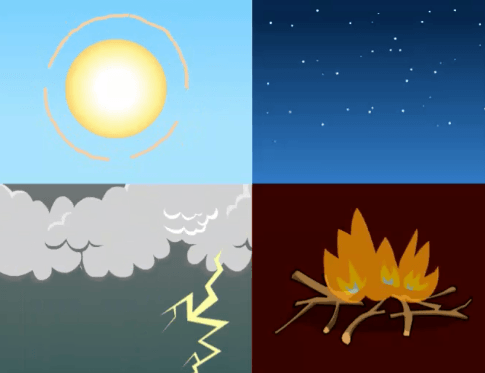
Which of these are examples of NATURAL sources of light?
a)
Sun 
b)
Stars
c)
Lightning
d)
ALL of them
66.
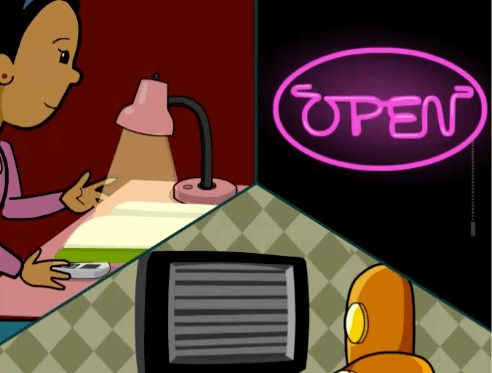
Which of these are examples of ARTIFICIAL sources of light?
a)
Lightbulbs
b)
Neon signs
c)
Televisions
d)
ALL of them
67.
What does ARTIFICIAL mean?
a)
Made by humans
b)
Natural
68.
Which of these is our MAIN (most important) source of light?
a)
Lightbulbs
b)
The Sun
c)
Fire
d)
All of them
69.
_______ is when light hits and object and it BOUNCES off.
a)
Reflection
b)
Refraction
70.
When light passes through things it ________. 
a)
BENDS
b)
STAYS in the SAME direction.
71.
___________ is when light BENDS or CHANGES direction.
a)
Reflection
b)
Refraction
72.
Light is a kind of.....
a)
reflection
b)
energy
c)
heat
d)
matter
73.
Light travels
a)
around corners
b)
in a straight line
74.

Which travels faster?

a)

sound

b)

light

c)

water

75.
The three primary colors of light are
a)
Red, Blue, Yellow
b)
Pink, Green, Blue
c)
Violet, Green, Red
d)
Blue, Green, Red
76.
Which color reflects the least light?
a)
Black
b)
White 
c)
Blue
d)
Red
77.
Sunlight is
a)
not light at all
b)
red light
c)
yellow light
d)
white light
78.
Light enters this part of the eye first.
a)
Retina
b)
Cornea
c)
Lens
d)
Cones
79.
Objects that reflect ALL colors will appear _____?
a)
Black
b)
White
c)
Gray
d)
Multi-colored
80.
Objects that ABSORB all colors of light will appear _______.
a)
white
b)
black
c)
multi-colored
d)
gray