
 Worksheets
Environmental Final Exam
Total questions: 40
Worksheet time: 21mins

________________ are consumers that eat ONLY PLANTS.
Herbivores
Carnivores
Omnivores
Producers

__________________ are consumers that eat ONLY MEAT (other animals)?
Omnivores
Carnivores
Producers
Herbivores

__________________ are consumers that eat BOTH Plants and Animals for food.
Omnivores
Producers
Herbivores
Carnivores
The study of how things interact with each other and with their environment is called __________
Ecology
Biosphere
Abiotic
Biotic
Grass is eaten by a prairie dog. The prairie dog is eaten by a coyote. This is an example of __________.
Food chain
A herbivore
an abiotic element
an omnivore
Vultures and hyenas, which feed on the remains of dead organisms, are considered…
Scavengers
Decomposers
Herbivore
Carnivores

What would likely happen if the mice population in the diagram above disappeared from the ecosystem?
The hawks would increase in population because they would eat more snakes
The grasshoppers would decrease in population because they would be eaten by the snakes
The grasshoppers would increase in population because they no longer are being preyed upon
The grass would increase in population because the grasshoppers would eat more
What do you call the first plants that inhabit a newly formed island?
pioneer species
colonial plants
protoplants
primevera
The five levels of organization in the environment, from the first to the fifth level are
Organism, population, biosphere, ecosystem, community
Organism, population, biotic elements, abiotic elements, community
Organism, population, community, ecosystem, biosphere
Organism, population, biosphere, abiotic elements, ecology
If an eagle eats a mouse that eats some berries, the eagle is a….
Producer
First level/primary consumer
Secondary consumer
Decomposer
A recently burned forest erupts in new growth, sprouting grasses and seedlings. What type of succession is this?
Primary
Secondary
Unnecessary
Incendiary
Which of the following is an example of a population?
The cats and dogs in your neighborhood
The park at the heart of your neighborhood
The rocks in your rock collection
The gray wolves in a forest
The smallest unit of ecological organization is….
organism
population
community
bioshphere
When a parasitic tapeworm gets inside a dog’s intestine to obtain food, who is the host?
the worm
the dog
the producer
the decomposer
What word best describes the mammals, fish, birds and plants, as well as the sun, soil, air and water in an environment?
Abiotic
Community
Biosphere
Ecosystem
What trophic level eats the secondary consumer?
Producer
Primary consumer
Tertiary consumer
The sun
Energy that can be replenished at the same rate as it is used
Natural Gas
Alternative Energy
Renewable Energy
Nonrenewable Energy
Energy that cannot be replaced in our lifetime
Nonrenewable Energy
Renewable Energy
Geothermal
Alternative Energy

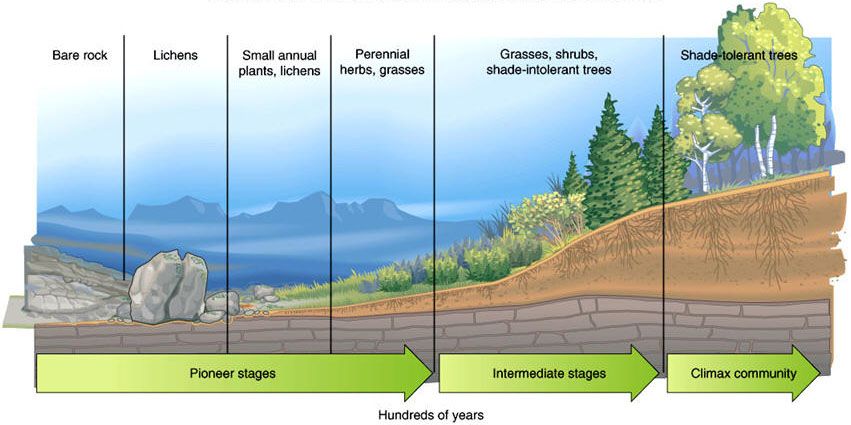
The picture shows what type of succession?
primary
secondary
tertiary
quadanary
What do we call the variety of life in an ecosystem?
Producer
Biology
Biodiversity
Keystone Species
What is an organism that uses energy from the Sun during photosynthesis?
Predator
Prey
Producer
Keystone Species
What is the relationship between a keystone species and its ecosystem
A keystone species is always the top predator in an ecosystem.
A keystone species is essential to maintain balance and biodiversity in its ecosystem.
A keystone species provides energy to all other organisms in the ecosystem.

This graph shows the growth of a population. Which of the following correctly describes the growth curve?
Logistic
Demographic
Limiting
Exponential

What is happening to the population of Daphnia in the graph at the arrow?
growing quickly
reached carrying capacity
growth has stopped
growth is beginning to slow down
A limiting factor is?
something that speeds up the growth of a population.
something that slows down or stops the growth of a population.
something that causes animals to die.
something that creates more resources fr a population.
Density independent (DI) limiting factors are things that impact every population the same , regardless of size. Which of the following is NOT a density independent limiting factor?
Competition
higher than normal temperature
A hurricane
drought

If there is 1000 Kcal available in the producers in trophic level 1, how much energy is available in the herbivores in trophic level 2?
10Kcal
1Kcal
100Kcal
1000Kcal

Which level has the fewest organisms?
Tertiary
Secondary
Primary
Quaternary

In the energy pyramid here, which organisms have the most energy available?
Producers
Carnivores
Herbivores
Top Predators

What would happen to the bird if the green fish died out?
The bird population would grow
The smaller fish will die out
The bird population will die out
What is the main cause of climate change?
Natural climate cycles have no human influence
Increase of greenhouse gases
Increase of oxygen levels
Decrease of greenhouse gases
What is the term for the variety of life on Earth?
ecosystem
environment
biodiversity
species

In Stage 1, the birth rate is...
High
Falling
Low

