
 Worksheets
Taxonomy
Total questions: 40
Worksheet time: 39mins
Name
Class
Date
1.
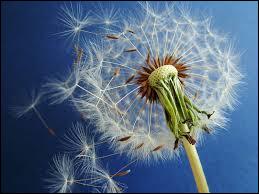
Dandelion, What kingdom does it belongs to?
a)
Plant Kingdom
b)
Animal Kingdom
c)
Fungi Kingdom
d)
Protista Kingdom
2.
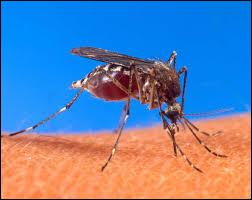
Mosquito belongs to what kingdom?
a)
Animal Kingdom
b)
Plant Kingdom
c)
Fungi Kingdom
d)
Protista Kingdom
3.
Plants are heterotrophs.
a)
True
b)
False
4.
A scientific name consists of
a)
Genus and Order
b)
Genus and Domain
c)
Genus and species
d)
Kingdon and Phylum
5.
The most specific of the classifications is?
a)
class
b)
order
c)
genus
d)
species
6.
The most general in the order of classification is?
a)
Kingdom
b)
Phylum
c)
Class
d)
Order
7.
Which term means "True Nucleus" or cell(s) with a nucleus?
a)
Eukaryotes
b)
Prokaryotes
c)
Multi-cellular
8.
The 2 kingdoms that make up Prokaryotes are?
a)
Animals and Plants
b)
Protists and Fungi
c)
Archea and Bacteria
9.
What kingdom's organisms often live in super harsh environments?
a)
archea
b)
animalia
c)
plantae
d)
protista
10.
Mushrooms are an example of this Kingdom?
a)
Animalia
b)
Protista
c)
Archea
d)
Fungi
11.
Kingdom, Phylum, Class, _______
a)
Family
b)
Order
c)
Genus
d)
Species
12.
Which of the following organisms are LEAST closely related?
a)
organisms that share a domain
b)
organisms that share a family
c)
organisms that share a genus
d)
organisms that share a species
13.
The 8 levels of classification, most broad to most specific.
a)
Domain, Genus, Family, Order, Class, Phylum, Kingdom, Species
b)
Domain, Species, Kingdom, Genus, Phylum, Family, Class, Order
c)
Domain, Kingdom, Phylum, Class, Order, Family, Genus, Species
d)
Order, Kingdom, Species, Domain, Phylum, Family, Class, Genus
14.
Which organisms are most closely related?
a)
Equus caballas (Horse) & Equus burchellii (Zebra)
b)
Cyanea artica (Jellyfish) &
Ctenodiscus crispatus (Mud Starfish)
Ctenodiscus crispatus (Mud Starfish)
c)
Naja naja (cobra) & Glycine max (soya bean)
d)
Ophiocomina nigra (black brittle star) & Brassica nigra (black mustard)
15.
The science of describing, classifying, and naming living things is called:
a)
Geology
b)
Biology
c)
Taxonomy
d)
Chemistry
16.
Why do scientists use scientific names?
a)
to confuse people
b)
to have a common language
c)
to allow people to say the same thing
d)
because common names are not appropriate
17.
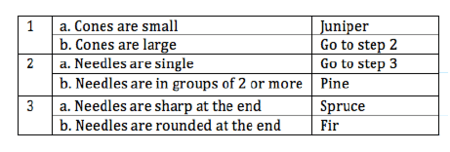
A dichotomous key for trees is provided. Hikers found a tree that has large brown cones and single sharp needles. What species of tree have the hikers found?
a)
Juniper
b)
Pine
c)
Spruce
d)
Fir
18.
A tool used by a taxonomist to identify an unknown organism is known as a __________.
a)
dichotomous key
b)
binomial nomenclature
c)
scientific name
d)
binomial key
19.
The science of classifying and naming organisms is ______________.
a)
evolution
b)
taxonomy
c)
grouping
d)
scientific names
20.
The taxon with the largest amount of organisms grouped together...
a)
Species
b)
Phylum
c)
Kingdom
d)
Domain
21.
Which of the following is not true when comparing scientific and common names?
a)
Scientific names vary from place to place.
b)
Common names can vary from place to place.
c)
Scientific names are written in Latin.
d)
Common names can inaccurately describe the organism and be confusing.
22.
Smallest taxonomic group with many similar characteristics...
a)
domain
b)
kingdom
c)
species
d)
class
23.

Which organisms pictured on the cladogram have hair?
a)
prosimians only
b)
prosimians and humans
c)
humans only
d)
prosimians and birds
24.

Which group(s) of organisms do not have vertebrae?
a)
lampreys and lancelets
b)
lampreys and tuna
c)
lancelets only
d)
salamanders, tuna, and lampreys
25.

I have tissues and I am autotrophic, what kingdom do I belong to?
a)
Monera
b)
Protoctista
c)
Plants
d)
Animals
26.

A cell with nucleus is
a)
Autotrophic
b)
Prokaryotic
c)
Eukaryotic
d)
Heterotrophic
27.

Kingdom with the following characteristics: eukaryotic cells, unicellular or multicellular, autotrophic or heterotrophic
a)
Fungi
b)
Monera
c)
Protoctista
d)
Plant
28.

Nutrition that consists of obtaining organic nutrients from other living being
a)
Autotrophic
b)
Photosynthesis
c)
Interaction
d)
Heterotrophic
29.

Unicellular fungi used to make bread
a)
Yeast
b)
Mushroom
c)
Flour
d)
Mould
30.

Type of nutrition that produces its own organic matter
a)
Food
b)
Autotrophic
c)
Heterotrofic
d)
carnivorous
31.

Autotrophic Protists that usually lives in the sea
a)
Protozoa
b)
Fish
c)
Shark
d)
Algae
32.

Kingdom with the following characteristics: eukaryotic cells, with tissues and autotrophic
a)
Protoctista
b)
Fungi
c)
Monera
d)
Plant
33.

Type of cell with no nucleus
a)
Chloroplast
b)
Bacteria
c)
Eukaryotic
d)
Prokariotic
34.

Type of multicellular fungi
a)
Plant
b)
Mushroom
c)
Yeast
d)
Moss
35.

Kingdom with the following characteristics: eukaryotic cells, unicellular or multicellular and heterotrophic
a)
Protoctista
b)
Fungi
c)
Animal
d)
Plant
36.

Kingdom with the following characteristics: eukaryotic cells, multicellular tissues, and heterotrophic
a)
Fungi
b)
Animal
c)
Protoctista
d)
Monera
37.
Unicellular means...
a)
An organism is made of many cells
b)
An organism is made of one cell
c)
An organism is made of no cells
38.
Multicellular means...
a)
an organism is made of many cells
b)
An organism is made of only one cell
c)
An organism is made of no cells
39.
Heterotroph is when an organism...
a)
Has to eat other things
b)
has to make it's own food
40.
Autotroph is when..
a)
An organism makes it's own food
b)
An organism has to eat other things
100 %

