
 Worksheets
Rate of reactions
Total questions: 20
Worksheet time: 27mins
The following equation shows the reaction between calcium carbonate, CaCO3 and hydrochloric acid, HCl:
CaCO3(aq) + 2HCl(aq) → CaCl2(aq) + CO2 (g) + H2O(l)
Which of the following is the suitable method to determine the rate of reaction?
Change in the temperature of the solution with time
Change in the volume of carbon dioxide gas with time
Change in the mass of water with time
Change in the concentration of hydrochloric acid with time

Diagram 7 shows a graph of the volume of gas produced against time for the reaction between zinc granules and hydrochloric acid.
The gradient of the graph decreases with time because
catalyst is not used
volume of mixture decreases
temperature of reaction decreases
concentration of hydrochloric acid decreases

Diagram 12 shows an energy profile diagram. Ea is the activation energy for the decomposition of hydrogen peroxide.
P
Which of the following is the activation energy for the dissociation of hydrogen peroxide when manganese(IV) oxide is added?
P
Q
R
S
Which of the following explains the meaning of effective collision?
The collision where its energy is less than the activation energy
The collision that has a low energy
The collision which takes place before a reaction
The collision that causes a reaction
Which of the following is the meaning of activation energy?
The maximum energy that the particles need to produce effective collision
The amount of energy used by the particles during a collision
The minimum amount of energy that particles must have in order to react
The amount of kinetic energy of molecules during a collision
Smaller particle size allows for a _________ surface area to be exposed for the reaction.
larger
smaller
rectangular
spherical
Which unit is correct for the rate of reaction?
g mol-1
g min-1
mol dm-3
kJ mol-1
The following equation represents a chemical equation.
CaCO3 + 2HCl --> CaCl2 + CO2 + H2O
Which graph shows the correct change in mass of reactant used in excess against time?
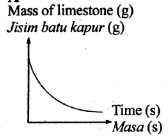
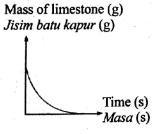
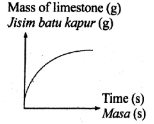
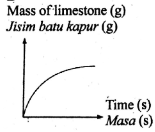
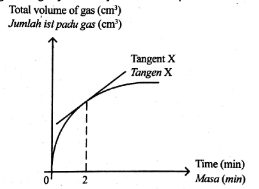
Diagram shows a graph to study the effect of total surface area on the rate of reaction.
What is represented by gradient tangent X?
Average rate of reaction in the first 2 minutes
Average rate of reaction in the 2nd minute
Overall average rate of reaction
Rate of reaction at the 2nd minute
Which of the following would react fastest in sweet tea?
a sugar cube
a sugar cube cut in half
a sugar cube cut in fourths
a sugar cube crushed into powder
Enzymes in your body act as catalysts. Thus, the role of enzymes is to___________.
inhibit chemical reactions.
increase the rate of chemical reactions.
decrease the rate of chemical reactions.
In the ice cream lab, what events support an endothermic reaction? Click all that apply.
Ice water temperature increasing
Ice water temperature decreasing
Frost on the outside of the container
Creamer turning into ice cream
For second order reaction, the initial concentration of reactant A is 0.24 M. If the rate constant is 8.1 x 10⁻² M-1 s-1, what is the concentration of A after 29 seconds?
0.02 M
0.15 M
0.30 M
0.45 M
Given the following balanced equation :
2NO(g) + Cl2(g) → 2NOCl(g)
If the rate of disappearance of Cl2 is 4.84 x 10⁻² Ms-1, what is the rate of disappearance of NO?
1.45 x 10⁻² Ms-1
2.42 x 10⁻² Ms-1
3.67 x 10⁻² Ms-1
9.68 x 10⁻² Ms-1
The reaction A + 2B → products was found to have the rate law, k = k[A][B]2. Predict by what factor the rate of reaction will increase when the concentration of B is doubled and the concentration of A remained uncanged
2
4
6
8
The overall order for the reaction,
2A + B → C
is one and with respect to B the order is zero. Which of the following statements is true?
The rate law of the reaction is rate =k[A]2[B]
The formation of C is double the appearance of A
The rate of reaction would increase with increasing concentration B
The half-life of the reaction is independent on the concentration of the reactants
The first order rate constant for the decomposition of 0.5 M compound A at 100oC is 0.03 min-1. Calculate the half-life of A.
1.5 min
8.3 min
23.1 min
66.7 min
The rate constant for a second order reaction at 30oC is 2.0 x 10⁻⁶ M-1s-1. The activation energy for this is 108 kJ mol-1. By using Arrhenius equation, determine the collision frequency factor, A for the reaction.
5.0 x 10¹²
6.0 x 10¹²
8.0 x 10¹²
1.0 x 10¹³

