Wayground logo

Free Printable Worksheets

Font size

S
M
L
XL
Worksheets

FIBER OPTICS

Total questions: 47

Worksheet time: 21mins

Name
Class
Date
1.
How do Fiber Optics work?
a)
By connecting and transferring energy
b)
By remitting and subtracting power from other fiber optics
c)
By using light pulses to transfer data
d)
By converting sound waves in to binary code
2.
For what are Fiber Optics mainly used?
a)
Long distance communication
b)
Imaging
c)
Phones
d)
Downloading Apps
3.
How does light travel through the cable?
a)
Refraction and Reflection
b)
Refraction only
c)
Dispersion
d)
Total Internal Reflection
4.

What are the types of optical fiber?

a)

Material

b)

Number of modes

c)

Refractive index profile

d)

All the above

5.

A light wave acting as a carrier wave is capable of carrying

a)

less information

b)

more information

c)

medium information

d)

No information

6.

Single mode fiber is

a)

one mode

b)

two mode

c)

more than one mode

d)

none

7.

Step index multi mode fiber has

a)

core diameter has 50 to 200 µm

b)

core diameter has 100 to 200 µm

c)

core diameter has 50 to 100 µm

d)

core diameter has 50 to 150 µm

8.

Fiber optics uses what medium to send information?

a)

Electrons

b)

Phonons

c)

Light

d)

None of these are correct

9.

What are the four parts of a fiber optic data link?

a)

Transmitter, optical fiber, connectors/splices, receiver

b)

Transmitter, optical fiber, data, optical connectors

c)

Optical fiber, data, optical connectors, receiver

d)

Optical fiber, optical connectors, optical splices, data

10.

The fiber optic transmitter has which of the following functions?

a)

Amplifies the optical signal

b)

Converts the electrical input signal to an optical signal

c)

Converts the input optical signal to an electrical signal

d)

Amplifies the output electrical signal

11.

What transmitter uses stimulated emission?

a)

LED

b)

LASER

c)

VCSEL

d)

APD

12.

A Laser differs from ordinary light in three distinct ways. Its coherent, directional and monochromatic.

a)

True

b)

False

13.

The basic structure of an optical fiber consists of which three parts?

a)

Core

b)

Ground

c)

Cladding

d)

Buffer

14.
What are the two general types of fiber optic cable found in current networking environments?
a)
Red and Green
b)
Singlemode and Multimode
c)
High-frequency and Low-frequency
d)
Narrowband and Wideband
15.
True or False: All fiber optic cables have the same type of physical connector?
a)
True
b)
False
16.
What are Fiber Optics?
a)
Thin, flexible fibers of glass
b)
Flexible fibers of glass
c)
Thin fibers of glass
d)
Those glow toys
17.
What is the most prominent use of Fiber Optics today?
a)
Phones
b)
Television Screens
c)
The Internet
d)
MRI imaging
18.
For what are Fiber Optics mainly used?
a)
Long distance communication
b)
Imaging
c)
Phones
d)
Downloading Apps
19.
How do Fiber Optics work?
a)
By connecting and transferring energy
b)
By remitting and subtracting power from other fiber optics
c)
By using light pulses to transfer data
d)
By converting sound waves in to binary code
20.
Are fiber optics used for long or short distance calls?
a)
Long Distance
b)
Both
c)
Short Distance
21.
How does light travel through the cable?
a)
Refraction and Reflection
b)
Refraction only
c)
Dispersion
d)
Total Internal Reflection
22.
How does light travel through the cable?
a)
Refraction and Reflection
b)
Refraction only
c)
Dispersion
d)
Total Internal Reflection
23.
The ray of light that strikes a reflecting surface is called ________.
a)
incident ray
b)
reflected ray
c)
normal ray
d)
none of the above
24.
The angle produced as a source of light bounces off a reflecting surface is called ______.
a)
angle of crookedness
b)
angle of reflection
c)
angle of incidence
d)
angle of bounce
25.
If the angle of incidence is 45 degree, what is the angle between the incident ray and reflecting surface
a)
45
b)
90
c)
180
d)
none of the above
26.
What does incidence angle equal?
a)
reflection angle
b)
∠C
c)
∠D
d)
all of these
27.
Law of reflection state that - The angle of incidence is .................. to the angle of reflection.
a)
equal
b)
double
c)
half
28.
According to the Law of reflection, a light ray striking a mirror
a)
continues moving through the mirror in the same direction
b)
moves into the mirror at a slightly different angle
c)
bounces off the mirror toward the direction it came from
d)
bounces off the mirror at the same angle it hits.
29.
This shows the phenomenon known as....
a)
reflection
b)
refraction
c)
mirrors
d)
focal point
30.
How does light behave as it enters these mediums?
a)
continue its path as straight line.
b)
bends toward the normal
c)
bends away from the normal
d)
reflects
31.

Fiber optic cables work because of the principle of _____.

a)

total internal refraction

b)

incomplete internal refraction

c)

total internal reflection

d)

partial internal reflection

32.

_____ cables transmit beams of light without allowing any of the light to escape until it gets to the end of the cable.

a)

Ethernet

b)

Fiber optic

c)

Armored

d)

Coaxial

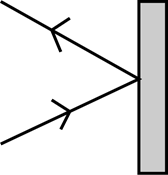
33.
The illustration shows a light ray striking an object.
In the illustration, the light ray striking the object is-
a)
absorbed
b)
stopped
c)
reflected
d)
refracted
34.
A student placed a pencil in a cup of water.  The pencil appears broken because light-
a)
always travels in a straight line
b)
bends when it passes through water
c)
makes the water in the glass evaporate
d)
reflects the pencil on the water's surface
35.
The bouncing off of light rays from the surface of an object such as a mirror or other shiny surface is called:
a)
mirror
b)
laser
c)
reflection
d)
refraction
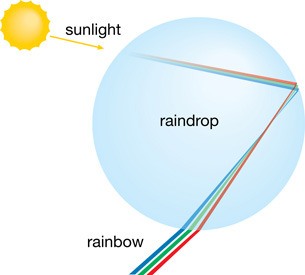
36.
Light bending as it passes through a rain drop is an example of...
a)
Refraction
b)
Reflection
37.
According to the Law of reflection, a light ray striking a mirror
a)
continues moving through the mirror in the same direction
b)
moves into the mirror at a slightly different angle
c)
bounces off the mirror toward the direction it came from
d)
bounces off the mirror at the same angle it hits.
38.

Optical fibers also make it possible for a __________ to get hundreds of channels.

a)

microwave

b)

television

c)

alarm clock

d)

pet

39.

Fiber optics uses what medium to send information?

a)

Electrons

b)

Phonons

c)

Light

d)

None of these are correct

40.

The fiber optic receiver performs which of the following functions?

a)

Amplifies the optical signal

b)

Amplifies the electrical signal

c)

Converts the electrical signal back into an optical signal

d)

Converts the optical signal back into an electrical signal

41.
For what are Fiber Optics mainly used?
a)
Long distance communication
b)
Imaging
c)
Phones
d)
Downloading Apps
42.
Are fiber optics used for long or short distance calls?
a)
Long Distance
b)
Both
c)
Short Distance
43.
How does light travel through the cable?
a)
Refraction and Reflection
b)
Refraction only
c)
Dispersion
d)
Total Internal Reflection
44.

Which of the following statement is correct?

a)

Refractive index of core and cladding are equal.

b)

Refractive index of core is more then that of cladding.

c)

Refractive index of core is less then that of cladding.

d)

Refractive index of core is less or equal to that of cladding.

45.

Which of the following is ( are) correct?

a)

The refractive index of the core of the step index fiber is constant throughout the core.

b)

The refractive index of the graded index fibre is maximum at the centre of the core and then it decreases towards core-cladding interface.

c)

The bandwidth in fibre optical communication is very high as against in case of coaxial cable transmission.

d)

All the above

46.

Which part is not included in the fiber-optic communication system?

a)

Transmitter

b)

Transmission channel

c)

Transformer

d)

Receiver

47.

The function of cladding is

a)

to produce refraction of rays.

b)

to produce total internal reflections of rays.

c)

to produce transmission of Ray's.

d)

to provide a firm support to the core glass.