
 Worksheets
AEC214 for BSCpE-2A
Total questions: 95
Worksheet time: 3hrs 43mins
Linear property is the combination of both the _________ and __________.
homogeneity property
additivity property
excitation property
response property
proportionality property
Analysis that provide general procedure for analyzing circuits using node voltages as the circuit variable is _______.
Nodal analysis
Mesh Analysis
Loop Analysis
KCL
KVL
In Wye to Delta Transformation, the Y–connection is like a “series connection” while the Δ–connection is like a
“parallel connection”.
True
False
In nodal analysis, we are interested in finding the ______ in the circuit.
currents
voltages
resistances
capacitance
inductance
Which of the following is an example of three-terminal equivalent network?
Delta
Omega
Zeta
Sigma
Ground that used when enclosure acts as reference point for all circuits is ______.
chasis ground
electric ground
basis ground
ground
capacitor ground
When do we used three-terminal equivalent network in circuit simplification?
when the resistors are neither in parallel nor in series
when the resistors are either in parallel or in series
when the resistors are in parallel
when the resistors are in series
To solve matrix equation, we can use ______.
Ohm's Law
Cramer's Rule
Newton Law
Joule's Law
Kirchoff's Law
The superposition principle applies to power calculation.
True
False
For superposition, it is not required that only one independent source be considered at a time; any number of independent sources may be considered simultaneously.
True
False
What tools that can be used to determine mesh analysis equation?
KCL
KVL
Ohm's law
Cramer's Rule
Newton Law
To obtain node voltages from matrix, we can use standard method such as _______
subtitution
elimination
cramer
matrix inversion
Gauss method
The reference node is commonly called as __________.
the ground
the mesh
the current
the resistance
the voltage
The step in mesh analysis application is ______.
Apply KVL to each meshes in the circuit
Assign voltages to the meshes
Apply Kirchhoff's Voltage Law to the non-reference nodes
Select mesh reference node
Apply KCL to each meshes
The current flows from higher potential to ________.
lower potential in resistor
medium potential in resistor
maximum potential in resistor
positive potential in resistor
A supermesh is formed by _______.
enclosing a voltage source connected between two non-reference and any elements connected parallel with it.
enclosing a current source connected between two meshes and any elements connected series with it.
enclosing a voltage source connected between two reference and any elements connected series with it.
enclosing a current source connected between two non-reference nodes and any elements connected parallel with it
If there are 6 nodes in a circuit network, we can get ____ number of equations in applying the nodal analysis.
9
8
7
6
5
In analyzing node, how many nodes are taken as the reference node?
2
1
5
3
6
The following are the properties of a supernode, except ______.
Supernode has no voltage of its own
Supernode requires the application of KCL and KVL
The voltage source provides a constraint equation
Requires only KCL to analyze
Requires only KVL to analyze
When do we apply both KCL and KVL to determine the node voltages?
When the voltage source is connected between two non-reference nodes
When the voltage source is connected between the reference and non-reference nodes
When the voltage source is connected between two reference nodes
When the voltage source is connected to multiple reference nodes
The total current entering the closed surface is ______ to the total current leaving the surface.
Equal
Less
Greater
Not Equal
What basic law is the underlying principle of Mesh Analysis?
KCL
KVL
HCL
HVL
KBL
Based on KCL, currents will be regarded as positive while _______.
Currents leave the node
Currents enter and leave the node
Currents in between the node
Currents enter the node
Currents beside the node
Kirchhoff's Voltage Law (KVL) states that ______.
the algebraic sum of the potential differences in any loop must be equal to zero
the algebraic sum of the potential differences in any loop must be equal to 1
the amount of algebraic electromotive force (є) with a voltage drop (I.R) is zero.
the algebraic sum of the potential differences in any loop must be equal to infinity
the amount of algebraic electromotive force (є) with a voltage drop (I.R) is one.
What are the basic laws we can use in Nodal Analysis?
Joules Law
KVL
KCL
General Circuit Law
Ohm's Law
The connecting point of two or more circuit elements is called a _______.
Mesh
Node
Cable
Supernode
Supermesh
What does the Kirchhoff's Current Law (KCL) states?
In a open circuit, the amount of algebraic electromotive force (є) with a voltage drop (I.R) is one.
In a closed circuit, the amount of algebraic electromotive force (є) with a voltage drop (I.R) is one.
The total current entering through a branching point in an electrical circuit is equal to the total current coming out of the branching point.
The total current entering through a branching point in an electrical circuit is equal to one
In a closed circuit, the amount of algebraic electromotive force (є) with a voltage drop (I.R) is infinite.
Application of KCL is combining current source in parallel. The combined current is __________.
the algebraic sum of the current supplied by the individual sources
the algebraic sum of the current supplied by the individual nodes
the algebraic sum of the current supplied by the individual voltages
the algebraic sum of the current supplied by the individual resistors
the algebraic sum of the current supplied by the individual mesh
What is the advantages of using Nodal analysis?
It reduces the number of equations that must be solved
It needs three steps to complete
it can only be solved manually
it must be solved with a computer programs
In applying KCL, what must we do next after we have determine the non-reference nodes?
Assign voltage designations to non-reference nodes
Apply KCL
Solve equations
Select the reference node
"The algebraic sum of all the voltages around any closed loop in a circuit is equal to zero". This statement can be mathematically written as _________.
ΣI+ΣR = 0
ΣR = 0
ΣI.R = 0
ΣI = 0
"The total current entering through a branching point in an electrical circuit is equal to the total current coming out of the branching point". This statement can be mathematically written as ________.
Σ I(IN) = Σ I(OUT)
Σ I(IN) - Σ I(OUT)=0
Σ I(IN) + Σ I(OUT)=0
Σ I(IN) . Σ I(OUT)=0
Σ I(IN)/Σ I(OUT)=0
When is the right time to use Nodal analysis?
When there is circuits with parallel connected elements
When there is dependent current sources
When there is supermesh
When there is circuits with series connected elements
When there is resistors
Based on KCL, _____________ will be regarded as negative or vice versa.
Currents entering the node
Currents leaving the node
Currents that broke the node
current sources is out of energy
A supernode is formed by enclosing a ______ source connected between two non-reference nodes and any elements connected in _______ with it.
voltage, parallel
current, series
voltage, series
current, parallel
How many statements do we have in Kirchhoff's Laws?
5
3
4
2
1

What equation can we get for i1 and i2 in the node A using KCL?
i1+2=i2
i2-i1=0
i1+i2=2
i1+i2=0
i1=i2-2

Find V2 in the circuit using loop analysis.
V2=1.5 V
V2=1.6V
V2=2 V
V2=1.7V
V2=3V

By applying KVL in loop 1, what equation can we get?
5i1+v=20
5i1+20=v
5i1-v=0
v-5i1=20
v+20=4i1

By applying KVL in loop 2, what equation can we get?
5i2=20
v=5i2
5i2=0
5i2=i1
4i2=v

Applying KCL in the node V2, what equation can we get?
i3+3+6=i4
i3+3+6=0
i3+3=i4+6
9=i4+i3
i3=9+i4

According to KCL, the equation at node V1 is ________.
i1+i2+i3+6=0
i1+i2+i3=0
i1+6=i2+i3
i1+i2+i3=6
i1-6=i2-i3

Using KCL at the node V1, what equation can we get?
i2+i1=i3
i1+i3=i2
i1=i2+i3
i1=i2-i3+1
i1+i2+i3=0

What is the following symbol represent?
Motor
Mouse
Ground
Fuse

What is the following symbol represent?
Battery
Fuse
Switch (closed)
Switch (open)

What is the following symbol represent?
Switch (Closed)
Switch (Open)
Bulb
Chassis Ground

What is the following symbol represent?
Buzzer
Switch (Open)
Diode
Horn

A continuous flow of electricity is called_____________.
series
circuit
static
current
The circuit is _________ when incomplete or broken.
closed
series
bad
open

What is the following symbol represent?
light bulb
switch
battery
resistor
A device for opening or closing the flow in a circuit is _______.
an insulator
a battery charger
a switch
a resistor

This symbol represents a _______.
LED
LDR
Lamp
Loudspeaker

What is the following symbol represent?
Wire
Light
Battery
Switch

Will the light bulb in this circuit light? Why or why not?
yes, because it has two batteries
no, because the switch is open
yes, because it is in a circuit
no, because the bulb is burned out
Electric current is the flow of ______.
electrons
protons
neutrons
atoms

What is the following symbol represent?
Wire
Battery
Buzzer
Fuse

What is the following symbol represent?
Wire
Resistor
Battery
Switch
What is the function of a switch in a circuit?
to make the current hotter or colder
turn on and off the flow of current
the pathway that current flows
to add more power to the circuit
The _______ is needed in a circuit to start the electrons moving.
light
power source
switch
wire


Based on the given figure, which of the following is the correct sentence?
This circuit will work because it is a closed circuit.
Energy will freely flow in this circuit.
This circuit will not work because there is no energy source.
This circuit will not work because there is no switch.

In this figure, what will happen if you replace the paper clip with a plastic spoon?
The bulb doesn't light
The bulb is dimmer
The wires get hot
There is no change
An object through which electrons can easily flow is called a ___________.
conductor
insulator

Which statement is true based on this figure?
The light bulb will light up because the circuit is complete.
The light bulb will light up because the circuit is broken.
The light bulb will not light up because the circuit is complete.
The light bulb will not light up because the circuit is broken.

Electricity is the flow of _________.
protons
neutrons
electrons
atoms
What will happen if I add more light bulbs to a series circuit?
The current speeds up and the lights get brighter
The current slows down and the lights dim lower
The current speeds up and the lights dim lower
The current slows down and the lights get brighter
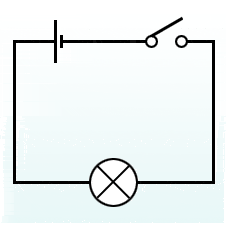
This circuit is _________.
open
parallel
closed
continuous

An incomplete circuit is shown.
To complete the circuit, a wire should be placed from _______.
Point D to Point C
Point B to Point C
Point A to Point D
Point B to Point D

This circuit has a battery, buzzer, and switch.
When the switch is closed the buzzer will sound because _________.
the switch gives energy to the battery
the buzzer is made of special plastic
the wires are cooled by the surrounding air
electricity can flow in a complete path
What is ampere?
Any electrical circuit through which no current flow occurs.
A unit of electrical current flow.
Can be hooked up to an electric guitar.
A unit of flow.
What is ground as it pertains to electricity?
Commonly refers to anything on the battery negative side of a load on a vehicle chassis.
A form of punishment for delinquent minors.
Commonly refers to anything on the battery positive side of a load on a vehicle chassis.
Used by electricians when working on electrical circuits.
What is resistance as it pertains to electricity?
Opposition to current flow measured in watts.
The fight against capitalism led by Che Guevara.
Opposition to current flow measured in ohms.
When no current is flowing.
What is voltage?
Electrical pressure, electromotive force, or electrical potential.
Eddy force.
The last living Marvel character.
A unit of power measurement.
What is watt?
The guy famous for the O.K. Corral.
A unit of electrical pressure.
A unit of power measurement.
Electrical pressure, electromotive force, or electrical potential.
An electrical circuit is powered by a 1.5-volt battery and contains a light bulb producing 5 Ohms of resistance. There is also another 5 Ohm resistor in the circuit. How many amps of current are in this circuit?
0.15 amps
15.00 amps
6.67 amps
1.50 amps
How should you put an Ammeter in a circuit?
In Parallel
In Series
A voltmeter should be placed ____________ in a circuit.
parallel
series
order
upside down

What would the voltmeter read?
1.00V
2.00V
3.00V
6.00V
A ________ element is capable of generating energy.
Reserved
Active
Passive
Alternative

In the circuit, resistors R1 and R2 are in series and have resistances of 5 Ω and 10 Ω, respectively. The voltage across resistor R1 is equal to 4 V. The current passing through resistor R2 is _______ amperes and the voltage across the same resistor is _______ volts.
(a)
The electric current in a resistor wire is 4 A. When both ends are given a potential of 12 Volts. The electrical resistance is (a) ohms.

Which of the two circuits would have the brightest bulbs?
A
B
either A or B
neither A nor B

Does this diagram represent a series or parallel circuit?
series circuit
parallel circuit
either series or parallel
neither series nor parallel

The voltage dropped across the 300 ohm resistor is ______.
6.00 V
9.00 V
2.00 V
30.00 V
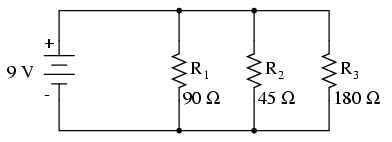
The total resistance of this circuit is ______.
26.00 ohms
315.00 ohms
324.00 ohms
90.00 ohms
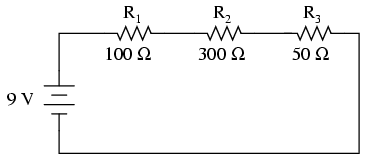
The total resistance in this circuit is ______.
100.00 ohms
450.00 ohms
400.00 ohms
30.00 ohms
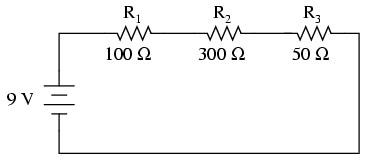
The total current through this circuit is _______.
0.02 amps
0.09 amps
50.00 amps
9.00 amps

What is the total resistance (RT) across this circuit?
3.00 kΩ
10.00 kΩ
13.00 kΩ
18.00 kΩ
Which circuit is most likely to conduct electricity?


It states that the voltage across or current through an element is the algebraic sum of the voltages across or currents through that element due to each independent source acting alone.
Superposition
Linear Circuit
Three-terminal Circuit Transformation
Kirchhoff's Laws
In applying superposition theorem, we ___________.
turn-off all independent sources except one source.
turn-off all dependent sources except one source.
consider dependent source one at a time
put the dependent source in an inactive state.
put the all independent source in an active state.
Which of the following are considered three-terminal equivalent network?
Wye
Delta
Pi
Tee
Sigma

