
 Worksheets
Solar System & The Universe
Total questions: 60
Worksheet time: 3600secs
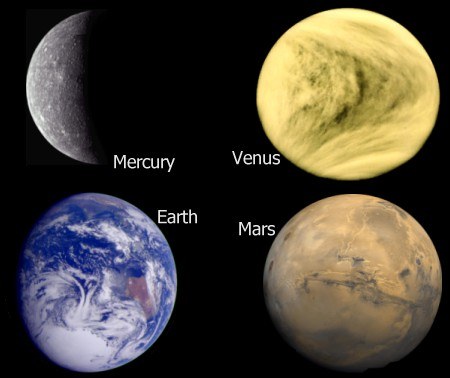

Which planet is NOT one of the
"Gas Giants"?
Uranus
Venus
Neptune
Saturn

Which stars in the diagram are the coolest?
White dwarfs
Super giants
The stars in the upper left corner of the main sequence
There is no way to know from the diagram
How do we measure distance in space?
miles
kilometers
Kelvin
astronomical unit

Approximately how old is the universe?
10.3 billion years
12.5 billion years
13.7 billion years
5 billion years
When did our Solar System form?
13.7 billion years ago
500 million years ago
4 billion years ago
5 billion years ago

About how long does it take for the moon to complete it's cycle?
2 weeks
365 days
one month
one week

Choose the correct order of the lunar phases.
New, 1st Quarter, 3rd Quarter, Full
1st Quarter, Full, New, 3rd Quarter
3rd Quarter, Full, New, 1st Quarter
New, 1st Quarter, Full, 3rd Quarter

What is the "Big Bang Theory" of the origins of the Universe?
A sudden expansion exploded and created all the matter in the Universe
The earth exploded and created the Universe
Our solar system exploded to create all the Universe
The Universe slowly grew from the Sun

What is the moon?
A natural satellite that revolves around a planet and reflects the Sun's light
A man-made satellite that revolves around Earth
A natural satellite that revolves around the sun
A small star that is close to Earth
the study of objects in space and their properties
scientist
universe
galaxy
astronomy
The path that one object in space follows as it revolves around another object in space
Orbit
Mass
Galaxy
The spinning of an object on its axis is called ___________.
Topsy Turvy
Tornado
Rotation/Rotate
What separates Mars from Jupiter?
sun
Milky Way galaxy
asteroid belt
black hole
These are called the “Gas Giants” even though the planets are actually liquid due to the pressure being very high. They are less dense and usually have many moons.
inner planets
outer planets

Scientists have observed that the universe continues to _____________ as billions of stars continue to move away from each other.
expand
contract
change
shift
an object made of rock, ice, dust, and gas that revolves around the Sun
Comet
Asteroid
Galaxy
Planet
an object that is found in the solar system, orbits the Sun, and is much smaller than a planet
comet
star
asteroid
constellation
the study of objects in space and their properties
scientist
universe
galaxy
astronomy
the motion of one object around another object
rotation
revolution
spin
moon
Which is true about the solar system?
The solar system is the center of the sun.
Only planets are found in the solar system.
Axis of the planets is elliptical.
All planets revolve around the sun.
Pluto was once considered a planet. Today, it is regarded as planetoid. Why?
It exploded.
It is too small.
It is far from the sun.
It does not have its own orbit.
What is caused by the tilt of the Earth on its axis?
day and night
the seasons
This is the 2nd largest planet in our solar system and it is made of gases & ice crystals. This planet has an extravagant ring system that is kept in place by the planet’s gravitational pull. The rings are mostly pieces of space rock(some small, some large).
Uranus
Saturn
Jupiter
This is the largest of all the planets and it has 60+ natural satellites. It is made of mostly hydrogen gas with ice crystals because it is very far from the sun and very cold. It has a giant red spot that is a massive storm!
Jupiter
Saturn
Venus
Neptune
The universe contains ............
galaxies and stars
planets and moons
living organisms
all of the previous
Eclipses occur when the moon, earth and sun are in one straight line causing the source of light to be blocked.
True
False
The Great Red Spot of Jupiter is actually a massive crater.
True
False
What new technology did Galileo use to make his observations?
Telescope
Microscope
Eyeglasses
Mirrors
What do scientists think may be the best way to avoid an asteroid collision with earth
Nuking it
Redirecting it
creating a huge force field around the earth
there is no good way

