wayground logo

Free Printable Worksheets

NEW

Font size

S
M
L
XL
Worksheets

Grade 8 Quiz - Sound

Total questions: 35

Worksheet time: 35mins

Name
Class
Date
1.

Sound is a kind of

a)

work

b)

energy

c)

force

d)

pressure

2.

Sound unlike light cannot be propagated in :

a)

solid

b)

liquid

c)

gas

d)

vacuum

3.

Sound waves in solids,liquids and gases are all propagated through

a)

illusion

b)

infusion

c)

imagination

d)

vibration

4.

Which of the phases of matter does sound waves travel fastest?

a)

Solid

b)

Liquid

c)

Gas

d)

Vacuum

5.

Which of the phases of matter does sound waves travel slowest?

a)

Solid

b)

Liquid

c)

Gas

d)

Vacuum

6.

What do you call these sound waves whose frequency is above 20,000 hertz?

a)

a. ultrasound

b)

b.infrasound

c)

c. noise

d)

d.echo

7.
If you want to change the pitch of a sound, you have to change the ___
a)
frequency
b)
amplitude
c)
speed
d)
volume
8.
What happens when you increase the amplitude of a sound?
a)
it makes the sound louder
b)
it makes the sound travel faster
c)
it increases the wavelength of the sound
d)
it increases the frequency of the sound
9.
This is the unit used to measure the volume of a sound. 
a)
Decibel
b)
Medium
c)
Vibration
d)
Oscilloscope
10.
What is a pitch?
a)
highness or lowness of a sound
b)
the intensity of a vibration
c)
the amplitude of the sound wave
d)
volume of sound
11.
Why is sound able to travel faster through a solid than a gas?
a)
Gas molecules are packed tightly.
b)
Sound does not travel faster through a solid than a gas.
c)
Solid molecules are packed tightly.
d)
Gas molecules move slowly.
12.
How does a sound wave interact with a human ear?
a)
vibrates the ear drum
b)
bounces off the ear canal
c)
rotates the ear drum
d)
vibrates the ear canal
13.

What is the range of frequencies audible to the human ear?

a)

lower than 20 Hz

b)

20 Hz - 20,000 Hz

c)

higher than 20,000 Hz

d)

0 Hz - infinite Hz

14.
A disturbance that travels through a medium as a longitudinal wave
a)
sound
b)
wavelength
c)
pitch
d)
frequency
15.

The back and forth movement of matter is:

a)

volume

b)

vibration

c)

pitch

d)

frequency

16.

Sound is caused by:

a)

force

b)

vibrations

c)

instruments

17.
Sound does not travel in space because
a)
Space is too far away.
b)
There is no matter in space.
c)
Space is the final frontier
d)
Space has planets.
18.
Your __________ vibrate when you talk
a)
stomach
b)
lips
c)
ears
d)
vocal cords
19.
An image made by an ultrasound machine, often used for seeing internal organs in humans is called a(n):
a)
infrasound
b)
Ultrasound
c)
doppler effect
d)
decibel
20.
A sound with a high pitch would have
a)
a low frequency
b)
a high frequency
c)
a low amplitude
d)
a high amplitude
21.
A sound with a low pitch would have a:
a)
high frequency
b)
low frequency
c)
high amplitude
d)
low amplitude
22.

A very loud sound would have a(n):

a)

high frequency

b)

low frequency

c)

high amplitude

d)

low amplitude

23.
A very quiet sound would have a (n):
a)
high frequency
b)
low frequency
c)
high amplitude
d)
low amplitude
24.
This fluid-filled snail-shaped sack in the inner ear contains hair cells attached to nerves which transmit sound information to the brain. 
a)
Cochlea
b)
Hammer
c)
Anvil
d)
Stirrup
25.
This part of the ear is vibrated by sound waves.  It is a lightly stretched membrane that is the entrance to the middle ear.
a)
Pinna
b)
Ear Drum
c)
Hammer
d)
Cochlea
26.

True or False: Sound waves are faster than light.

a)

False

b)

True

27.

The number of vibrations per second is known as ----

a)

Hertz

b)

Amplitude

c)

Frequency

28.

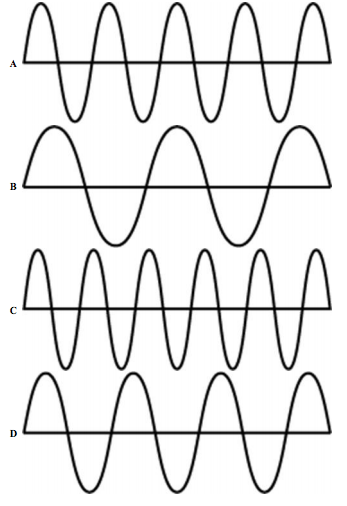
Which of these waves represents the loudest sound?

a)
b)
c)
d)
29.

Which of these waves represents the highest pitch?

a)
b)
c)
d)
30.
What are you doing when you're making sound?
a)
Causing photons to travel.
b)
Causing air molecules to vibrate.
c)
Causing electromagnetic waves to radiate.
d)
Causing air pressure to drop.
31.
What is compression?
a)
When air molecules move apart from one another.
b)
When air molecules collide with each other.
c)
When air molecules become packed tightly together.
d)
When air molecules move around freely.
32.
What wave produces the highest frequency?
a)
1
b)
2
c)
3
d)
4
33.

What does the Auditory nerve do?

a)

Carries the message to the brain

b)

Carries the message to the Semi-Circular canal

c)

Send the message to the Eustachian tube
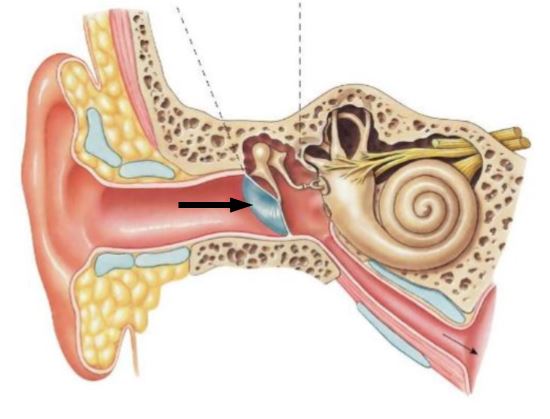
34.

What is this?

a)

Ear Drum

b)

Ear Canal

c)

Pinna

d)

Hammer

e)

Cochlea

35.

Sound is a form of energy produced by ______________.

a)

Vibrations

b)

Distances

c)

Prisms

d)

Forces