
 Worksheets
Quiz on Cell Biology-I
Total questions: 140
Worksheet time: 2hrs 32mins


Ribosomes are found in following cells
animal
plant
prokaryotic
bacteria

rRNAs present in Eukaryotic ribosomes
5S
5.8S
16S
28S
Prokaryotic Ribosomes are made up of
40S and 60S subunits
30S and 50S subunits
30S and 60S subunits
40s and 50S subunits
Number of Proteins in Prokaryotic ribosomes
21 in smaller subunit and 31 in larger subunit
33 in smaller subunit and 49 in larger subunit
21 in smaller subunit and 49 in larger subunit
rRNAs present in prokaryotic ribosomes
5S, 16S and 23 S
5,8S, 16S and 23S
5S, 16S and 28S
5S, 18S and 28S


What do Lysosomes contain?
Sulfuric Acid
Hydrolytic Enzymes
Nitric Acid
Hydrochloric Acid
What organelle makes energy for the cell?
Cytoplasm
Nucleus
Mitochondria
Rough ER
What organelle packages and ships proteins?
Golgi Body
Rough ER
Smooth ER
Cytoplasm
What is the function of the Smooth ER
to help make protein
to make calcium and lipids
to hold the DNA
to make ATP
What organelle digests materials and "cleans" the cell?
Smooth ER
Rough ER
ribosome
lysosome
What is made by the nucleolus?
RNA
ribosomes
ATP
energy
True or False? All cells have ribosomes and chloroplasts.
True
False
Endoplasmic Reticulum was proposed by....
Porter and Kallman
De Duve
Singer Nicolson
Robert Hook
E.R. (Endoplasmic Reticulum) composed of following kind of structure...
Cisternae, vesicles, tubules
Vesicles, ribosome, proteins
Tubules, vacuoles, centrioles
Which of the following is the basic type of E.R. ?
Rough E.R.
Smooth E.R.
Both of above
None of above
....... Acts as a storage organelle.
Smooth ER
Rough ER
Both of above
None of above
Sarcoplasmic Reticulum (SR) is a variation of ..... Which is able to store many ions.
Smooth ER
Rough ER
Both of above
None of above
......is important in the creation and storage of lipids and steroids.
Smooth ER
Rough ER
Lysosome
Mitochondria
Sarcoplasmic Reticulum is found in ..
Liver cells
Muscle cells
Kidney cells
Neurons
.........biomolecules are NOT synthesized by the Endoplasmic Reticulum.
Proteins
Lipids
Cholesterol
Nucleic acids
Which of the following statements are true regarding ER.?
SER is involved in lipid synthesis
ER provides structural framework to the cell
ER act as intracellular transporting system.
All of the above
Rough ER are found in the cells which are actively synthesizing..
Lipids
Cholesterol
Proteins
Nucleic acids
GERL System involved organelles ....
Endoplasmic Reticulum
Lysosomes
Golgi Bodies
All of Above
What does the Golgi Body do?
The Golgi Body gathers simple molecules and combines them to make molecules that are more complex.
Makes lasagna for dinner
Completes the Mitosis process
Sleeps and does nothing
Who found the Golgi Body?
Ski Mask the Slump God
YOUR MOM
Camillo Golgi
A person.
Which part of the cell is made up of a network of filaments that maintains the cell structure?
Cytoplasm
Endoplasmic reticulum
Cytoskeleton
Vacuoles
Channels that perforate plant cell wall
Plasmodesmata
Tight junctions
Desmosomes
Gap junctions
Which of the following is correct regarding cilia characteristic?
Drive the cell in the same direction
Contains dynein protein
Can slide far
Snake like movements
Which cellular junction is not found in animal cell?
Tight junction
Desmosomes
Gap Junction
Plasmodesmata
Cilia and flagella are …..
Intermediate filaments
Microfilaments
Microtubules
Phospholipids
Microtubules are formed of the protein ……..
Dynein
Keratin
Tubulin
Actin
Which of the following contain the 9+2 arrangement of microtubules?
cilia
centrioles
flagella
Cilia and flagella
Actin and myosin filaments are most abundant in …… cells
connective
Muscle
Epithelial
nerve
Microfilaments are well known for their role in which of the following:
Amoeboid movements.
Formation of cleavage furrows.
Contracting of muscle cells.
All of the above
Communication junction is
desmosomes
plasmodesmata
gap junction
tight junction
Plasmodesmata in plant cell are most similar in function to which of the following structures in animal cells:
Gap junction
Tight junction
Extracellular matrix
Desmosomes
Which of the following is part of the mitochondria
outer membrane
DNA
matrix
all of the above
Mitochondria have their own ____ and DNA floating in the matrix
ions
ATP
water
ribosomes
True or False. The Krebs Cycle takes place within the mitochondrial matrix.
True
False
True or False. The electron transport chain for both the mitochondria and the chloroplast occur on membranes.
True
False
Increase the surface area available for ATP synthesis
cristae
matrix
inner membrane
outer membrane
What is the function of the intermembrane space of the mitochondria?
space where H+ ions accumulate quickly for ATP synthesis
space where electrons accumulate for ATP synthesis
to increase the surface area to volume ratio for ATP production

Letter F is which structure of the mitochondria?
inner membrane
outer membrane
cristae
matrix
Letter E is which structure of the mitochondria?
inner membrane
outer membrane
cristae
matrix
Letter B is which structure of the mitochondria?
inner membrane
intermembrane space
cristae
matrix
Letter G is which structure of the mitochondria?
mtDNA
intermembrane space
mitochondrial ribosome
matrix
How many ATP are produced in fermentation?
0
~30
2
too many to count

What is the correct order for aerobic cellular respiration?
glycolysis-->ETC--> Krebs Cycle
ETC-->glycolysis-->Krebs Cycle
glycolysis-->Krebs Cycle-->ETC
Krebs Cycle-->glycolysis-->ETC
What is NOT a part of the mitochondria
The Matrix
Inner membrane
Cristae
Thylakoid
The mitochondria has its own DNA
True
False
All of these reactions are aerobic
Glycolysis
Krebs cycle
Electron Transport chain
All of these reactions happen in the mitochondria
Glycolysis
Krebs cycle
Electron Transport chain
What does ATP stand for?
(a)
What are some unique features of the mitochondria
It has 2 membranes
It can perform photosynthesis
It has its own DNA
It performs cellular respiration

Identify the name of an organelle.
(a)

Identify the name of an organelle.
(a)

Identify the name of an organelle.
(a)

Identify the name of an organelle.
(a)

Identify the name of an organelle.
(a)
Statements below are true about receptor medited endocytosis EXCEPT .
It is a specialized type of pinocytosis.
It is a type of passive transport
Substance can be acquired even in low quantities in extracellular fluid
It enables cells to acquire bulk quantities of specific substance.
A major function of glycoproteins and glycolipids in the membane is to
glue cells together to form tissues
allow cells to identify each other
attach membrane to cytoskeleton
help retain shape

Which statements are true about active transport?
molecules move from low concentration to high concentration.
molecules move from high concentration to low concentration.
ATP is required
Uses channel proteins
Small polar molecules like O2 and CO2enter a cell through
simple diffusion
osmosis
facilitated diffusion
phagocytosis
Some celery sticks were placed in distilled water. What type of solution are they in? What will happen to the celery sticks?
hypotonic, the celery sticks increase in size
hypertonic, the celery sticks reduce in size
isotonic, the celery sticks remains in size
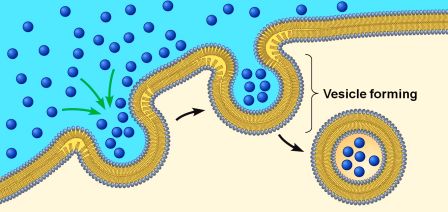
Which form of active transport is being shown?
Facilitated Diffusion
Exocytosis
Endocytosis
Proton pump
sodium-potassium pump transport
only potassium ions and sugar molecules
3 potassium ions out of the cell
3 sodium ions into the cell
2 potassium ions into the cell
white blood cells engulfing invading bacteria is an example of
Phagocytosis
Exocytosis
Pinocytosis
Facilitated Diffusion

This image is an example of a phospholipid. Which part of a phospholipid is HYDROPHOBIC?
the phosphate "head"
the lipid "tails"

Where can carbohydrates be found when part of a plasma membrane?
On the outside of the membrane
On the inside of the membrane
Embedded part of the way into the membrane
Embedded the whole way through the membrane
All of the above
Where can PROTEINS be found when part of a plasma membrane?
On the outside of the membrane
On the inside of the membrane
Embedded part of the way into the membrane
Embedded the whole way through the membrane
All of the above
What is the function of cholesterol in a plasma membrane?
To make the membrane flexible
To control the effect of temperature changes
To attract water molecules
To allow nutrients and other essential molecules into the cell
Plasma membranes are selectively permeable. This means
anything can pass in and out
the membrane regulates the passage of the material in and out of the cell
glucose cannot enter the cell
cholesterol cannot enter
Which is NOT a function of the membrane?
it forms a selective barrier
it has receptors for chemical messages
it is the control center of the cell
it is involved in self recognition
When doctors perform organ transplants, they choose a donor tissue match. Which component is being matched?
membrane phospholipids
cytoskeleton
cell surface carbohydrates
cholesterol
Chemical composition of plasma Membrane is best described as..
Plasma Membrane is bilayers of phospholipids with associated Protein and carbohydrates.
Plasma membrane is composed of equal number of phospholipids,proteins and carbohydrates.
Plasma membrane is bilayers of proteins with associated lipid and carbohydrates.
Plasma membrane is composed of two layers, one layer of phospholipids and another layer of protein.
Lipid bilayer model of P.M. was proposed by...
Singer & Nicolson
Davson Daniel & Robertson
Grendel Gorter
De Duve
Sandwich model of P.M. was given by...
Danielle & Davson
Singer & Nicolson
Grendel & Gorter
De Duve
Fluid Mosaic Model of P.M. was proposed by...
Danielle & Davson
Singer & Nicolson
De Duve
Gorter & Grendel
The term plasma membrane was given by....
C. Nageli
De Duve
Robert Hook
Watson
The membrane protein that extend through both sides of lipid bilayer are...
Intrinsic Proteins
Extrinsic proteins
Peripheral proteins
All of above
Unit membrane model of P.M. was given by...
Robertson
De Duve
Watson
Singer & Nicolson
Plasma membrane have ...... heads
Polar heads
Hydrophilic
Both of above
Non-polar
Plasma membrane have.... Tail.
Hydrophobic
Non-polar
Both of above
Polar and hydrophilic
Most accepted model of plasma membrane is....
Fluid Mosaic Model
Unit membrane model
Sandwich model
Lipid bilayer model
Function of plasma membrane is....
Protection of cell from surroundings.
Regulates entry and exit of molecules into and out of the cell.
Receive chemical messenger from other cell
All of the above
The phospholipid head is _____________ & _____________
Hydrophilic
Hydrophobic
Polar (+)
Uncharged
The phospholipid tail is _____________ & _____________
Hydrophilic
Hydrophobic
Polar (+)
Uncharged
Which type of cellular transport does not require energy?
Passive
Active
Endocytosis
Exocytosis
What is osmosis?
equal concentration
diffusion of water through a selectively permeable membrane
movement of sugar through a selectively permeable membrane
non-polar tails
Which is true about active transport?
It requires energy
it does not require energy
It moves material with the concentration gradient
it moves material from high to low concentration
Diffusion is the movement of
particles from low to high concentration
water from low to high concentration
sugar from high to low concentration
particles from high to low concentration
If you put a plant in salt water, the cells will
swell because water diffuses into the cells
not change in appearance
shrivel because water diffuses out of the cell
Placing a cell containing 20% salt into a solution containing 7% salt will cause the cell to
shrink
swell
stay the same
Which process requires the help of a PROTEIN to move particles across the membrane from high to low concentration?
Endocytosis
Exocytosis
Facilitated diffusion
Simple diffusion
Which process is the movement of WATER from an area of high concentration to an area of low concentration?
Diffusion
Facilitated diffusion
Osmosis
Endocytosis

An amoeba engulfs a particle of food, which type of transport is this?
Exocytosis
Diffusion
Endocytosis
Exportation
The Na/K pump is a type of
Facilitated diffusion
Simple diffuction
Exocytosis
Active transport

Which letter is pointing to a phospholipid?
A
B
C
D
E
Which letter is pointing to an integral / transmembrane / channel protein?
A
B
C
D
E
Which letter is pointing to a peripheral protein?
A
B
C
D
E
Which letter is pointing to cholesterol?
A
B
C
D
E
Which letter is pointing to a glycoprotein?
A
B
C
D
E
SELECT ALL THAT APPLY: Which of the following describes active transport?
It uses energy
It ONLY moves molecules
It moves molecules from LOW to HIGH concentration
It moves water & molecules
SELECT ALL THAT APPLY: Which of the following best describes the difference between simple & facilitated diffusion?
Simple = molecules float across the membrane, Facilitated = molecules flow through protein channels
Simple = molecules flow through protein channels, Facilitated = molecules float across the membrane
Simple = small molecules, Facilitated = large
Simple = large molecules, Facilitated = small
Which of the following substances would have the most trouble crossing the membrane by diffusing through the bilayer?
Vitamin D
Oxygen
Fatty acid
A sodium ion
Potassium ions will cross the plasma membrane by
Facilitated diffusion through pore protein
Simple diffusion through phospholipid bilayer
Facilitated diffusion through carrier protein
Simple diffusion through carrier protein
Which of these are types of active transport
Symport
Osmosis
Antiport
Diffusion
Facilitated diffusion is best described as
Diffusion of molecules through the cell membrane, from high to low concentration, without the need for energy
Diffusion of molecules through membrane proteins, from low to high concentration, requiring energy.
Diffusion of molecules through membrane proteins, from high to low concentration, without energy
Diffusion of molecules through the cell membrane. From low to high concentration.
The Na/Glucose pump is an example of a
Uniport
Symport
Antiport
The Na/K pump is an example of a
Uniport
Symport
Antiport
In Active transport, the protein will undergo a shape change and will never revert back to its original shape.
True
False
___ is an example of a Co-Transporter
aquaporin
calcium pump
sodium-potassium pump
Animal cells communicate with each other through
gap junctions
plasmodesmata
cell-cell recognition
chemical messengers
Which is not a function of membrane proteins?
cell to cell communication
cell to cell recognition
intercellular joining
storage of energy, carbon and nitrogen

