wayground logo

Free Printable Worksheets

Font size

S
M
L
XL
Worksheets

PMA3 Review Quizizz

Total questions: 64

Worksheet time: 1hrs 6mins
Name
Class
Date
1.
The BEST reason another scientist is unable to replicate an experiment...
a)
They did it wrong.
b)
They had variables that were not controlled.
c)
They didn't follow the procedure.
d)
They measured wrong.
2.
Scientists have MANY trials so their results are 
a)
countable
b)
graphable
c)
reliable
d)
hard to understand
3.
When a another scientist does someone's experiment to see if the results are valid?
a)
repetition
b)
replication
c)
experimental method
d)
controlled variable
4.
Josue goes to Silver River each week for 4 weeks and collects 5 samples of water to test the pH.
a)
repetition
b)
replication
5.
Dr. Smith has been reading about another scientist’s research in a physics journal. He plans to do these experiments himself and see if he gets the same result.
a)
repetition
b)
replication
6.
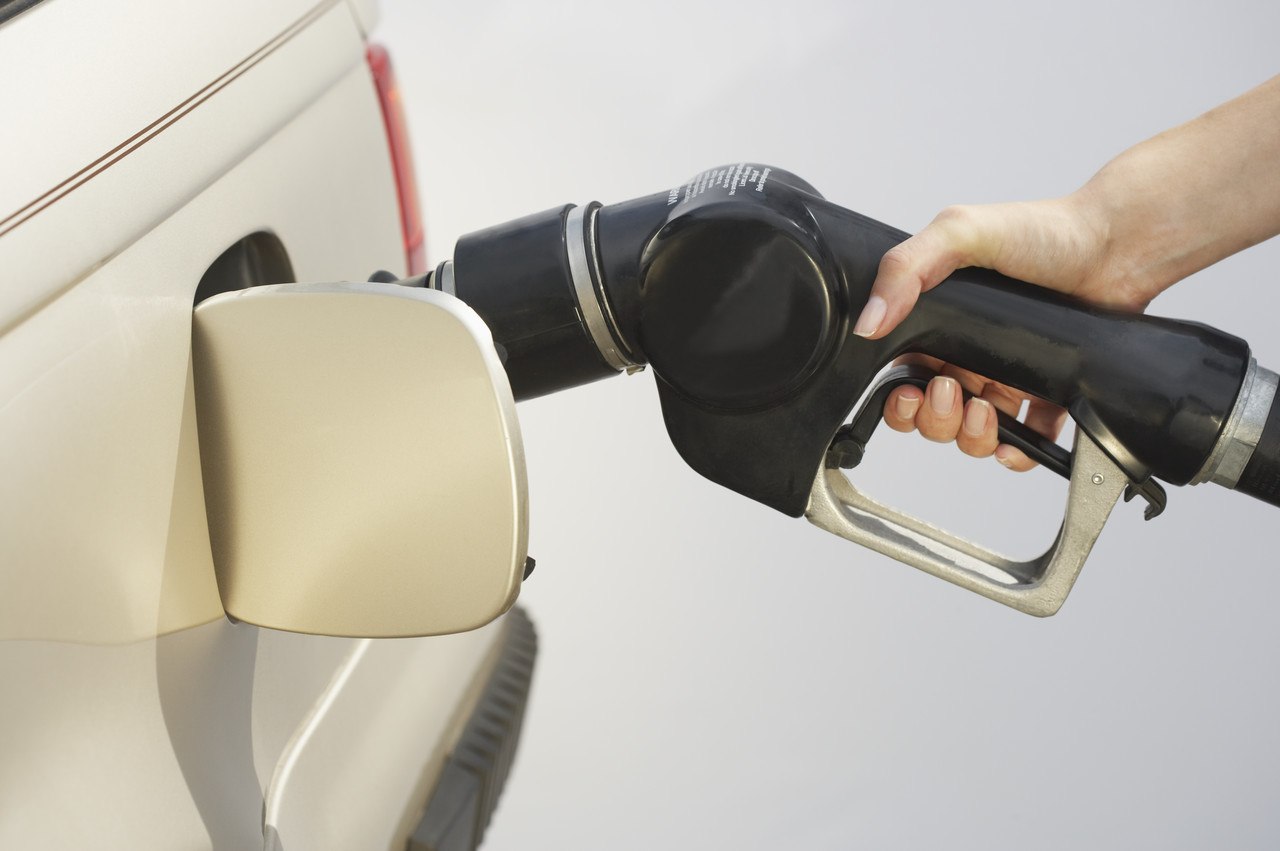
Which energy conversion is taking place when you put gasoline in a car?
a)
thermal -> electrical
b)
mechanical -> electrical
c)
chemical -> mechanical
d)
mechanical -> electromagnetic
7.
what type of energy is stored in a battery?
a)
electrical
b)
chemical
c)
thermal
d)
mechanical
8.
"Energy can be transformed from one form into another or transformed from one region or another, but energy cannot be created or destroyed."
Which law is this?
a)
Law of Conservation of Mass
b)
Newton's Second Law
c)
Law of Conservation of Energy
d)
Newton's Third Law
9.
A student listens to music with a digital music player, similar to the one shown below. Which best describes the energy transformations that take place in the music player?
a)
Mechanical to chemical to electrical
b)
Chemical to sound to electrical
c)
Chemical to electrical to sound
d)
Electrical to heat to sound
10.
The heat from a lamp allows a lizard to remain warm. This is an example of which type of heat transfer?
a)
radiation
b)
conduction
c)
convection
d)
insulation
11.

What is the definition of CONVECTION

a)

When heat transfers through waves.

b)

When heat transfers from objects that are touching.

c)

warm fluid rises; cool fluid sinks

d)

Heat traveling from the sun

12.

Hot water rises and cold water sinks. Is this:

a)

Convection

b)

Conduction

c)

Radiation

13.

Stir frying vegetables is an example of

a)

Convection

b)

Conduction

c)

Radiation

14.

Grilling Hamburgers OVER a charcoal flame.

a)

Convection

b)

Conduction

c)

Radiation

15.
which material does sound travel the fastest?
a)
solid 
b)
liquid 
c)
gases
16.
What is a medium?
a)
something between a small and a large?
b)
the substance through which a wave can travel
c)
a pattern of vibration that simulates when a wave is standing still
d)
the distance from any point on a wave to an identical point on the next wave
17.
A mechanical wave cannot travel through...
a)
a vacuum(empty space).
b)
water.
c)
air. 
d)
glass.
18.
Sound will travel slowest through which of the following forms of matter?
a)
milk
b)
desk
c)
air
d)
door
19.
Which explains why the fork looks different under water?
a)
light can't pass through the glass
b)
the wavelength of light lengthens
c)
the amount of light increases when going through water
d)
light is refracted at an angle
20.
Sound is able to travel faster in solids than in air because the molecules in a solid are
a)
closer together than air molecules
b)
more easily moved than air molecules
c)
moving faster than air molecules moving faster than air molecules
d)
larger than air molecules
21.

Which correctly sequences the waves of the electromagnetic spectrum from greatest energy to lowest?

a)

Radio waves, microwaves, x-rays

b)

microwaves, radio waves, ultraviolet waves,

c)

x-rays, visible light waves, microwaves

d)

visible light waves, ultraviolet waves, microwaves

22.

Which of the following identifies a type of electromagnetic radiation with a higher frequency than microwaves but a lower frequency than ultraviolet waves?

a)

x-rays

b)

radiowaves

c)

Visible light

d)

Gamma rays

23.

Which of the following BEST compares and contrasts electromagnetic radiation?

a)

Each type of electromagnetic radiation has different frequencies but each have similar energy.

b)

Each type of electromagnetic radiation has different wavelengths but each have similar frequencies.

c)

Each type of electromagnetic radiation travels at the same speed but have different wavelengths.

d)

Each type of electromagnetic radiation travels at different speeds but have the same wavelengths.

24.
Cell phones and televisions use this type of EM wave.  It has the longest wavelength with the lowest frequency.
a)
radio wave
b)
tv wave
c)
Gamma wave
d)
ultra violet
25.

Which part of the electromagnetic spectrum has high enough energy to cause damage to eyes and skin, and sometimes even cancer?

a)

infrared light

b)

visible light

c)

ultraviolet light

d)

microwaves

26.

Which of the following electromagnetic waves can be felt as heat?

a)

ultraviolet light

b)

x-rays

c)

gamma rays

d)

infrared rays

27.
Which type of rock is made by small bits of rock, mud, or sand compacted and cemented together?
a)
Coal
b)
igneous
c)
metamorphic
d)
sedimentary
28.

Which type of rock is made from lava or magma cooling?

a)

igneous

b)

sedimentary

c)

metamorphic

29.
Which type of rock is made from a rock being changed by heat and pressure?
a)
Smooshed Rock
b)
igneous
c)
metamorphic
d)
sedimentary
30.
The process by which gravity, water, wind, and ice deposit weathered and relocated sediment.
a)
Deposition
b)
Sedimentary rock
c)
Ocean trench
d)
Magma
e)
Erosion
31.
Occurs when rock particles or sediments are pressed together or packed down by gravity and the pressure of overlying rock layers.
a)
Compaction
b)
Ocean trench
c)
Rock cycle
d)
Plate tectonic theory
e)
Earth's evolution
32.

The process by which water, ice, wind, and gravity remove and transport sediment from one place to another.

a)

Erosion

b)

Heat and pressure

c)

Igneous rock

d)

Mineral composition

e)

Sedimentary rock

33.
The mechanical or chemical processes that break rocks into smaller pieces, and sometimes change the chemical composition.
a)
Weathering
b)
Earth's evolution
c)
Erosion
d)
Cementation
e)
Deposition
34.
The solid, outer layer of the Earth that consists of the crust and the rigid upper part of the mantle
a)
Lithosphere
b)
Mesosphere
c)
Mantle
d)
Crust
35.
Pressure ______________________ as you go deeper into the Earth
a)
increases
b)
decreases 
c)
goes up or down depending on the layer
d)
stays the same
36.
The order of the earth’s compositional layers from most dense to least dense are
a)
Inner Core, Crust, Mantle and Outer Core
b)
Crust, Mantle, Outer Core and Inner Core
c)
Inner Core, Outer Core, Mantle and Crust
d)
Crust, Outer Core, Inner Core and Mantle.
37.
Scientists determine what Earth’s interior looks like by using:
a)
Volcanoes
b)
Seismic Waves
c)
Continental Drift
d)
Convection Currents
38.
What layer is the hottest?
a)
Core
b)
Crust
c)
Mantle
39.

California sits along the boundary of two tectonic plates. One plate is moving north and the other is moving south. There are thousands of earthquakes in this region every year. Which of the following best explains why earthquakes are common in California?

a)

The two plates form a transform boundary by sliding horizontally past one another.

b)

The two plates form a convergent boundary by colliding into one another.

c)

The two plates form a divergent boundary by the two plates pulling away from each other.

d)

The two plates form a subduction zone where the pacific plate goes under the continental plate.

40.

Which of the following best describes the outer core?

a)

It is the liquid layer that rotates around the inner core and causes Earth's magnetic field.

b)

The outer core is the outermost later of the Earth.

c)

The outer core is the densest layer and is made of solid iron.

d)

The outer core is in the middle of the Earth and is the hottest layer.

41.

Which of the following best describes the outer core?

a)

It is the liquid layer that rotates around the inner core and causes Earth's magnetic field.

b)

The outer core is the outermost later of the Earth.

c)

The outer core is the densest layer and is made of solid iron.

d)

The outer core is in the middle of the Earth and is the hottest layer.

42.

How are volcanoes formed on Earth?

a)

Hot magma in the mantle forms convection currents which cause the tectonic plates to push together and pull apart.

b)

Hot water under the crust forms convection currents which generate pressure until it erupts.

c)

Weathering and erosion carve an opening at the tops of the mountains which allow magma to come up from the mantle.

d)

Divergent plates cause mountains to separate leaving a gap for the volcano to come up through.

43.

Which is true about the inner core?

a)

It is dense and solid and has the highest temperature and greatest density.

b)

It is thin and crumbles easily and is made of rock.

c)

It is made of hot rock that flows as a plastic and forms convection currents.

d)

It is a shell of liquid iron that has a high temperature and creates Earth's magnetic field.

44.

How does the heat and the movement of Earth's mantle move the tectonic plates to form ocean basins?

a)

divergent plates?

b)

subducting plates

c)

converging plates

d)

transform plates

45.

Which diagram shows how mountains are formed?

a)
b)
c)
d)
46.

The movement of plate tectonics can cause both slow and rapid changes in Earth's surface. Which of the following is an example of a rapid change?

a)

Earthquake

b)

Seafloor spreading

c)

Mountain range formation

d)

Formation of ocean trench

47.

Where do most volcanoes occur in the world?

a)

Along convergent boundaries.

b)

Along transform boundaries

c)

In the middle of tectonic plates

d)

Under the crust.

48.
What causes tectonic plates to move along the Earth's surface?
a)
wind
b)
ocean currents
c)
convection in the mantle
d)
expansion of the Earth
49.
What type of boundary occurs when two plates move away from each other?
a)
transform
b)
subduction
c)
convergent
d)
divergent
50.
What type of boundary occurs when two plates move toward each other?
a)
convergent
b)
divergent
c)
transform
d)
lateral
51.
A rift valley occurs at a ____________ boundary.
a)
divergent
b)
convergent
c)
transform
d)
horizontal
52.
What type of boundary occurs when two plates slide past each other?
a)
divergent
b)
transform
c)
lateral
d)
convergent
53.
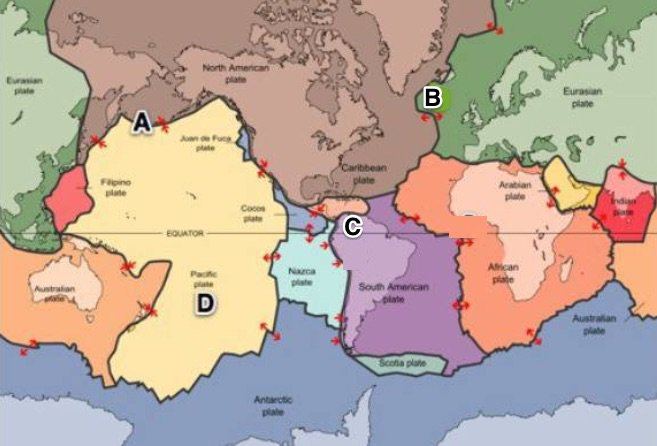
What type of boundary is shown at A?
a)
transform
b)
convergent
c)
divergent
d)
subduction
54.
Scientists use radioactive decay to measure...
a)
relative time
b)
absolute time
c)
half-lives
d)
time of day
55.
How does absolute age differ from relative age?
a)
only absolute dating indicates which rock is older than another
b)
only absolute dating finds the age in years
c)
only relative dating finds the age in years
56.

Where would sea floor spreading most likely occur?

a)

At convergent boundaries (oceanic vs. oceanic)

b)

At convergent boundaries (oceanic vs. continental)

c)

At divergent plate boundaries (oceanic vs. oceanic)

d)

At transform plate boundaries

57.
According to the law of superposition, the oldest fossils are found 
a)
At the top of the rock layers
b)
Near the bottom of the rock layers
c)
In the middle of the rock layers
d)
Somewhat near the surface
58.
Which type of dating method can be used on rock layers by applying the Law of Superposition?
a)
relative dating
b)
absolute dating
c)
radioactive dating
d)
radiometric dating
59.
According to the law of superposition, which layer is the youngest?
a)
A
b)
B
c)
C
60.
All plants and ANIMALS contain carbon.
a)
True
b)
False
61.
True or False: The geologic record can help scientists to determine past environment and climate conditions.
a)
True
b)
False
c)
Maybe
d)
Sometimes
62.

What is the importance of studying fossils?

a)

to provide information about how current life forms would exist in previous environmental conditions

b)

to provide information about how life and environmental conditions may have changed

c)

to provide information about how previous life forms would exist in current environmental conditions

63.

Fossils provide evidence of __________.

a)

how life and the environment has remained stable over time

b)

how the climate and weather has remained stable over time

c)

how life and the environmental conditions have changed over time

64.

After reading a scientific paper in 1911, that listed identical plant and animal fossils on opposite

sides of the Atlantic Ocean. Alfred Wegener, a meteorologist and explorer, hypothesized that

the continents were once a large landmass. He then set out to search for other cases of identical fossils on opposite sides of oceans. Wegener published his findings in 1915 (as seenin Figure 1)

a)

All fossils contain the same DNA, showing a common ancestor among them.

b)

All fossils change the area they lived in, showing their rapid changes over time.

c)

Fossils of the same type of organism can be found on continents that are not connected, showing that all continents were once together.

d)

Fossils of the same type of organism can be found only on the same continent, showing that the continents have always been separated.