
 Worksheets
Atoms and Chemical Bonds Test Review
Total questions: 63
Worksheet time: 2hrs 6mins
Why do elements bond?
To be friends
To create a new element
To become stable
To get bigger
Which of the following describes covalent bonds?
Bonds form because of opposite charges
electrons are shared to fill outer electron shells
Electrons are transferred between atoms
Covalent bonds are magical
The octet rules states that most elements want to have _____ valence electrons.
2
4
6
8
Which of the following atoms is most likely to bond with another atom?


Chemical bond is ...
the physical mixing of two different atoms.
the force that holds two atoms together
the energy used up when two atoms combined.
the temperature that changes the phase of matter.

How many valence electrons does Oxygen (O) have?
6
8
15
16
Which statement best describes the relationship between atoms & molecules.
molecules are made of atoms that are chemically bonded together.
atoms are made of molecules that are chemically bonded together.
molecules are made of a mixture of atoms and compounds.
atoms are made of protons, neutrons & electrons.

For representative elements (Groups 1A - 8A), the number of valence electrons is equal to
the group number
the period number
the atomic number
the group number minus 10
For metals (groups 1-3), its easier to _____ electrons to have a full outer shell.
gain
lose
share
For nonmetals (grousp 5-7), its easier to _____ electrons to have a full outer shell.
gain
lose
share


the basic structural unit of matter
atom
matter
element
nucleus
a collection of atoms of one type that cannot be broken down into simpler substances by ordinary chemical or physical means
element
subatomic particle
electron
matter
the positively charged subatomic particle contained in the nucleus of an atom
proton
neutron
electron
matter
a subatomic particle, contained in the nucleus of an atom, having the same mass as a proton but no electrical charge
proton
neutron
electron
matter
an arrangement of the elements according to their atomic numbers so that elements with similar properties are in the same column and properties repeat from row to row
Periodic Table of Elements
Atomic Theory
Isotopes
Subatomic Particles
one or two letters that represent the name of an element
element name
element symbol
atomic number
atomic mass
the mass of an atom, calculated by adding the number of protons and neutrons in the nucleus of the atom
element name
element symbol
atomic number
atomic mass
one of several forms of a single element, which contains the same number of protons, but different numbers of neutrons
isotope
ion
orbital
nucleus
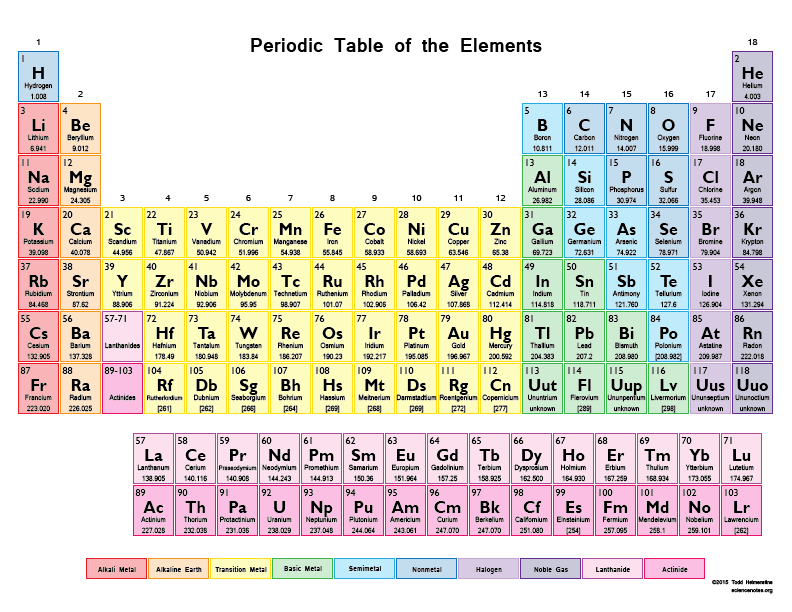
What is the atomic number of Barium, Ba? (enlarge the periodic table)
20
38
56
88
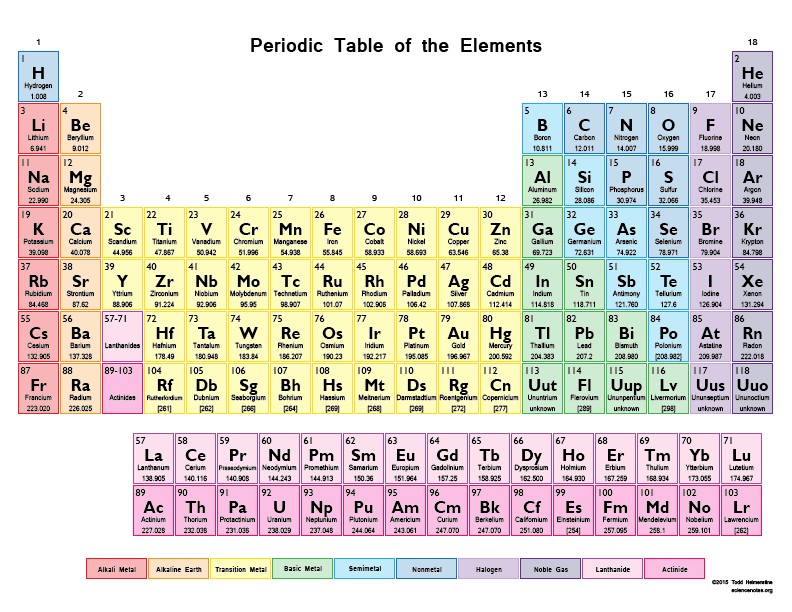
How many protons are in a sodium atom, Na? (tap to enlarge the periodic table)
Sodium has 1 proton.
Sodium has 3 protons.
Sodium has 11 protons
An element has the mass number 12 and atomic number 6. The number of neutrons in it is:
6
10
4
8
If an atom has 10 electrons, how many protons does it have?
0
1
10
5

The small numbers in a chemical formula:
(the BLUE numbers)
Subscripts
Coefficients
Numbers
Molecules
The big/regular sized numbers in a chemical formula:
(the RED numbers)
Subscripts
Coefficients
Numbers
Molecules
How many Hydrogen are in H2O?
1
2
3
Not enough information.
How many Chlorine in 5NaCl?
1
5
3
Not enough information.
How many Oxygen in 3CO2?
3
2
6
Not enough information.

Is this equation balanced?
Yes, everything appears the same amount on each side.
No, there are too many oxygen on the left side.

Is this equation balanced?
Yes, everything appears the same amount on each side.
No, there are too many hydrogen on the left side.
No, there are too many oxygen on the left side.


H2 + O --> H2O
N2 +3 H2 --> 2NH3

