wayground logo

Free Printable Worksheets

Font size

S
M
L
XL
Worksheets

Mackillop College Chemistry Revision 2

Total questions: 52

Worksheet time: 37mins

Name
Class
Date
1.

Look at this picture of Argon off the periodic table. Which of the following is true for this element?

a)

18 protons

b)

40 protons

c)

22 protons

d)

21.9 protons

2.

Look at this picture of Argon off the periodic table. Which of the following is true for this element?

a)

18 neutrons

b)

40 neutrons

c)

22 neutrons

d)

21.9 neutrons

3.

Look at this picture of Argon off the periodic table. Which of the following is true for this element when it is neutral?

a)

18 electrons

b)

40 electrons

c)

22 electrons

d)

21.9 electrons

4.

Which part of an atom is used to identify it?

a)

number of protons

b)

number of neutrons

c)

number of electrons

5.

When you have an ion of an atom, O-2 for example, what has changed in the atomic structure?

a)

Number of protons

b)

Number of neutrons

c)

Number of electrons

6.

When you have a negative ion of an atom, O-2 for example, do you have a higher number of protons or electrons?

a)

Number of protons

b)

Number of electrons

7.

When you have a positive ion of an atom, Na+1 for example, do you have a higher number of protons or electrons?

a)

Number of protons

b)

Number of electrons

8.
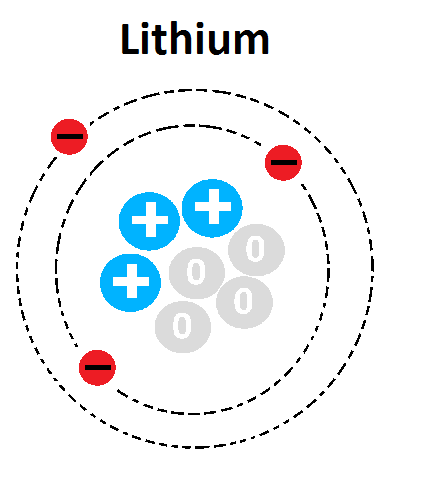
What is the name of this element?
a)
Lithium
b)
Boron
c)
Carbon
d)
Neon
9.
What is the mass number of this atom?
a)
1
b)
3
c)
4
d)
7
10.
How many valence electrons?
a)
2
b)
3
c)
5
d)
10
11.
What's a valence electron?
a)
electrons in the second energy level
b)
electrons in the outermost energy level
c)
the atomic number
d)
electrons in the first level
12.

What are the three main groups of the periodic table?

a)

groups

b)

metal

c)

nonmetals

d)

metalloids

e)

periods

13.

What are the vertical columns on the periodic called?

a)

groups

b)

periods

c)

nonmetals

d)

metals

e)

metalloids

14.

What do the vertical columns on the periodic table tell us?

a)

The number of orbitals

b)

The number of valence electrons (electrons on the outer most shell)

15.

What are the horizontal rows on the periodic table called?

a)

periods

b)

groups

c)

metals

d)

nonmetals

e)

metalloids

16.

What do the horizontal rows on the periodic table tell us?

a)

The number of orbitals

b)

The number of valence electrons (the electrons on the outer most shell)

17.

How many valence electrons do the atoms of elements in the hydrogen column have?

a)

1

b)

2

c)

4

d)

7

e)

8

18.

How many valence electrons do the atoms of elements in the beryllium column have?

a)

1

b)

2

c)

4

d)

7

e)

8

19.

How many valence electrons do the atoms of elements in the carbon column have?

a)

1

b)

2

c)

4

d)

7

e)

8

20.

How many valence electrons do the atoms of elements in the fluorine column have?

a)

1

b)

2

c)

4

d)

7

e)

8

21.

How many valence electrons do the majority of atoms of elements in the helium column have?

a)

1

b)

2

c)

4

d)

7

e)

8

22.

What charge do the ions of elements in the boron column take on?

a)

+3

b)

-3

c)

-2

d)

+2

e)

+1

23.

What charge do the ions of elements in the nitrogen column take on?

a)

+3

b)

-3

c)

-2

d)

+2

e)

+1

24.

What charge do the ions of elements in the oxygen column take on?

a)

+3

b)

-3

c)

-2

d)

+2

e)

+1

25.

What charge do the ions of elements in the beryllium column take on?

a)

+3

b)

-3

c)

-2

d)

+2

e)

+1

26.

What charge do the ions of elements in the hydrogen column take on?

a)

+3

b)

-3

c)

-2

d)

+2

e)

+1

27.

Ionic bonds are formed between...

a)

Non - metals

b)

A metal and a non-metal

c)

Metals

28.

How is an ionic bond formed?

a)

Sharing of electrons

b)

Delocalised electrons

c)

Transfer of electrons

29.
 Which of the following is the correct formula for these two ions:
Al+3 +  S-2
a)
AlS3
b)
Al2S3
c)
Al3S2
d)
Al3S
30.
Whats the formula
Sr+2  +  (CO3)-2
a)
Sr(CO3)
b)
Sr(CO3)2
c)
Sr1(CO)5
d)
Sr(CO5)
31.
To form a charge of +2 an atom must _ electrons.  To form -3 it must _ electrons.
a)
Gain 2; Lose 3
b)
Gain 3; Lose 2
c)
Lose 2; Gain 3
d)
Lose 3; Gain 2
32.
Which is the correct name for CaBr2?
a)
Calcium Bromine
b)
Bromine Calcium
c)
Calcium Bromide
d)
Carbon and Bromine
33.
What is the formula for aluminum fluoride?
a)
AlF
b)
Al2F3
c)
AlF3
d)
Al3F2
34.
What is the correct formula for the compound, lithium oxide?
a)
LiO
b)
Li2O
c)
LiO2
d)
Li2O2
35.

What is the charge of ion "X" in the formula XF3?

a)

+3

b)

-3

c)

+1

d)

-1

36.

What is the charge of ion "X" in CaX?

a)

+1

b)

-1

c)

+2

d)

-2

37.
A cation is a ____ ion.
a)
negative
b)
positive
c)
neutral
d)
ficticious
38.
A anion will be a ____ ion.
a)
negative
b)
positive
c)
neutral
d)
ficticious
39.
Write the formula for barium + nitrogen
a)
Ba2N3
b)
Ba3N2
c)
BaN
d)
BaN3
40.
Write the correct chemical formula for Ag  and  Br -
a)
AgBr
b)
silver bromide
c)
Ag2Br2
d)
gold bromide
41.
Write the correct formula for an ionic compound formed from S2- and Rb1+.
a)
SRb2
b)
SRb
c)
Rb2S
d)
RbS2
42.

Which organelle is the site of photosynthesis?

a)

Chloroplast

b)

Mitochondria

43.
Which of the following is the correct equation for PHOTOSYNTHESIS?
a)
CO+ light + H2O --> O+ Sugar
b)
CO+ sugar + H2O --> O+ light
c)
O2 + light + H2O --> CO+ Sugar
d)
CO+ O2 + H2O --> Light+ Sugar
44.
What two products does a plant make during photosynthesis?
a)
Water and Glucose
b)
Oxygen and Glucose
c)
Oxygen and Water
d)
CO2 and Glucose
45.

When light intensity goes up, the rate of photosynthesis goes _______.

a)

up

b)

down

c)

at the same rate. It does not change.

46.
the products of photosynthesis are...
a)
glucose and sunlight
b)
carbon dioxide and water
c)
glucose and chlorophyll
d)
oxygen and glucose
47.
In which way are photosynthesis and cellular respiration different?
a)
Cellular respiration stores ATP, while photosynthesis releases ATP.
b)
Cellular respiration produces oxygen, while photosynthesis uses oxygen.
c)
Photosynthesis releases energy, while cellular respiration stores energy.
d)
Photosynthesis uses carbon dioxide, while cellular respiration produces carbon dioxide.
48.
What is the correct equation for cellular respiration?
a)
6O2 + C6H12O6 -> 6CO2 + 6H2O + Energy
b)
6O2 + C6H12O6 + Energy -> 6CO2 + 6H2O
c)
6CO2 + 6H2O -> 6O2 + C6H12O6 + Energy
d)
6CO2 + 6H2O + Energy -> 6O2 + C6H12O6
49.

Which organism go through cellular respiration?

a)

animals

b)

plants

c)

both animals and plants

d)

none

50.

Select ALL the products of Cellular Respiration? *clue: 3*

a)

oxygen

b)

glucose

c)

carbon dioxide

d)

water

e)

ATP (energy)

51.
How would the concentration of CO2 in water affect photosynthesis?
a)
The higher the CO2, the greater the rate
b)
The higher the CO2, the lower the rate
c)
CO2 concentration doesn't affect photosynthesis
d)
a greater rate of photosynthesis causes higher CO2 concentrations 
52.

Why would temperature affect the rate of photosynthesis?

a)

Increased temperature increases rate of photosynthesis.

b)

Increased temperature decreases rate of photosynthesis.

c)

Increased temperature has no effect on photosynthesis.