wayground logo

Free Printable Worksheets

Font size

S
M
L
XL
Worksheets

Genetics : Pedigrees

Total questions: 85

Worksheet time: 2hrs 18mins

Name
Class
Date
1.

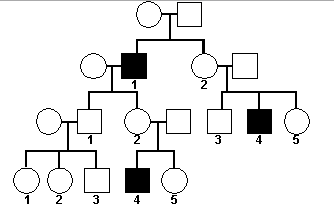
This pedigree shows a trait that is most likely

a)

autosomal dominant.

b)

sex-linked.

c)

autosomal recessive.

2.

The mom in generation 1

a)

has the disorder.

b)

is homozygous for the trait.

c)

is a carrier.

3.

This is an autosomal recessive disorder. The parents in generation one must

a)

have the disease.

b)

be homozygous.

c)

be heterozygous.

d)

be related.

4.

In generation 2 which individual died?

a)

1

b)

2

c)

3

d)

4

5.

This is a __ trait.

a)

autosomal recessive.

b)

sex-linked.

c)

autosomal dominant.

6.

If the shape is not filled in, the individual

a)

has the disorder.

b)

is homozygous dominant.

c)

is heterozygous.

d)

is homozygous recessive.

7.

This trait is

a)

autosomal recessive.

b)

sex-linked.

c)

autosomal dominant.

8.

If the person is filled in

a)

they don't have the disorder.

b)

they are homozygous dominant.

c)

they are heterozygous.

d)

they are homozygous recessive.

9.

Generation 2 individual 3 is

a)

male.

b)

female.

10.

Generation 1 individual 1's relationship to generation 2 individual 3 is

a)

number 3's mom.

b)

number 3's dad.

c)

number 3's brother.

d)

number 3's uncle.

11.

Generation 2 individuals 5 and 6 are

a)

brother and sister.

b)

cousins.

c)

married.

d)

not related.

12.
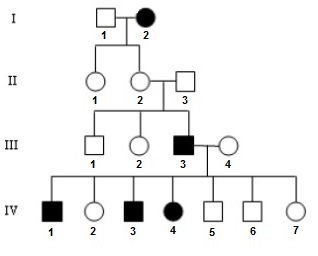
If this pedigree shows an autosomal recessive disorder, what MUST the genotype of individual II-3 be?
a)
HH
b)
Hh
c)
hh
d)
None of the above
13.
How are individuals III-2 and II-4 related?
a)
Cousins
b)
Dad and Daughter
c)
Uncle and Niece
d)
Grandpa and Granddaughter
14.
What type of heredity is shown in the pedigree?
(hint: check your notes - "modes of inheritance")
a)
Sex-Linked Dominant
b)
Sex-Linked Recessive
c)
Autosomal Dominant
d)
Autosomal Recessive 
15.

If this pedigree shows a recessive disorder, what MUST the genotype of individual 4 be?

a)

HH

b)

Hh

c)

hh

16.
In a pedigree, what shape represents a male?
a)
circle
b)
square
c)
triangle
d)
diamond
17.
How many generations are shown in this pedigree?
a)
1
b)
2
c)
3
d)
4
18.
How many kids did the mother and father from the first generation have?
a)
2
b)
4
c)
5
d)
6
19.
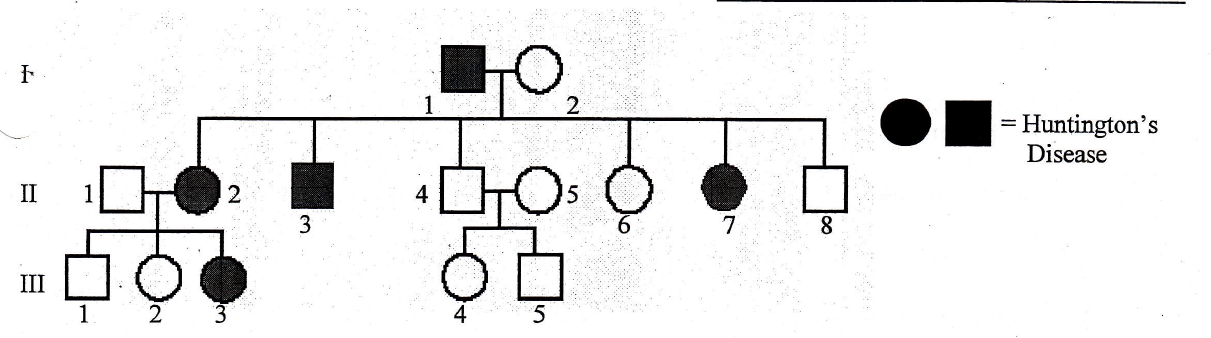
There are no carriers for Huntington's Disease- you either have it or you don't. Is Huntington's disease caused by a dominant or recessive trait?
a)
Dominant
b)
Recessive
20.
How are individuals I-2 and III-5 related?
a)
Grandpa and grandson
b)
Mom and son
c)
Uncle and nephew
d)
Grandma and grandson
21.
This pedigree represents the inheritance of hemophilia in this family. How many of the females have the hemophilia trait?
a)
8
b)
5
c)
2
d)
3
22.
Huntington's Disease is a dominant trait.
What is the correct genotype for individual I-2?
a)
HH
b)
Hh
c)
hh
d)
H_
23.
Does this pedigree show a dominant or recessive trait?
a)
Dominant
b)
Recessive
24.
Hemophilia is a recessive sex-linked trait. If H = normal & h = has hemophilia, which genotype represents a male with hemophilia. 
a)
XHY
b)
XHXh
c)
XhXh
d)
Xh
25.
a)
Not affected Female
b)
Not affected Male
c)
Affected Male
d)
Affected Female
26.
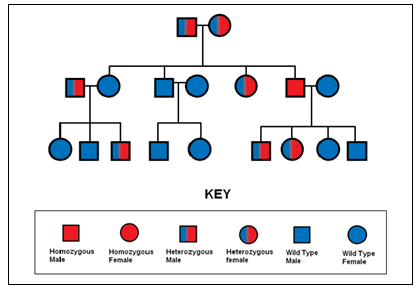
What do half colored symbols represent?
a)
The individual is a carrier (heterozygous).
b)
The individual expresses the trait.
c)
The individual has both recessive alleles.
d)
The individual has both dominant alleles.
27.
This pedigree represents the inheritance of hemophilia in this family. How many of the females have the hemophilia trait?
a)
8
b)
5
c)
2
d)
3
28.
Colorblindness is a recessive sex-linked trait. If B = normal & b = colorblind, which genotype represents a female with colorblindness
a)
XBXB 
b)
XBXb 
c)
XbXb 
d)
Xb
29.
All males receive their X chromosome from their ________.
a)
mother
b)
father
c)
brother
d)
sister
30.
This pedigree shows what pattern of inheritance?
a)
Autosomal Dominant
b)
Autosomal Recessive
c)
Sex-linked Dominant
d)
Sex-linked Recessive
31.
What is the genotype of the father?
a)
AA
b)
aa
c)
Aa
d)
AA or aa
32.
What is the genotype of the mother?
a)
BB
b)
bb
c)
Bb
d)
BB or Bb
33.
How many kids did the mother and father from the first generation have?
a)
2
b)
4
c)
5
d)
6
34.
Imagine the shaded individuals are those WITH a "hitchhikers thumb." What must be the genotype of individual II-1?
a)
TT
b)
tt
c)
Tt
d)
Impossible to tell
35.
Is this trait (the shaded individuals) dominant or recessive?
a)
dominant
b)
recessive
36.
Why do all the daughters in Generation II carry the colorblind gene?
a)
Because mom passed on the gene.
b)
Because dad passed on the X chromosome.
c)
Because their brother has it.
d)
Because their brother gave it to them.
37.
What does a horizontal line between a square and a circle mean?
a)
They are siblings
b)
They are cousins
c)
They are married ("together")
d)
They are the children
38.
What does a vertical line coming down from a square and circle that are connected by horizontal line indicate?
a)
They are cousins
b)
The children
c)
Aunts and Uncles
39.
Freckles (F) are dominant over nonfreckles.   What is the phenotype of individual #3
a)
Ff
b)
ff
c)
freckles 
d)
nonfreckles 
40.
pedigreeWhat type of heredity is shown in the pedigree?
a)
Cannot tell
b)
Sex-Linked
c)
Autosomal Dominant
d)
Autosomal Recessive 
41.
What type of heredity is shown in the pedigree?
a)
Sex-Linked Dominant
b)
Sex-Linked Recessive
c)
Autosomal Dominant
d)
Autosomal Recessive 
42.
Which individual in the first generation is a carrier?
a)
The male
b)
The female
c)
individual 1
d)
None of the above
43.
The genotype of the affected son and daughter at the bottom of this pedigree...
a)
homozygous dominant
b)
homozygous recessive
c)
heterozygous
d)
Can't tell
44.
What type of heredity is shown in the pedigree?
a)
Y-Linked Dominant
b)
Sex-Linked Recessive
c)
Autosomal Dominant
d)
Autosomal Recessive 
45.
Time to think!  If couple H + C have another child, what is the chance of the child NOT having the trait shown in this pedigree?
a)
100%
b)
50%
c)
25%
d)
0%
46.
What is the mode of inheritance shown here?
a)
Autosomal Dominant
b)
Sex Linked
c)
Autosomal Recessive
47.
Achondroplasia is an autosomal disease, there for it affects which chromosome pair:
a)
4
b)
23
c)
24
d)
46
48.
The genotype of the affected son and daughter at the bottom of this pedigree must be:
a)
homozygous dominant
b)
homozygous recessive
c)
heterozygous
d)
Can't tell
49.
What is the mode of inheritance shown here?
a)
Sex Linked
b)
Autosomal Dominant
c)
Autosomal Recessive
50.
What is the mode of inheritance shown here?
a)
Autosomal Dominant
b)
Autosomal Recessive
c)
Sex Linked
51.
Chromosome that is not a sex chromosome
a)
Chromosome
b)
Autosome
c)
Sex Chromosome
d)
Homologous pair
52.
If a gene is found only on the X chromosome and not the Y chromosome, it is said to be what?
a)
sex-linked trait
b)
polygenic trait
c)
codominant trait
d)
incomplete dominance trait
53.
In the second generation-how many people have the disease or display the physical trait?
a)
2
b)
4
c)
5
d)
6
54.
What do we use pedigrees for?
a)
To look at families
b)
To make determinations about the offspring
c)
To track traits in families
d)
Nothing
55.
Why do all the daughters in Generation II carry the colorblind gene?
a)
Because mom passed on the gene.
b)
Because dad passed on the X chromosome.
c)
Because their brother has it.
d)
Because their brother gave it to them.
56.
Give the genotype for person II-1
a)
GG
b)
Gg
c)
gg
57.

What most correctly describes the chromosomes in the germ cell and in the gametes in this image?

a)

The germ cell has 2 chromosomes, and each gamete has 4 chromosomes.

b)

The germ cell has 1 chromosomes, and each gamete has 4 chromosomes.

c)

The germ cell has 2 chromosomes, and each gamete has 2 chromosomes.

d)

The germ cell has 2 chromosomes, and each gamete has 1 chromosome.

58.

The pedigree in this image shows inheritance of Huntington's Disease, an autosomal dominant disease. Select ALL of the individuals that have Huntington's Disease. (Click on the image to see it larger)

a)

Person 1

b)

Person 2

c)

Person 3

d)

Person 4

59.

The pedigree in this image shows inheritance of Huntington's Disease, an autosomal dominant disease. Person #10 does NOT have Huntington's disease. What is their genotype?

a)

HH

b)

Hh

c)

hh

d)

It could be HH or Hh

60.

One characteristic is determined by 2 or more genes.

a)

incomplete dominance

b)

multiple alleles

c)

polygenic inheritance

d)

codominance

61.

In this pedigree, individual 6 is a ____ who _____ the trait.

a)

girl, does not have

b)

girl, has

c)

boy, does not have

d)

boy, has

62.
This gene linkage map shows the order of genes A, B, and C. Which of the following statements about the genes is true?
a)
The distance between A and B is 14.5 map units.
b)
A and B cross over 2.5% of the time.
c)
A and C are linked 8.5% of the time.
d)
 B and C are most likely to be inherited together.
63.
Thomas Morgan’s research with fruit flies determined that...
a)
 alleles always assort independently.
b)
chromosomes are inherited as a group.
c)
genes never assort independently.
d)
traits sometimes are inherited as a group.
64.
Two genes cross over 6% of the time. This percentage means that the genes are
 
a)
 inactivated in 6 out of 100 offspring.
b)
incompletely dominant in 6 out of 100 offspring.
c)
not inherited together in 6 out of 100 offspring. 
d)
on sex-chromosomes in 6 out of 100 offspring.
65.

A female is born with attached earlobes, which is a recessive phenotype. Which of the following genotypes could her parents have?

a)

RR and RR

b)

Rr and rr

c)

Rr and RR

d)

RR and rr

66.
Suppose a person is a carrier for a genetic disorder. Which of the following phrases about this person is true?
a)
does not have the disorder but can pass it on 
b)
will develop the disorder only late in life
c)
cannot pass the disorder to sons, just daughters
d)
the allele is not passed on due to Y chromosome inactivation 
67.
Some members of a family have a recessive sex-linked disorder. Which of the following statements about the family would be true? 
a)
All males would have the disorder.
b)
All females would be carriers.
c)
Only males would have the disorder.
d)
Only females would be carriers.
68.
What is the main reason that sex-linked disorders are most often observed in males? 
a)
The X chromosome only has genes for genetic disorders.
b)
The Y chromosome cannot have genes that cause genetic disorders.
c)
The Y chromosome cannot mask alleles on the X chromosome.
d)
The X chromosome has genes only for sex determination.
69.

Klinefelter’s syndrome results from the fusion of

a)

an X egg and a YY sperm.

b)

an XY egg and an X sperm.

c)

an XX egg and a Y sperm.

d)

an XX egg and a YY sperm.

70.

Being able to use a Punnett square to track the pattern of inheritance in a two-characteristic cross (e.g., pea seed color and seed shape) demonstrates Mendel’s idea of

a)

allele segregation.

b)

blending inheritance.

c)

environmental influences on genes.

d)

independent assortment.

71.

The linkage map of X-chromosome of fruitfly has 66 units, with yellow body gene (Y) at one end and bobbed hair (b) gene at the other end. The recombination frequency of these two genes (Y and b) should be :

a)

66%

b)

> 50%

c)

< 50%

d)

100%

72.

Distance between the genes and percentage of recombination show

a)

A direct relationship

b)

An inverse relationship

c)

A parallel relationship

d)

No relationship

73.
How are locations of genes determined in gene maps?
a)
How often chromosomes separate in anaphase 1
b)
frequency of genes separating by crossing over
c)
how homologous pairs pair up in metaphase 1
d)
frequency of cells separating in cytokinesis
74.
Gene A, B, and C are on the same chromosome.  Gene A separates from gene B 15% of the time and gene B separates from gene C 2% of the time. Which genes are most likely linked?
a)
A - B
b)
B - C
c)
A - C
d)
none of the above
75.
Gene A, B, and C are on the same chromosome.  Gene A separates from gene B 15% of the time and gene B separates from gene C 2% of the time. How far apart are genes A and C in gene map?
a)
2 map units
b)
15 map units
c)
17 map units
d)
30 map units
76.
1 map unit is equal to:
a)
1 nm
b)
1% recombination
c)
1 chromosome
d)
1 mutation
77.
Hemophilia is an x-linked trait.  A normal man marries a woman that is a carrier.  What are their chances of having a child with the disorder?
a)
O%
b)
50%
c)
25%
d)
100%
78.
A and B are linked genes. In a study of 100 offspring, 80 parental genotypes for A and B, while 20 were recombinants. A and B are how many map units apart? 
a)
10
b)
5
c)
20
d)
30
79.
X-inactivation balances the inequality of genes between males and females. 
a)
True 
b)
False 
80.
Causes genes to not segregate independently. Causes genes to be more likely to be inherited together. Represents an exception to Mendel's Law of Independent assortment.
a)
Gene linkage
b)
Epistasis
c)
Polygenic traits
d)
Codominance
81.
True or False: Men can NEVER be "carriers" for recessive sex-linked traits because they only have one X chromosome.
a)
True
b)
False
82.
A drawing that shows the sequence of genes on a chromosome and can be created using data collected about crossing-over.
a)
chromosome mapping
b)
gene linkage
c)
karyotype
83.
T10 - Based on this pedigree about ALBINISM (recessive), individual III - 7 must be...
a)
AA
b)
Aa
c)
aa
d)
Can´t Tell
84.
A red flowered plant (RR) breeds with a White flowered plant (WW). The gene for petal color in these plants expresses incomplete dominance.  What percentage of the offspring will have pink (RW) flowers?
a)
0%
b)
25%
c)
50%
d)
100%
85.
In chickens, feather color is codominant.  If a black chicken BB is mated with one that is black and white (BW) what are the chances of having a chicken that is black and white?
a)
50%
b)
0%
c)
25%
d)
100%