
 Worksheets
Imperialism and World War 1 Review
Total questions: 53
Worksheet time: 27mins
Mobilization is?
Assembly and movement of troops in order to prepare for action
A written, signed agreement between countries
A situation where no further action is possible
What are Reparations?
Payments made to pay for war damages.
Glorification of war and members of the military
Period of low economic activity with widespread unemployment
Policy of supporting neither side of the war

Austria Hungarian Archduke Franz Ferdinand was assassinated by a member of the extreme nationalist group known as the
The Purple Foot
Orange Arms
The Black Hand

The area between opposing trench lines that was very dangerous was known as _________?
Three Man's Land
No Man's Land
German Land

The U.S. was ________ at the start of the war in 1914, meaning they did not support either side.
Pacifist
Neutral
Militarism
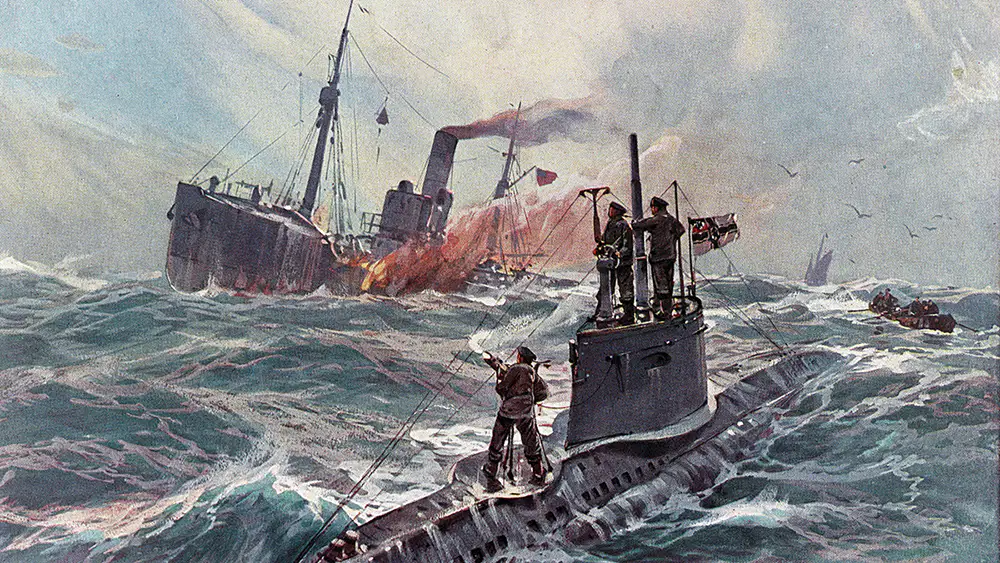
German submarines boats known as _______________ did a lot of damage to the Allies due to them sinking civilian and merchant ships carrying supplies to Britain.
Small Boats
U- Boats
Warfare vessels

New technologies made modern warfare, very dangerous for soldiers. In France, on the Western front soldiers had to hide and protect themselves in these.
Mines
Cages
Trenches

A treaty the Allied leaders signed which finalized the end of the war and blamed Germany for the war.
Treaty of Brest-Litovsk
Treaty of the Versailles
Treaty of Paris

What is considered the "Spark" that started WWI?
U.S. entering the war in 1917
The sinking of the Lusitania
Assassination of the Austrian Hungarian Archduke Franz Ferdinand
Rise of nationalism in Europe
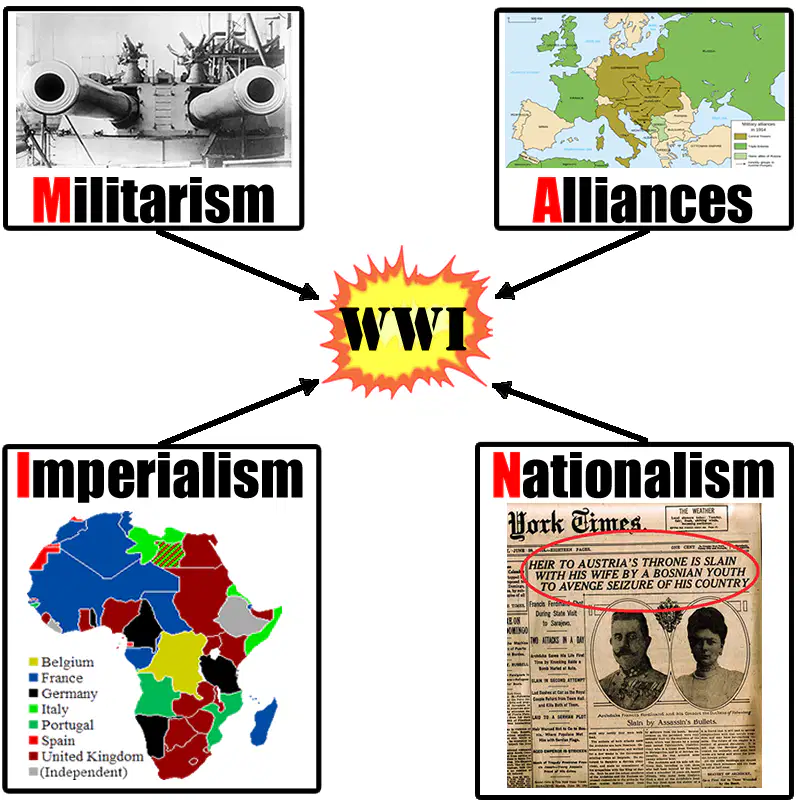
What does each letters of the M.A.I.N causes of WW1 stand for?
Military, Allie, Imperialism, Nationality
Militarism, Alliance, Imperialism, Nationalism
Militarism, Allegiance, Immunity, Nationalism
What does Armistice mean?
A signed document that is agreed upon by signing it.
an agreement made by opposing sides in a war to stop fighting; a truce.
leader of Germany during World War 1.
What country introduced flame throwers into warfare?
France
Russia
Germany
United States
Check ALL events that caused the U.S. to enter the war?
The Sinking of the Lusitania
Unrestricted Submarine Warfare
Zimmerman Telegram
food shortages at home
The United States signed a treaty with Germany in 1914
What was one of the new technologies that was used for the 1st time as a weapon in WW1?
Tanks
Airplanes
Poison Gas
Flamethrower
All of the Above
What year did world war 1 begin and end?
1914-1918
1913-1915
1918-1920
Germany declared unrestricted submarine warfare. What is unrestricted submarine warfare?
when submarines are restricted to only lakes and canals
when submarines attack any type of enemy ship without warning
submarines are only to be used by Germans.
What did the Treaty of Versailles decide?
Germany won the war and United States had to pay reparations to them
Germany was blamed for part of the war and only had to give up some land and could build up their army still.
Germany was to be blamed for the whole war, lose its colonies/land, had to pay reparations, and reduce its military.
A stalemate is what caused troops to create trenches. Troops needed to dig into the ground to protect themselves from heavy bombing and weapons. What is a stalemate?
Period of low economic activity with widespread unemployment
Assembly and movement of troops in order to prepare for action
A situation in war where no further action is possible
What is Propaganda?
Information, especially of a misleading nature, used to promote a particular point of view.
Period of low economic activity with widespread unemployment
A written, signed agreement between countries
What was one of the effects of World War 1?
the creation of the League of Nations
Austria Hungary was dissolved
Huge causalities (death and injuries) never yet seen before in war.
Germany had to pay reparations and was blamed for the whole war
All of the Above
What were the two sides in world war 1?
Allied Powers and Central Powers
Reds and Whites
Allie and Bolsheviks
_______ had rapidly increased technological advances and changed how wars were fought ( land, at sea, and for the first time, in the sky)
Russian Revolution
American Indian War of 1840
Industrial Revolution
Agricultural Revolution
What is the League of Nations?
an organization that help stop World War Two
an international organization to promote world peace, created by Treaty of Versailles
an international organization that kept conflict between countries
The United States gained control of the land it needed to build the Panama Canal by:
Open Door Policy
Annexing Panama
invading and attacking Colombia
Paying $10 million, while supporting Panama's independence
How did the U.S. acquire Cuba, Puerto Rico, Guam, and the Philippines?
Teller Amendment
Open Door Policy
Treaty of Paris 1898
Treaty of Versailles
Soon after _________________ was destroyed; the United States declared war on Spain, starting the Spanish American War.
U.S.S. Maine
Lusitania
CSS Virgina
A series of events leading to the overthrow of Tsar Nicholas II resulting in his nation’s early exit from WWI.
Paris Uprising
Civil War
Boxer Rebellion
Russian Revolution 1917
Theodore Roosevelt led this volunteer cavalry unit at the Battle of San Juan Hill during the Spanish American War.
Central Powers
The Triple Entente
Rough Riders
A policy practiced by the United States, to remain neutral in conflicts between other nations.
Militarism
Isolationism
Imperialism
Socialism
Who led the Bolsheviks and the Communist Revolution in Russia while overthrowing and eliminating the Romanov royal family?
The Black Hand Group
Vladimir Lenin
Karl Marx
Kaiser Wilhem II
A proposal by Woodrow Wilson, outlining peace and stability for the post-war world.
13 civil laws
14 points
10 commandments
The document officially ended WWI.
Treaty of Versailles
Treaty of Paris
Demilitarization
In addition to President Wilson, The Big Four” were the leaders of the following nations EXCEPT:
France
Russia
Italy
Great Britain
A result of the war-ending document that forced Germany to pay large sums of money to the Allied powers.
Reparations
Demilitarization
Exclusionary Clause
A result of the war-ending document that forced Germany to dismantle bases, reduce number of troops to 10,000 and dispose of weapons.
Fourteen Point Plan
Demilitarization
Reparations
The section of the war-ending document, "Treaty of Versailles" that forced Germany to take responsibility for starting the war.
War Guilt Clause
Demilitarization
Reparations
The United States will have to deal with a rebellion after the Spanish American war in the _.
Yellow Journalism
Cuba
Philippines
American public opinion turned against Spain with this exaggerated type of reporting.
Yellow Journalism
Treatism
Delome Letter
This document criticized President McKinley, increased American hostility toward the Spanish.
Delome Letter
14 points
Yellow Journalism
The international organization, proposed by Woodrow Wilson, aimed at preventing future global conflict.
League of Nations
Treaty of NATO
European Union
This British passenger liner was sunk by a German U-Boat killing 128 Americans, angering the United States.
Lusitania
U.S.S. Maine
Delome Letter
Which of the following countries became controlled and protected by the United States after the Spanish American War.
Cuba
Philippines
Delome
When Austro-Hungarian Empire declared war on ___, which started WWI.
Germany
Serbia
Ottoman Empire
What country was the industrial powerhouse of the Central Powers
Germany
France
Austria Hungary
The Western Front trenches were mainly in what country?
France
Germany
Great Britain
The heir to the throne was assassinated, which sparked the war. What country was he from?
Austria-Hungary
France
Germany
This country collapsed after WWI and then became known as Turkey
Ottoman Empire
Austria Hungary
Germany
France was a colonial and imperial power in Cuba.
True, it was France!
False, it was actually Spain.
What country was on both sides during the war? Switched sides in 1915?
Germany
Serbia
Italy
What Allied powers powerful Navy would be most affected by Germany unrestricted submarine warfare?
Russia
Great Britain
France
The Schlieffen Plan was designed by Germany to take France out of the war quickly.
True
False
Propaganda is information, especially of a biased or misleading nature, used to promote or publicize a particular political cause or point of view
True
False
Extending a country’s power over other
nations for political, military, cultural or economic reasons.
Militarism
Alliance
Imperialism
Nationalism

