
 Worksheets
6.2 IB Cardiac Cycle & Heartbeat
Total questions: 35
Worksheet time: 12mins

When blood leaves the left atrium it passes through which valve?
left atrioventricular valve
aortic semilunar valve
pulmonary semilunar valve
tricuspid valve

Blood passes through this valve after leaving the right ventricle:
right atrioventricular valve
tricuspid valve
aortic semilunar valve
pulmonary semilunar valve

Diastole refers to what action?
Relaxing
Contracting

Systole refers to what action?
Relaxing
Contractint

The 'Lub' sound of the heart's LUB DUB? are the....
Atrioventricular valves closing
Semilunar Valves closing
Blood flowing through the Pulmonary Trunk and Aorta
Blood Flowing down into the venticles
The 'Dub' sound of the heart's LUB DUB? are the....
Atrioventricular valves closing
Semilunar Valves closing
Blood flowing through the Pulmonary Trunk and Aorta
Blood Flowing down into the venticles

What is the definition of the Cardiac Cycle?
the contraction of the atria
the sequence of events that occur during one complete heartbeat
the contraction and relaxation of the ventricles
the circulation of blood in the heart

What stimulates ventricular contraction and ejection of blood from the heart?
Sinoatrial (SA) Node
Atrioventricular (AV) node
Bundle of His
Purkinje fibers

This is where the electrical signal splits into two bundle branches.
Sinoatrial (SA) Node
Atrioventricular (AV) node
Purkinje fibers
Bundle of His

What is located at the top of the right atrium?
Sinoatrial (SA) node
Atrioventricular (AV) node
Bundle of His
Purkinje fibers

Pacemaker of the heart
Sinoatrial (SA) node
Atrioventricular (AV) node
Purkinje fibers
Bundle of His
Initiates the electrical impulse of the heart's conduction system.
Sinoatrial (SA) node
Atrioventricular (AV) node
Purkinje fibers
Bundle of His

Which of the following correctly outlines the eletrical path of a cardiac impulse through the cardiac conduction system?
SA > AV > Bundle of His > Bundle Branches > P. Fibers
AV > SA > Bundle of His > Bundle Branches > P. Fibers
AV > SA > Bundle of His > P. Fibers > Bundle Branches
SA > AV > Bundle Branches > Bundle of His > P. Fibers
SA > Bundle of His > Bundle Branches > AV > P. Fiber

Cardiac muscles are myogenic - what does this mean?
Muscles contract and relax by receiving signals from the nervous system
They have a particular genetic mutation
Muscles contract and relax without receiving signals from the nervous system
The muscle cells wall are made of myelin

Specifically which part of the brain can influence heart rate and the SAN?
Hippocampus
Medulla oblongata
Amygdala
Hypothalamus

What does the sinoatrial node do?
Sends out regular waves of electrical activity to relax all of the heart muscles
Sends out regular waves of electrical activity to the ventricular walls, causing contraction
Sends out regular waves of electrical activity to the medulla oblongata
Sends out regular waves of electrical activity to the atrial walls, causing contraction

Why is there a slight delay before the AVN passes on the electrical impulse from the SAN to the Bundle of His?
To allow the atria to completely fill with blood
To ensure the ventricles have completely emptied of blood before they contract
To ensure the atria have completely emptied of blood before the ventricles contract
To stop the electrical impulse travelling through the heart too quickly

What fibres allow the ventricles to contract?
SAN fibers
AVN fibers
Purkinje fibers
Bundle of His

The sinoatrial node is located in the......
aorta
right atrium
left atrium
right ventricle
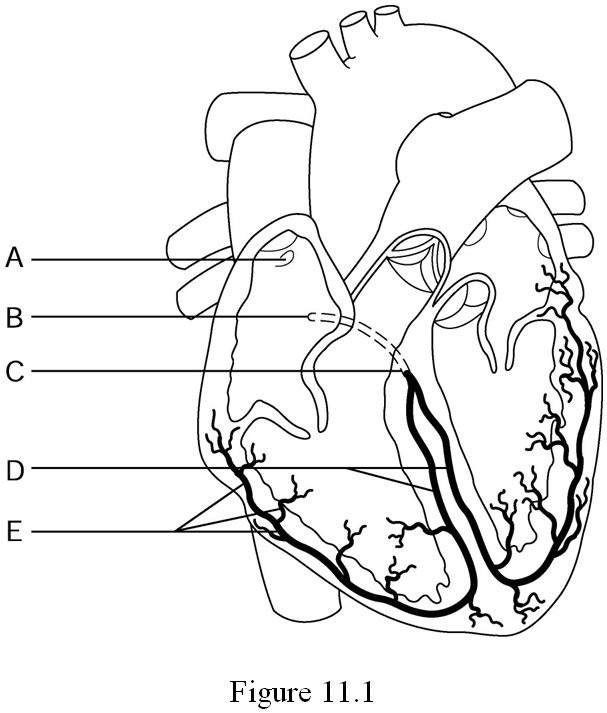
Which label is representing the Purkinje fibers?
A
C
D
E
Which label is representing the SA node?
A
C
D
E
Which label is representing the left & right branches of Bundle of His?
A
C
D
E

What is the contraction phase of a hearbeat called?
Diastole
Sinoatrial
Systole
Atrioventricular

When the atria contract this is called......
Atrial systole
Atrial diastole
Sinoatrial systole
Sinoatrial diastole

When the ventricles contract this is called......
Ventricular systole
Ventricular diastole
Atrioventricular systole
Atrioventricular diastole

When the atria relax it is called....
Atrial diastole
Atrial systole
Sinoatrial diastole
Sinoatrial systole

When the ventricles relax is it called.....
Ventricular diastole
Ventricular systole
Atrioventricular diastole
Atrioventricular systole

Why does a beating heart removed from the body eventually stop?
The brain can no longer send it signals to pump.
The cardiac cells run out of oxygen
The electrical impulses have nowhere to go
In the absence of blood in the atria and ventricles, the heart is no longer stimulated to pump.

What does the term 'cardiac' refer to?
The heart
The lungs
The nervous system
The digestive system

What does the term 'pulmonary' refer to?
The heart
The lungs
The nervous system
The digestive system

What is A?
Valve
Tunica intima
Tunica media
Tunica externa
Epithelial cells
What is B?
Valve
Tunica intima
Tunica media
Tunica externa
What is C?
Valve
Tunica intima
Tunica media
Tunica externa
What is D?
Valve
Tunica intima
Tunica media
Tunica externa
What are E?
Epithelial Cells
Tunica intima
Tunica media
Tunica externa

