
 Worksheets
GCA IA5 Review Physical Science
Total questions: 59
Worksheet time: 2hrs 33mins

Terry fills two balloons with the same amount of helium gas. She places one of her helium balloons in the freezer.
After twenty minutes, she removes the balloon from the freezer and notices that it is smaller than the balloon that
stayed at room temperature. Her balloons are shown above.
How does Terry correctly explain the difference in
the size her balloons?
She says that an increase in pressure increases
the volume of helium gas.
She says that a decrease in pressure decreases
the volume of helium gas.
She says that a decrease in temperature
increases the volume of helium gas.
She says that an increase in temperature increase the volume of the helium gas.

Using the periodic table, which of the following properties does Terry list for helium? Select all that apply.
Helium is a metal.
Helium is a metalloid.
Helium is a nonmetal.
Helium has 2 valence electrons.
Helium has 4 valence electrons.

Which sequence of atomic numbers represents elements that have similar chemical properties?
3,12,21,40
4,20,38,88
9,16,33,36
19,23,30,36

The table shows the measurements of the volume and pressure of a portion of gas at a constant temperature. After graphing, the data reveals that the volume is
inversely proportional to pressure
directly proportional to pressure
inversely proportional to pressure squared
directly proportional to pressure squared
Look at the following equation
_NaCl + _ CaF2 => _NaF + _CaCl2
2,1,3,1
2,2,2,2
2,1,2,1
1,3,1,3
In nuclear fusion reaction, the mass of the products is
less than the mass of the reactants because some of the mass has been converted to energy
more than the mass of the reactants because some of the mass has been converted to energy
less than the mass of the reactants because some of the energy has been converted to mass
more than the mass of the reactants because some the energy has been converted to mass.


What do waves carry from place to place?
Energy but not matter or particles
Matter or particles but not energy
Energy and matter and particles
Frequency is transferred
What is true about sound and light?
Sound has photons and light does not
Sound travels slower than light
Sound can travel through space but light cannot
Frequency and wavelength are directly related for sound and inversely related for light.
Check all that are true about charges.
Neutral atoms have equal proton and electron numbers.
If you lose electrons you become positive.
If you gain electrons you become negative.
Negative ions are called cations.
A lever used to lift a heavy box has an input arm of 4 meters and an output arm of 0.8 meters. What is the mechanical advantage of the lever?
1
2.5
5
10
A child makes a ramp to push his toy dump truck up to his sandbox. If he uses 5 newtons of force to push the 12-newton truck up the ramp, what is the mechanical advantage of his ramp?
1.2
2.4
3.6
4.8
This tells you how many times a simple machine multiplies your force.
action-reaction forces
inertia
mechanical advantage
efficiency
Which of these statements is not one of Newton's Laws?
Objects at rest stay at rest because they have inertia.
Gravity pulls all falling objects down at 9.8 m/s2
Objects with a greater mass will accelerate less.
Object A pushes on object B. B pushes back on object A with an equal and opposite force.

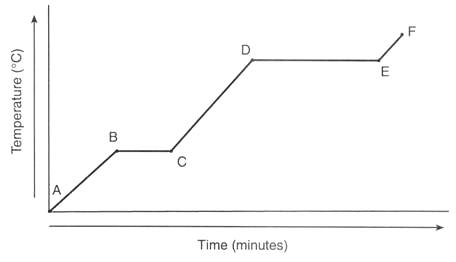

NaCl(s) was heated up starting at an initial temperature of 0°C. The heating curve is shown in the picture. What is the melting point of this substance?
0°C
801°C
1000°C
1465°C

Given the heating curve of water, what is happening to potential and kinetic energy during segment CD?
the potential energy and kinetic energy both increase
the potential energy increases while the kinetic energy decreases
the potential energy is constant while the kinetic energy increases
the potential energy increases while the kinetic energy is constant
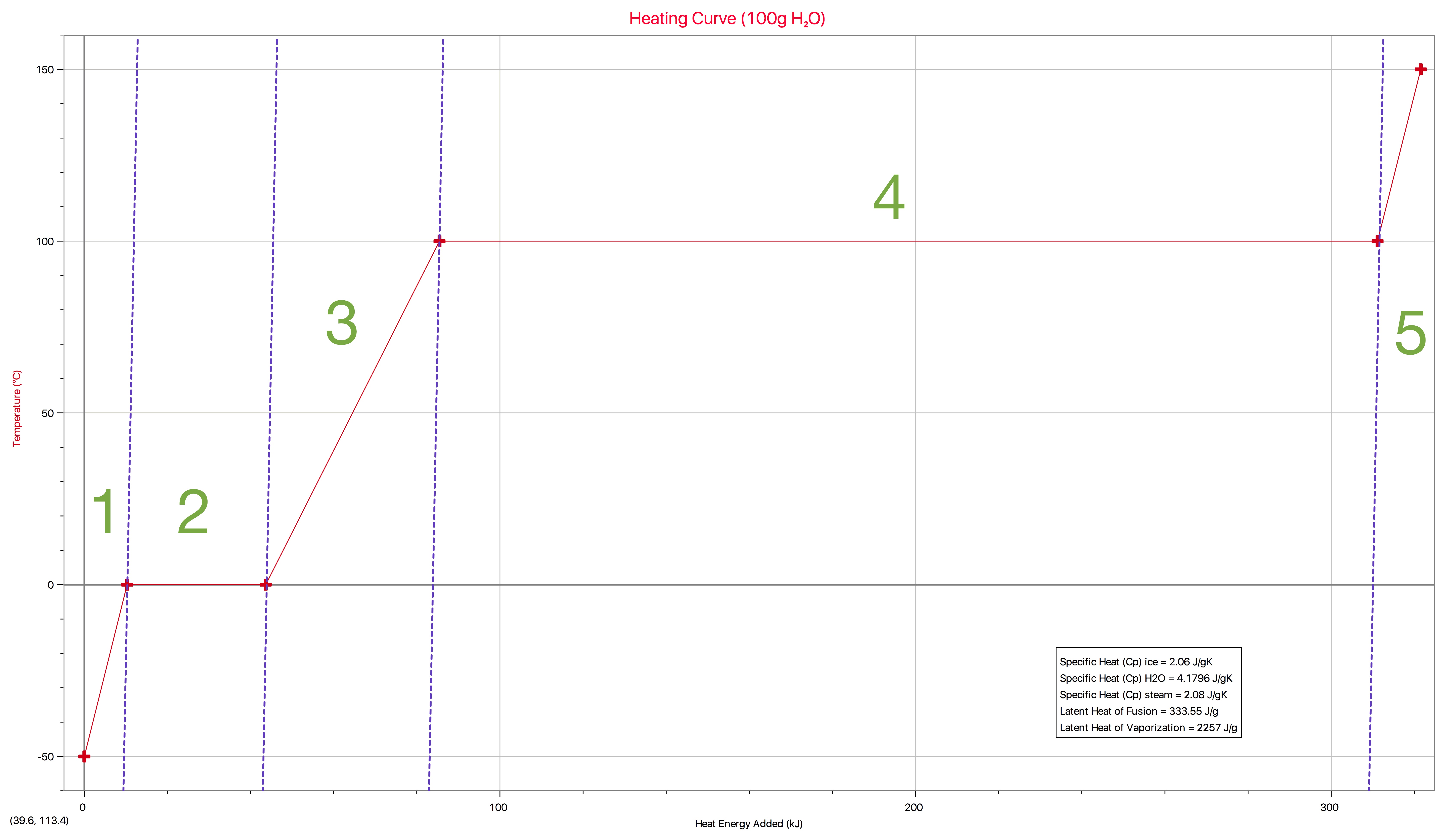
In which region(s) of the graph would the substance be a liquid and a gas at the same time?
Region 1
Region 2
Region 3
Region 4
Region 5

Which will heat up faster?
copper
granite
iron
basalt

Which will heat up slower?
water
lead
granite
iron

A group of friends gather around a fire to stay warm. This is an example of ________.
conduction
convection
radiation
Which is an example of heat being transferred by conduction?
a furnace heating the air in a school
an ice cube melting in a person’s hand
a pot of water on a stove boiling
the sun heating water in a swimming pool

Near the ceiling of a room the air is warmer. The warm air rises because of ________.
conduction
convection
radiation

What is the energy transformation that occurs in an electric pencil sharpener?
mechanical energy to electrical energy
electrical energy to mechanical energy
radiant energy to sound energy
chemical energy to mechanical energy
Which object shows an energy transformation from electrical to mechanical?


What type of energy transformation happens in a hydroelectric power plant?
kinetic to potential
sound to mechanical
chemical to electrical
mechanical to electrical

What combination would dissolve a solid solute the fastest?
high temperature, no stirring
no heat, no stirring
sugar cube, no heat
high temperature, stirring

For a particular substance, which state of matter has the least thermal energy?
solid
liquid
gas
plasma
When using this to generate electricity, the main problem is radioactive waste.
natural gas
coal
fission
fusion
This process occurs mainly in the sun and other stars.
fusion
fission
radioactive decay
dissolution
In a powerplant, fuel is used to change water into steam. The steam turns a turbine that is connected to the _____. This rotates a magnet in a coil of wire to produce a potential difference.
reactor
simple machine
motor
generator
If 10 mg of iodine 131 is given to a patient, how much is left after 24 days? The half-life of iodine-131 is 8 days.
1.25 mg
2.5 mg
5 mg
10 mg
How many grams are left after 1 half life?

Carbon-14 has a half life of about 5000 years, how many years would it take the 4.0 g sample to decay to 0.25 g?
5 years
5000 years
20,000 years
25,000 years
If iodine-131 is given to a patient, how much of the sample is left after 24 days? The half-life of iodine-131 is 8 days.
1/8
1/2
1/4
1/16
Helium and carbon are combined and produce oxygen. This process is called ___.
fusion
syntheses
fission
combustion
Why do nuclear reactions give off so much energy?
The reaction attracts energy from the surroundings and bounces it off the reactants.
Energy is created out of thin air.
A little energy is converted into mass.
A little mass is converted into energy.
You do an experiment and the mass of the products did not match the mass of the reactants. Check all possiblilities.
Your scale is broken
reactants were destroyed
the reaction produced a gas that didn't get measured
the reaction was an explosion and you couldn't recover all of the products
reactants were destroyed
PbCl2 + AgNO3 → Pb(NO3)2 + AgCl
NH3 + HCl → NH4Cl
Potassium and Sulfur create...
KS
KS2
K2S
K2S2
Have high melting points, crystalline structures, and are brittle. Also formed from a metal and a nonmetal.
ionic compounds
covalent compounds
acids
solutions
Why is the atomic number important?
It tells you the mass of the element
It determines which isotope an atom is
It determines the properties and locatation of an element.
They are gained and lost to form ions.

