wayground logo

Free Printable Worksheets

NEW

Font size

S
M
L
XL
Worksheets

Newton's 2nd Law

Total questions: 51

Worksheet time: 50mins

Name
Class
Date
1.

What is Newton's 2nd Law?

a)

Every action has an equal and opposite reaction

b)

An object at rest stays at rest, an object in motion stays in motion.

c)

F = ma

d)

Friction

2.

If the man pushes with an equal amount of force, which object will accelerate more?

a)

Car because it has more mass

b)

Lawnmower because it has less mass

c)

Car because it has less mass

d)

Lawnmower because it has more mass

3.

What unit do we measure force in?

a)

Kilometer/hr

b)

Joules

c)

Seconds

d)

Newtons

4.

What is force?

a)

A push on an object

b)

A pull on an object

c)

A push or pull on an object

5.
The larger the mass you have the _____ force you need to change its motion.
a)
more
b)
less
6.
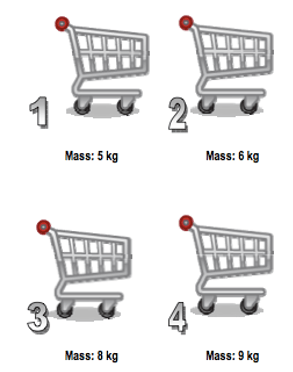
A force of 90N is applied to each cart below, which one will accelerate the fastest?
a)
Cart 1
b)
Cart 2
c)
Cart 3 
d)
Cart 4
7.
Two students are in a baseball game. The first student hits a ball very hard and it has a greater acceleration than the second student who bunts the ball lightly.
a)
Newton's 1st Law
b)
Newton's 2nd Law
c)
Newton's 3rd Law
8.
Why would one ball travel a greater distance than the other when pushed with the same amount of force?
a)
Different sizes
b)
Different weights
c)
Different masses
d)
Different forces
9.
Acceleration is a change in...
a)
Inertia
b)
Gravity
c)
Velocity
d)
Distance
10.
Two skaters begin at rest. Skater 1 has a smaller mass than Skater 2. After they push off each other,...
a)
Skater 1 experiences a greater change in momentum
b)
Skater 2 experiences a greater change in momentum
c)
Skater 1 has a greater velocity than Skater 2
d)
Skater 1 experiences a greater force
11.
Two skaters begin at rest. Skater 1 has a smaller mass than Skater 2. After they push off each other,...
a)
Skater 1 experiences a greater change in momentum
b)
Skater 2 experiences a greater change in momentum
c)
Skater 1 has a greater velocity than Skater 2
d)
Skater 1 experiences a greater force
12.

What are the units of force?

a)

kg

b)

N

c)

m/s

d)

m/s2

13.
When mass is 10 kg, acceleration is 2 m/s/s, what is force?
F = ma
a)
5 N
b)
20 N
c)
8 N
d)
12 N
14.
The larger the mass you have the _____ force you need to change its motion.
a)
more
b)
less
15.
As force applied to a textbook increases, what happens to its acceleration?
a)
Stays the same
b)
Increases
c)
Decreases
d)
Opens
16.
After a cannonball is fired into frictionless space, the amount of force needed to keep it going equals
a)
twice the force with which it was fired
b)
the same amount of force with which it was fired
c)
1/2 the force with which it was fired
d)
zero, since no force is requires to keep it moving. 
17.
Two students are in a baseball game. The first student hits a ball very hard and it has a greater acceleration than the second student who bunts the ball lightly.
a)
Newton's 1st Law
b)
Newton's 2nd Law
c)
Newton's 3rd Law
18.
My cat eyeballs the christmas tree and decides to apply all of his mass directly to the center of the tree. This force causes the tree to accelerate down towards the ground.
a)
Newton's 1st Law
b)
Newton's 2nd Law
c)
Newton's 3rd Law
19.
A person not paying attention while skateboarding hits a rock. The skateboard stops...they don't.
a)
Newton's 1st Law
b)
Newton's 2nd Law
c)
Newton's 3rd Law
20.
Something with a greater mass requires a(n) _____ force to move it. 
a)
greater
b)
lesser
c)
equal
d)
opposite
21.

If the net force is equal to zero, the forces acting on the object are

a)

balanced

b)

unbalanced

22.
An object has a velocity of 20 m/s. How long will it take the object to travel 1000 meters (1 kilometer)?
a)
50 seconds
b)
1 minute
c)
30 seconds
d)
1 minute and 30 seconds
23.
Since Force = Mass * Acceleration, how would you manipulate the equation to solve for mass?
a)
Divide both sides of the equation by Mass
b)
Divide both sides of the equation by force
c)
Divide both sides of the equation by acceleration
d)
Equations cannot be manipulated
24.

If the man pushes with an equal amount of force, which object will accelerate more?

a)

Car because it has more mass

b)

Lawnmower because it has less mass

c)

Car because it has less mass

d)

Lawnmower because it has more mass

25.
What is the net force for this situation?
a)
17 N Right
b)
17 N Left
c)
3 N Right
d)
3 N Left
26.

Which has the MOST inertia?

a)
b)
c)
d)
27.

Which one has the LEAST inertia?

a)
b)
c)
d)
28.
Why would one ball travel a greater distance than the other when pushed with the same amount of force?
a)
Different sizes
b)
Different weights
c)
Different masses
d)
Different forces
29.

A 20 kg bike accelerates at 10 m/s2. What is the force?

a)

25 Newtons

b)

20 Newtons

c)

200 Newtons

d)

10 Newtons

30.
What is the net force?
a)
40 N left
b)
0 N Balalnced
c)
400 N right
d)
40 N right
31.

Which wagon will require more force to move?

a)

Top wagon, because it has more weight.

b)

Top wagon, because it has more mass.

c)

Bottom wagon, because it has more weight.

d)

Bottom wagon, because it has more mass.

32.

A cat has a mass of 200 kg and accelerates at 3 m/s2 to catch a mouse. How much force would be needed to stop the cat?

a)

200 N

b)

300 N

c)

500 N

d)

600 N

33.

Which would require more force to place in your shopping car?

a)

Both

b)

Pineapple

c)

Watermelon

34.
A 20 kg bike accelerates at 10 m/s2.  what was the force
a)
25 N
b)
200 N
c)
20 N
d)
10 N
35.
Suppose that a sled is accelerating at a rate of 2 m/s2. If the net force is tripled then what is the new acceleration of the sled?
a)
12 m/s/s
b)
6 m/s/s
c)
12 in/s/s
d)
120 m/s/s
36.
What law of motion does this picture represent?
a)
Newtons 1st law
b)
law of gravity 
c)
Newtons 4th law 
d)
Newtons 2nd law
37.
Which of Newtons laws  best explains why football teams have big, large, fast athletes.
a)
Gravity
b)
second law
c)
first law
d)
Third law
38.
According to Newton’s first law of motion, a moving object that is not acted on by an unbalanced force will
a)
remain in motion.
b)
eventually come to a stop.
c)
change its momentum.
d)
accelerate.
39.
Pushing  a child on a swing is easier than pushing an adult on the same swing. 
a)
1st Law 
b)
2nd Law
40.
A 20 kg bike accelerates at 10 m/s2.  what was the force
a)
25
b)
200 N
c)
20 N
d)
10 N
41.
Which type of force(s) will cause a change in an object's motion?
a)
gravity
b)
zero net force
c)
balanced forces
d)
unbalanced forces
42.

Henry sees a basketball and decides to put in motion. What kind of force does Henry use to move the ball?

a)

small

b)

balanced

c)

equal

d)

unbalanced

43.

Which activity would BEST demonstrate Newton's law of Inertia?

a)

A plate sits on a table top.

b)

A lady pushes a grocery cart.

c)

A child jumps on a trampoline.

d)

A boy swings a baseball bat.

44.

When there is an INCREASE in MASS of an object you will have a DECREASE in ______________.

a)

friction

b)

acceleration

c)

force

d)

gravity

45.

A 25 kg bike accelerates at 10 m/s2. What was the force?

a)

250 N

b)

2.5 N

c)

25 N

d)

15 N

46.
Acceleration changes and object's...
a)
speed, direction or both
b)
speed, gravity or both
c)
gravity, direction or both
d)
inertia, speed or both
47.
"If we apply a ___________ to an object, its __________________ will change and it will  ______________."
a)
force, accelerate, gravity
b)
accelerate, inertia, gravity
c)
force, velocity, accelerate
d)
velocity, gravity, inertia
48.

A 10-kg crate is pushed across a frictionless surface with a force of 30 N. What is its acceleration?

a)

300 m/s2

b)

3 m/s2

c)

20 m/s2

d)

0.33 m/s2

49.

The law which states that force equals mass

times acceleration. F = ma

a)

Newton's Law of Gravitation

b)

Newton's 1st Law of Motion

c)

Newton's 2nd Law of Motion

d)

Newton's 3rd Law of Motion

50.

The rate of change in velocity: speeding up, slowing down, or changing direction

a)

Force

b)

Speed

c)

Mass

d)

Acceleration

51.

The overall force acting on a system or object after opposing or balanced forces cancel each other out

a)

Net Force

b)

Balanced Force

c)

Unbalanced Force

d)

Frictional Force