Wayground logo

Free Printable Worksheets

Font size

S
M
L
XL
Worksheets

Who's In Control & It's A Breeze

Total questions: 73

Worksheet time: 3585secs

Name
Class
Date
1.

_____________ is average weather condition of a place over a long period of time over a large area.

a)

Climate

b)

Weather

2.

____________ Changes from Day to Day

a)

Climate

b)

Weather

3.

Which of the following area receive direct sunlight

a)

Tropic of Cancer

b)

Artic circle

c)

Equator

4.

Identify the factor that influence the temperature of these two areas

a)

Latitude

b)

Altitude

c)

Distance from Large Bodies of Water

d)

Ocean Currents

5.

Which of the following area receive direct sunlight

a)

Tropic of Cancer

b)

Artic circle

c)

Equator

6.

Identify the factor that influence the temperature of these two areas

a)

Latitude

b)

Altitude

c)

Distance from Large Bodies of Water

d)

Ocean Currents

7.

What factor is influencing the temperature of these two cities

a)

Latitude

b)

Altitude

c)

Distance from Large Body of Water

d)

Ocean Currents

8.
What is the measure of distance in degrees north and south from the equator?
a)
latitude
b)
longitude
c)
elevation
d)
topography
9.
What is the height of an area above sea level?
a)
elevation
b)
topography
c)
latitude
d)
longitude
10.
Which sentence best describes how latitude and temperature are related?
a)
LOWER latitude = COLDER air temperature
b)
HIGHER latitude = COLDER air temperature
c)
HIGHER latitude = WARMER temperatures
11.

What determines the major climate zones?

a)

altitude

b)

latitude

c)

ocean currents

12.

Which city will have warmer average temperatures

a)

Denver

b)

Cheyenne

13.

Which BEST describes why latitudes closest to the equator have warmer climates?

a)

they are at lower elevations

b)

they receive high angle sunlight

c)

they are nearer to ocean currents

d)

they get more winds that carry energy in the form of heat

14.
What effect does a large body of water usually have on a nearby landmass?
a)
The water causes cooler summers and colder winters. 
b)
The water causes cooler summers and warmer winters. 
c)
The water causes hotter summers and warmer winters. 
d)
The water causes warmer summers and colder winters. 
15.

What are the major climate zones?

a)

tundra, desert, mediterranean

b)

grasslands, mountains, rainforest

c)

polar, temperate, tropical

16.

What is the average weather of an area over a long period of time?

a)

climate

b)

weather

17.

Describe the climate for the polar zone.

a)

Very cold

b)

Very hot

c)

Different seasons (hot, cold, warm, cool)

18.

Describe the climate for the tropical zone.

a)

Very cold

b)

Very hot

c)

Different seasons (hot, cold, warm, cool)

19.

Describe the climate for the temperate zone.

a)

Very cold

b)

Very hot

c)

Different seasons (hot, cold, warm, cool)

20.

Which city will have a cooler average temperature

a)

Chapel Hill

b)

Havana

21.

Identify the factor that influence the temperature of these two areas

a)

Latitude

b)

Elevation

c)

Distance from Large Bodies of Water

d)

Ocean Currents

22.
What is the height of an area above sea level?
a)
elevation
b)
topography
c)
latitude
d)
longitude
23.

Fill in the blank: The higher the altitude, the ______ the temperature.

a)

warmer

b)

colder

24.

What factor is influencing the temperature of these two cities

a)

Latitude

b)

Elevation

c)

Distance from Large Body of Water

d)

Ocean Currents

25.

Which city will have warmer average temperatures

a)

Denver

b)

Cheyenne

26.

Which BEST describes why latitudes closest to the equator have warmer climates?

a)

they are at lower elevations

b)

they receive high angle sunlight

c)

they are nearer to ocean currents

d)

they get more winds that carry energy in the form of heat

27.
What effect does a large body of water usually have on a nearby landmass?
a)
The water causes cooler summers and colder winters. 
b)
The water causes cooler summers and warmer winters. 
c)
The water causes hotter summers and warmer winters. 
d)
The water causes warmer summers and colder winters. 
28.
The biggest factor in determining climate is?
a)
elevation
b)
an ocean
c)
latitude
d)
mountain
29.

Latitudes closer to the equator are _________

a)

Cooler

b)

Warmer

c)

Dryer

30.

It gets ______ the further you move from the equator.

a)

warmer

b)

colder

c)

wetter

d)

dryer

31.
The sun’s rays are least direct __________.
a)
near the poles.      
b)
in July.
c)
near the equator.
d)
far from the ocean.
32.

What type of air mass do we have at the equator?

a)

Cold descending air

b)

Warm rising air

33.
As you go to the top of a mountain, what happens to temperature?
a)
Nothing
b)
It increases
c)
It decreases
d)
It goes up and down
34.
Large bodies of water affect climate of the land next to them because
a)
water heats up and cools more slowly than land
b)
water heats up and cools faster than land
c)
water and land cool at the same time
d)
water and land heat at the same rate
35.
Which of the following will heat the fastest? 
a)
water
b)
land
c)
both heat at equal rates
36.

What is the height of an area above sea level?

a)

altitude

b)

topography

c)

latitude

d)

longitude

37.
What region receives the least amount of solar radiation?
a)
Polar Region
b)
Temperate Region
c)
Equatorial Region
d)
Tropical Region
38.

Which two factors cause Oudtshoorn to receive less rain than George.

a)

Relief and latitude

b)

Latitude and ocean currents

c)

Relief and distance from the sea.

d)

Height above sea level and ocean currents
39.
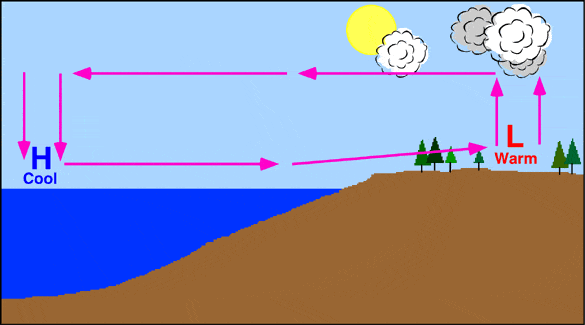
Do sea breezes typically happen during the day or night?
a)
Day
b)
Night
40.
Do land breezes typically happen during the day or night?
a)
Day
b)
Night
41.
During a land breeze which way does the wind blow?
a)
from the sea to the land
b)
from the land to the sea
42.
During a sea breeze which way does the wind blow?
a)
from the land to the sea
b)
from the sea to the land
43.
Is this a land or a sea breeze?
a)
land breeze
b)
sea breeze
44.
Is this a land or a sea breeze?
a)
land breeze
b)
sea breeze
45.
How does the air move in a land breeze?
a)
From east to west
b)
From west to east
c)
From the land to the ocean
d)
From the ocean to the land
46.
The strength of a sea breeze depends on
a)
the heat of the day
b)
the difference between the temperature of the sea and the land
c)
the wind speed
d)
the amount of precipitation that day
47.
How does the air move in a sea breeze?
a)
wind moves from north to south
b)
wind moves from ocean to the land
c)
wind moves from the land to the ocean
d)
wind moves from south to north
48.
In a sea breeze, the air is warmer above the _____.
a)
land
b)
ocean
c)
sky
d)
beach
49.
Where does the initial source of energy come from that creates winds?
a)
the moon
b)
the sun
c)
the Earth's surface
d)
the rotation of the Earth
50.
Land and water absorb and release the sun’s heat in different ways. One result of this is a sea breeze. Which statement is true of sea breezes?
a)
They originate in the day and blow toward the land.
b)
They originate in the day and blow toward the water.
c)
They originate in the evening and blow toward the land.
d)
They originate in the evening and blow toward the water.
51.
Why does warm air rise?
a)
Warm air is more dense than cooler air.
b)
Warm air has more pressure than cooler air.
c)
Warm air is less dense than cooler air.
d)
Warm air has a higher dew point than cooler air.
52.
Why do land breezes occur at night?
a)
Land cools off slower than water, so the air above water is cooler.
b)
Water cools off faster than land, so the air above land is warmer.
c)
Land heats up slower than water, so the air stays cooler during the day.
d)
Water cools off slower than land, so the air above water is warmer.
53.
What occurs when cool air moves from the beach toward the ocean during the night? 
a)
a land breeze 
b)
prevailing winds 
c)
a sea breeze 
d)
updrafts
54.

Land breeze and sea breezes are caused by the different _________ between land and water surfaces.

a)

rotations

b)

temperatures

c)

gases

d)

solids

55.

Sea breezes take place during the ________ because the warmer land temperature results in a warmer air mass above the land compared to the cooler air mass over the surface of water.

a)

day

b)

night

56.

What is the main cause of winds?

a)

amount of trees

b)

the moon's gravity

c)

amount of animals

d)

uneven heating of Earth's surface

57.

A cool breeze is blowing from the ocean towards the land during the day. This is called a

a)

land breeze

b)

trade wind

c)

sea breeze

d)

easterly

58.

Air moves from _______ pressure to ________ pressure.

a)

high to low

b)

low to high

c)

high to high

d)

low to low

59.

The Coriolis Effect influences wind direction around the world due to the ______ of Earth cause the winds to curve.

a)

tilt

b)

shift

c)

height

d)

rotation

60.

The jet stream ___________ (select all that apply)

a)

flows from west to east

b)

a high speed air current current

c)

helps form weather fronts

61.
This is a...
a)
Land Breeze
b)
Sea Breeze
62.
Which warms up faster during the day?
a)
Sea/Water
b)
Land
63.

Do sea breezes typically happen during the day or night?

a)

Day

b)

Night

64.
Do land breezes typically happen during the day or night?
a)
Day
b)
Night
65.

Flow of air from land to a body of water is called:

a)

doldrum

b)

chinook

c)

sea breeze

d)

land breeze

66.

Sea breezes occur?

a)

during the day

b)

during the night

c)

high noon

d)

full moon

67.
What kind of air pressure does COLD air have?
a)
High pressure
b)
Low pressure
68.
What kind of air pressure does WARM air have?
a)
High pressure
b)
Low pressure
69.
During the day, warm air rises over the land then cools and falls over water in a continuous cycle.
a)
Land breeze
b)
Sea breeze
70.
What kind of breeze is this and when would it form?
a)
Land breeze - daytime
b)
Land breeze - nighttime
c)
Sea breeze - daytime
d)
Sea breeze - nighttime
71.
How does the air move in a land breeze?
a)
From east to west
b)
From west to east
c)
From the land to the ocean
d)
From the ocean to the land
72.
Which best describes why winds at the beach change direction between day and night? **
a)
because the temperatures over land and over water change 
b)
because warm air over land sinks and stays in place over land
c)
because cool air rises and is replaced by warm air from the ocean 
d)
because cool air sinks and stays in place over land 
73.
Why do land breezes occur at night?
a)
Land cools off slower than water, so the air above water is cooler.
b)
Water cools off faster than land, so the air above land is warmer.
c)
Land heats up slower than water, so the air stays cooler during the day.
d)
Water cools off slower than land, so the air above water is warmer.