Wayground logo

Free Printable Worksheets

Font size

S
M
L
XL
Worksheets

Unit 4 Earth Structure

Total questions: 33

Worksheet time: 28mins
Name
Class
Date
1.
What do we call the center of the Earth?
a)
Mantle
b)
Crust
c)
Apple
d)
Core
2.
Which is the hottest part of the Earth?
a)
The core
b)
The mantle
c)
The crust
d)
The Asthenosphere
3.
What is the core made of?
a)
Molten rock
b)
Solid rock
c)
Molten metal
d)
Solid metal
4.
Which is the coolest part of the planet?
a)
inner core
b)
outer core
c)
mantle
d)
crust
5.
Which two metals are thought to be found in the core?
a)
iron and steel
b)
iron and nickel
c)
gold and silver
d)
iron and copper
6.
Which of these layers is the largest?
a)
lithosphere
b)
asthenosphere
c)
outer core
d)
mantle
7.

Which layer is made (mostly) of LIQUID iron and nickel?

a)

crust

b)

mantle

c)

outer core

d)

inner core

8.
Which explains that the continents were once joined together and over time they broke up and then drifted apart?
a)
Plate Tectonic Theory
b)
Continental Drift 
9.
This boundary is described by two plates moving away from eachother along the edges and separating. The resulting gap allows magma to rise and create new crust, forming new lithosphere. 
a)
Convergent Boundary 
b)
Divergent Boundary  
c)
Transform Boundary
10.
This boundary is described as two plates moving past eachother ALONG THE EDGES horizontally.  These boundaries will get stuck or lock against eachother causing earthquakes when they slip and release. 
a)
Convergent Boundary
b)
Divergent Boundary
c)
Transform Boundary
11.
This boundary is described as moving toward one another  When the plates are both continental plates the will crumple up and form a mountains. When they are continental and oceanic plates, subduction occurs  and earthquakes and volcanoes form. 
a)
Convergent Boundary
b)
Divergent Boundary
c)
Transform Boundary
12.
New crust is created at this type of  boundary.
a)
Divergent
b)
Convergent, Subduction Zone
c)
Transform 
13.
Mountains are created at this type of  boundary.
a)
Divergent 
b)
Convergent
c)
Transform 
14.
Mid Ocean Ridge Formation  is created at this type of  boundary.
a)
Divergent 
b)
Convergent
c)
Transform 
15.

Earth's plates meet at ____________.

a)

plate tectonics

b)

plate boundaries

c)

continental drift

d)

oceans

16.

Breaks in the crust called __________ form where plates meet.

a)

mountains

b)

rift valleys

c)

faults

d)

trenches

17.

Plates slide past each other at _________________ boundaries.

a)

divergent

b)

convergent

c)

transform

d)

universal

18.

________________ currents drive Earth's plate movement.

a)

ocean

b)

atmosphere

c)

wind

d)

convection

19.

The San Andreas fault is an example of which type of boundary?

a)

transform

b)

divergent

c)

convergent

d)

universal

20.

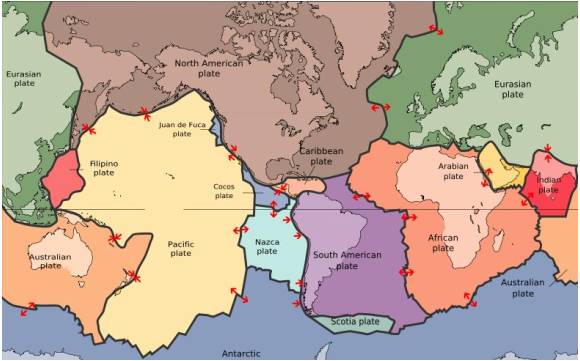
The map in the picture shows tectonic plate boundaries. This map would be useful in predicting the location of future

a)

droughts

b)

hurricanes

c)

earthquakes

d)

tornadoes

21.
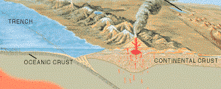
What geological forces might be responsible for this range of mountains?
a)
diverging tectonic plates
b)
erosion of the land by the ocean
c)
converging tectonic plates
d)
deposition of sediments by the ocean
22.

Why does Japan experience a lot of earthquakes?

a)

They are located on three tectonic plates

b)

They are on a hotspot

c)

There's a big convection current under Japan

d)

Japan is an island

23.
____ is when one plate sinks beneath another plate.
a)
collide
b)
subduction
c)
isostasy
24.

Which of the following did not contribute to Hawaii's formation?

a)

A hot spot coming through the crust

b)

Subduction in the Ring of Fire around the Pacific

c)

The plate moving over a hotspot

d)

Volcanoes forming islands and eventually eroding

25.
What is this a picture of?
a)
plate tectonics
b)
continental drift
c)
pangea
d)
glacier scaring
26.
Which piece of evidence did Wegener use to prove continental drift?
a)
The shape of the continents
b)
Similar fossils found on separate continents
c)
Tree fossils found in odd places
d)
All of the above
27.

What do seismic waves teach us about the layers of the earth? Click the best answer.

a)

That they are all different.

b)

That the crust is solid.

c)

That the outer core is liquid.

d)

That the inner core has the most pressure.

28.

Volcanoes do not usually form at...

a)

Hotspots

b)

Transform boundaries

c)

Divergent boundaries

d)

Convergent boundaries

29.

Which of the following is not a type of crust? Select all that apply.

a)

Oceanic

b)

Subduction

c)

Continental

d)

Glaciated

e)

Convection

30.

Why is the inner core solid? Choose the best answer.

a)

Pressure

b)

Temperature

c)

Made of metal

d)

Made of rock

31.

New crust is most likely to form at which boundary?

a)

Transform

b)

Convergent

c)

Divergent

32.

What is the difference between the focus of an earthquake, and the epicenter?

a)

The focus is underground, the epicenter is above ground.

b)

The focus is above ground, the epicenter is underground.

c)

The focus is underground, the epicenter is how far the earthquake reaches

d)

They are the same thing

33.

Which layer has the most pressure?

a)

Crust

b)

Mantle

c)

Outer Core

d)

Inner Core