wayground logo

Free Printable Worksheets

NEW

Font size

S
M
L
XL
Worksheets

Semester 2 Review

Total questions: 44

Worksheet time: 4hrs 19mins

Name
Class
Date
1.
For the Balanced Reaction: 3 Mg + 1 Fe2O3 → 3 MgO + 2 Fe; What is the Ratio of moles of MgO to moles Fe?
a)
3mol Mg / 2 mol Fe
b)
2 mol Mg/ 3 mol Fe
c)
1 mol Fe/ 2 mol Fe
d)
3 mol MgO / 2 mol Fe
2.
2H2  +   O2  →  2H2O
How many moles of oxygen are consumed if 8 moles H2 are used?
a)
2
b)
4
c)
6
d)
8
3.
 SiO2 + 3C → SiC + 2CO
I need to add 8 moles of Carbon to the reaction. How many grams of Carbon should I weigh?
a)
96 g
b)
0.67 g
c)
2.67 g
d)
48 g
4.
KNO3 --> KNO2 + O2
What coefficients are needed to balance the reaction?
a)
2, 2, 1
b)
2, 3, 2
c)
1, 2, 2
d)
1, 3, 1
5.
O2 + CS2 --> CO2 + SO2
What coefficient would go in front of the O2?
a)
1
b)
2
c)
3
d)
4
6.
2H2   +   O2  →  2H2O
How many moles of water can be produced if 8 moles H2 are used?
a)
4 moles
b)
8 moles
c)
16 moles
d)
2 moles
7.
For the Balanced Reaction: 3 Mg + 1 Fe2O3 → 3 MgO + 2 Fe; What is the Ratio of moles of Mg to moles Fe?
a)
3mol Mg / 2 mol Fe
b)
2 mol Mg/ 3 mol Fe
c)
1 mol Fe/ 2 mol Fe
d)
3 mol MgO / 2 mol Fe
8.
How many moles are in 19.82 g Mg? 
a)
1.226mol Mg
b)
481.7mol Mg
c)
1.000mol Mg
d)
 0.8156 mol Mg
9.

What is the mass in grams of 2.3456 moles of W?

a)

431.22 grams

b)

6.02 grams

c)

207.2 grams

d)

486.01 grams

10.

How many moles are in 1459 grams of Na?

a)

63.46 moles

b)

60.36 moles

c)

10 moles

d)

1 mole

11.

How many grams are equal to 0.11 mole of copper (I) chromate, Cu2(CrO4)?

a)

26.74 g

b)

19.75 g

c)

39.50 g

d)

13.69 g

12.

Find the mass of 11.37 mol of BaO. Round to the nearest whole number.

a)

1,354 g

b)

1,740 g

c)

17.40 g

d)

1,684 g

13.

Determine the number of moles of AlNO3 that are in 264 g of the compound.

a)

2.97 mol

b)

3.45 mol

c)

2.73 mol

d)

1.86 mol

14.

Determine the amount of moles in CuBr that are in 276.9 g of the compound.

a)

3.2 mol

b)

1.7 mol

c)

2.1 mol

d)

1.9 mol

15.

How many moles of hydrogen, H2, are needed to react with 2.0 moles of nitrogen, N2?

a)

3 moles H2

b)

0.66 moles H2

c)

6 moles of H2

d)

1.5 moles H2

16.

How many moles of oxygen are produced by the decomposition of 6.0 moles of potassium chlorate, KClO3?

a)

12 moles O2

b)

4 moles O2

c)

18 moles O2

d)

9 moles O2

17.

You are and engineer at a chemical plant. The plant manager says you need to make 6 moles of Zinc(II) Chloride. How many moles of Hydrochloric Acid (HCl) do you need to be able to make 6 moles of Zinc(II) Chloride?

a)

2 mole Zn

b)

0.33 mole Zn

c)

3 mole Zn

d)

12 mole Zn

18.

You are a chemistry teacher and you have to order chemicals for next year’s classes. You want to the students to complete labs using the reaction provided. How many moles of each reactant would you need to order if you want to make 10 moles of the product.

a)

5 and 15

b)

20 and 30

c)

0.2 and 6.67

d)

1 and 3

19.

You are a car mechanic. How many moles of Oxygen do you add to the gas tank to convert 10 moles of propane (C3H8) to give you additional power?

a)

0.30 moles O2

b)

30 moles O2

c)

3.33 moles O2

d)

0.30 moles O2

20.
2Na + S -->Na2S
What is the total number of moles of Na2S produced when 8.0 moles of Na were completely consumed?
a)
1
b)
2
c)
0.5
d)
4
21.
4NH+ 5O2-->4NO + 6H2O
What is the total number of moles of NO produced when 1 mole of O2 is completely consumed?
a)
1
b)
1.2
c)
0.8
d)
4
22.
Is the equation balanced?: 2H2O + O2 --> 4MgO + 3Fe
a)
Yes
b)
No
23.
Balance this equation
_Zn+_HCl-->_ZnCl+_H2
a)
1,1,2,1
b)
1,1,1,2
c)
1,2,1,1
d)
2,1,1,1
24.
Balance this equation-
__P+ __O--> __P2O3
a)
it is already balanced
b)
2, 1, 3
c)
1, 2, 3
d)
1, 3, 2
25.

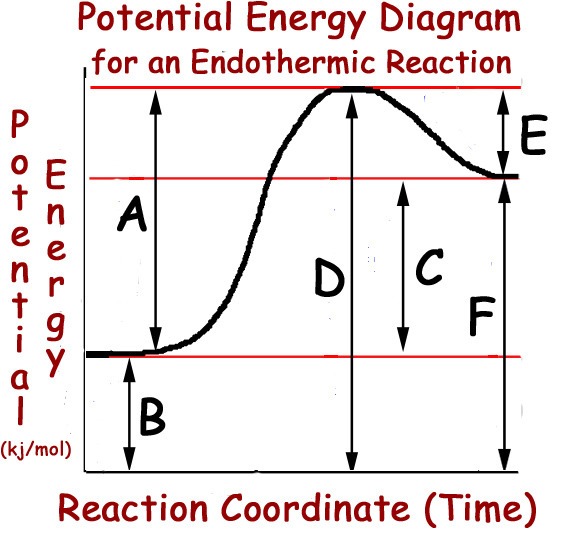
What type of reaction is this?

a)

Endothermic

b)

Exothermic

26.
Grinding a seltzer tablet into powder increases the rate of reaction due to increased
a)
concentration
b)
surface area
c)
temperature
d)
reactants
27.
Why does a higher temperature increase the rate of a reaction?
a)
it increases both the frequency and energy of particle collisions
b)
it only increases the frequency of particle collisions
c)
it only increases the energy of particle collisions
d)
it reduces the activation energy of the reaction
28.
Why does a higher concentration increase the rate of reaction?
a)
it increases the amount of reactants
b)
it lowers the activation energy
c)
it increases the energy of particle collisions
d)
it increases the frequency of particle collisions because there are more collision sites
29.

More collisions correspond to a:

a)

Faster reaction rate

b)

Slower reaction rate

c)

Constant reaction rate

30.
Which of the following is/are the fundamental idea(s) of collision theory?
a)
Molecules react by colliding together
b)
The effective collisions must occur with certain minimum amounts of energy 
c)
In a large sample, the greater the number of effective collisions, and the faster the rate of reaction
d)
All of the above
31.
What process occurs when coal (fossil fuel) is used for energy?
a)
Decomposition
b)
Combustion
c)
Pressurization 
d)
Respiration 
32.
Respiration is the process by which animals take in _____ and release _____. 
a)
photosynthesis, air
b)
carbon, oxygen
c)
oxygen
d)
oxygen, carbon dioxide
33.
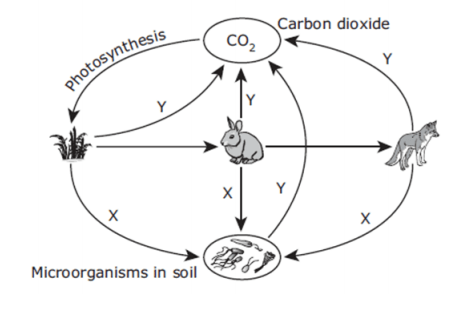
The diagram shows the flow of organic molecules through an ecosystem. What two processes are identified by the labels X and Y?
a)
X : Respiration
Y : Predation
b)
X : Adaptation
Y : Decomposition
c)
X : Fermentation
Y : Nitrogen Fixation
d)
X : Decomposition
Y : Respiration
34.
What does NOT produce carbon dioxide?
a)
Photosynthesis
b)
Burning Fossil Fuels
c)
Animal respiration
d)
Plants decaying
35.
Combustion is another word for __________.
a)
Transportation
b)
Respiration
c)
Fossil Fuels
d)
Burning
36.
Which of the following is an example of a decomposer?
a)
Owl
b)
Fish
c)
Tree
d)
Mushroom
37.

C6H12O6 is also known as glucose (sugar). Where is it found?

a)

Plants

b)

Animals

c)

Both plants and animals

d)

Neither plants or animals

38.

How do carbon emissions lead to global warming?

a)

By trapping the sun's heat in the atmosphere.

b)

By causing very hot volcanic eruptions.

c)

Rocks become richer in carbon as time goes by.

d)

By increasing the amount of carbon in the earth's crust

39.
Which of the following is the best conclusion that can be made from this graph?
a)
atmospheric carbon dioxide levels have been decreasing since 1960
b)
Hawaii has a lot of carbon dioxide
c)
humans have been working hard to decrease carbon dioxide levels
d)
atmospheric carbon dioxide levels have increased steadily since 1960
40.
Which process converts carbon in the form of sugar into carbon dioxide gas?
a)
Bioremediation
b)
Photosynthesis
c)
Respiration
d)
Transpiration
41.

How do animals get carbon?

a)

By eating plants and or other animals.

b)

They absorb it from the atmosphere.

c)

From the ground

d)

They do not get carbon from anywhere.

42.

Is carbon dissolved at the surface of the ocean or in the deep ocean?

a)

Surface

b)

Deep

43.
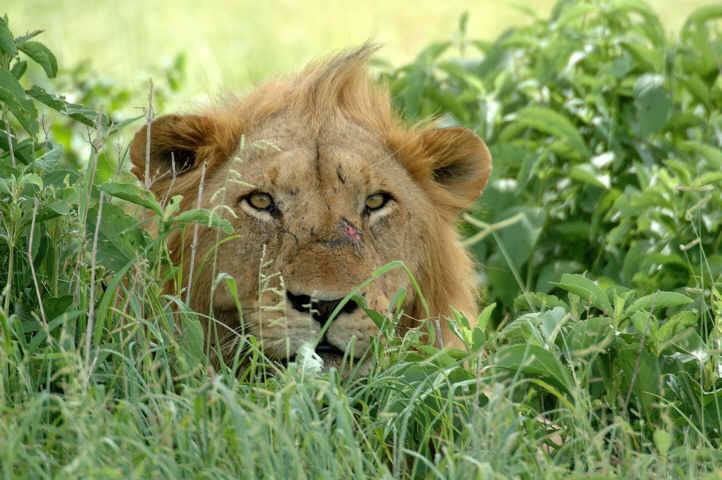
How does the carbon in grass become part of a lion?
a)
The lion eats the grass
b)
Carbon from grass doesn't end up in a lion. 
c)
The carbon ends up in the lion's food chain. 
d)
The lion breathes in carbon given out by the plant
44.

Which gas do plants release, that humans depend on for survival?

a)

Water

b)

Carbon Dioxide

c)

Oxygen

d)

Sugar