wayground logo

Free Printable Worksheets

NEW

Font size

S
M
L
XL
Worksheets

2nd Semester Final Review

Total questions: 70

Worksheet time: 35mins

Name
Class
Date
1.

What foreign policy guided American presidents during the Cold War to stop the spread of communism?

a)

Open Door Policy

b)

Dollar Diplomacy

c)

Big Stick Policy

d)

Containment

2.

What American policy provided Western European countries financial assistance so they could recover from WWII?

a)

Marshall Plan

b)

Domino Theory

c)

Truman Doctrine

d)

Big Stick Policy

3.

What individual/group contributed to the Red Scare and accused American citizens of being communists?

a)

Martin Luther King & Black Panthers

b)

Jane Addams & Settlement Houses

c)

Joseph McCarthy & HUAC

d)

Cesar Chavez & United Farmworkers Union

4.

During what event did the U.S. bypass a Soviet blockade without provoking a military conflict?

a)

Berlin Airlift

b)

Cuban Missile Crisis

c)

Korean War

d)

Vietnam War

5.

During the Cuban Missile Crisis, what did JFK do when he heard that the Soviet Union was construction a missile site in Cuba.

a)

JFK gave into the Soviet demands.

b)

JFK bombed the Soviet Union with an atomic bomb.

c)

JFK ordered a naval blockade of Cuba.

d)

JFK invaded Cuba from Guantanamo Bay.

6.

After WWII what happened to the population of the U.S?

a)

The population moved westward as a result of the railroad.

b)

African Americans moved north as part of the Great Migration.

c)

The population shifted from the Rust Belt to the Sun Belt.

d)

The population grew due to the Baby Boom.

7.

What did those in the counter-culture do when the government escalated deployment of troops in Vietnam and implemented a draft?

a)

The counter-culture organized protests.

b)

There were mass anti-war demonstrations.

c)

Some individuals burned their draft cards.

d)

All of the above

8.

What wars were fought during the Cold War as a result of containment and the Domino Theory?

a)

Korean & Vietnam War

b)

WWI & WWII

c)

Civil War & Spanish American War

d)

Persian Gulf & War on Terror

9.

What policy implemented in the Cold War said the U.S. would give military aid to a country that needed to resist communism?

a)

Marshall Plan

b)

Truman Doctrine

c)

Domino Theory

d)

Open Door Policy

10.

What theory caused the U.S. to enter the Vietnam War in order to stop the expansion of communism across Southeast Asia?

a)

Marshall Plan

b)

Domino Theory

c)

Open Door Policy

d)

Dollar Diplomacy

11.

What words should you immediately associate with the Cold War?

a)

Hitler & the Nazis

b)

Economic recession

c)

Containment of Communism

d)

Corruption & Industrialization

12.
Winston Churchill led which country during World War II?
a)
France
b)
United States
c)
Great Britain
d)
Soviet Union
13.
Benito Mussolini led which country during World War II?
a)
Italy
b)
Japan
c)
Soviet Union
d)
France
14.
Hideki Tojo led which country's military during World War II?
a)
Italy
b)
Soviet Union
c)
Japan
d)
United States
15.
What were the two U.S. Presidents during World War II?
a)
Eisenhower and Truman
b)
FDR and Eisenhower
c)
Trump and Washington
d)
FDR and Truman
16.
What event led to the US joining World War II? 
a)
Germany invaded Poland. 
b)
Germany sent Mexico a secret telegram. 
c)
Japan bombed Pearl Harbor.
d)
Germany bombed Pearl Harbor. 
17.
During World War II, many Japanese Americans living on the West Coast were relocated to detention centers primarily because they
a)
were known spies for Japan
b)
were seen as a security threat
c)
refused to serve in the United States military
d)
expressed their support for Italy and Germany
18.
Shortly after entering World War II, the United States began the Manhattan Project to
a)
work on the development of an atomic bomb
b)
increase economic production to meet wartime demands
c)
defend New York City against a nuclear attack
d)
recruit men for the military services
19.
What was the purpose of the "cash and carry" policy adopted by the US government in 1939?
a)
to preserve US neutrality
b)
to gain access to new trade markets
c)
to spread democracy around the world
d)
to punish aggressor nations
20.
What was the purpose for rationing by the Office of Price Administration?
a)
to ensure schools did not run out of supplies
b)
to ensure that children did not use too many products
c)
to ensure enough products were available for military use
d)
to ensure elderly citizens had enough goods
21.
Why did Americans buy war bonds during World War II?
a)
To avoid paying taxes.
b)
To donate part of their wages to the military
c)
To finance public works projects.
d)
To lend the government money to pay for the war.
22.
Why did President Truman ultimately decide to use atomic weapons in Japan?
a)
To prevent the potential loss of American lives from an invasion of Japan.
b)
The need to defeat Japan before defeating Germany
c)
plan to bring democratic government to Japan 
d)
The failure of the island hopping campaign against Japan
23.
The goal of the Double V Campaign was Victory for the Allies in Europe and Victory over which social issue?
a)
discrimination and inequality in the United States
b)
government censorship and propaganda
c)
the gender wage gap in the United States
d)
the suspension of civil liberties during wartime
24.
The American campaign to defeat the Japanese shown in the map above was known as
a)
island blitzkrieg
b)
shock and awe in the islands
c)
island hopping
d)
island trenching
25.
Which of the following shows the correct sequence of events in WWII?
a)
Pearl Harbor; Battle of Midway; D-Day; VE-Day; VJ-Day
b)
Pearl Harbor; Battle of Midway; VJ-Day; D-Day; VE-Day
c)
Battle of Midway; D-Day; VE-Day; Pearl Harbor; VJ-Day
d)
D-Day; VE-Day; Pearl Harbor; Battle of Midway; VJ-Day
26.
The ____ granted the president broad military powers in Vietnam
a)
Geneva Accords
b)
Tonkin Gulf Resolution
c)
Marshall Plan
d)
Operation Rolling Thunders
27.
Shifting the burden of actual combat from American troops to S. Vietnamese forces.
a)
Vietminization
b)
Vietcong
c)
Internationalism
d)
Linkage
28.
What event caused a negative shift in U.S. public opinion during the Vietnam War?
a)
The Geneva Accords
b)
Operation Rolling Thunder
c)
The Tet Offensive
d)
Gulf of Tonkin
29.
At which University did the National Guard open fire upon protestors? 
a)
K-State 
b)
Kansas 
c)
Kennesaw 
d)
Kent State
30.

What problem were both the Civilian Conservation Corps (CCC) and the Works Progress Administration (WPA) developed to address?

a)

Excessive stock market speculation

b)

High unemploment

c)

Increased use of credit

d)

Overproduction of goods

31.
When President Roosevelt talked to the American people directly over the radio, they called it ____ ____.
a)
Fireside Chats
b)
the President talking
c)
Chats with me
d)
Campfire chats
32.
One difference between the administrations of President Roosevelt and President Hoover was that Roosevelt was-
a)
more willing to use government intervention to solve economic problems
b)
unwilling to allow government agencies to establish jobs
c)
able to ignore economic issues for most of his first term in office
d)
opposed to any type of government regulation of financial institutions
33.

The Agricultural Adjustment Act tried to help farmers by

a)

helping them become more efficient

b)

paying them not to grow crops

c)

buying up their surpluses

d)

making land available for farming

34.
Which "R" does NOT belong?
a)
Relief
b)
Recovery
c)
Reform
d)
Redemption
35.
What was the name of FDR's plans and programs designed to meet the needs and problems of the Great Depression?
a)
New Deal
b)
Great Deal
c)
Social Security
d)
the New Liberalism
36.
The Great Depression began in
a)
1925
b)
1929
c)
1932
d)
1940
37.
What effect did the Dust Bowl storms have on the Great Depression?
a)
Many farmers were forced to leave the Great Plains.
b)
Unemployment decreased gradually.
c)
Many homes long the Mississippi River were flooded.
d)
Hoover was re-elected as president.
38.
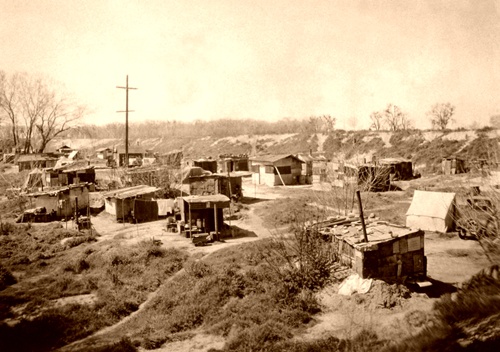
What were the villages full of shacks located in cities filled with unemployed Americans called?
a)
Hoovervilles
b)
Okies
c)
Bonus Army Bases
d)
Rooseveltowns
39.
Which economic factor contributed most directly to the start of the Great Depression?
a)
low worker productivity
b)
high income taxes
c)
decreasing tariff rates
d)
buying stocks on margin
40.

The 1920s was a decade known as....

a)

The Roaring Lions

b)

The Roaring Years

c)

The Roaring Days

d)

The Roaring 20's

41.

On which day did people lose a lot of cash when the stock market crashed?

a)

October 31, 1929

b)

May 7, 1929

c)

January 14, 1929

d)

October 29, 1929

42.

Which president created the New Deal programs?

a)

George W. Bush

b)

Franklin Roosevelt

c)

Richard Nixon

d)

John F Kennedy

43.
Abraham Lincoln's Emancipation Proclamation declared --
a)
United State's freedom from Great Britain
b)
an end to the Civil War
c)
freedom for slaves in rebellious southern states
d)
the beginning of Reconstruction
44.

The purpose of the Freedman's Bureau was to

a)

provide 40 acres and a mule for each slave.

b)

gain the vote for millions of former slaves.

c)

provide work, education, and relief for former slaves.

d)

get radical Republicans in positions of power in the South.

45.

Which Amendment abolished slavery in the United States?

a)

13th

b)

14th

c)

15th

d)

3rd

46.
What did the 14th Amendment do?
a)
made slavery illegal
b)
made former slaves citizens and gave them rights
c)
gave black men the right to vote
d)
gave former slaves land to begin farms
47.
What did the 15th Amendment do?
a)
made slavery illegal
b)
made former slaves citizens and gave them rights
c)
gave black men the right to vote
d)
gave former slaves land to begin farms
48.
What were Jim Crow Laws?
a)
equal treatment for all people
b)
laws that made segregation legal
c)
a farmer shares part of his crop to pay for land
d)
the period of time after the Civil War
49.

Literacy tests were created as a way to suppress African American voters after the passage of the _______________.

a)

Civil Rights Act of 1964

b)

13th Amendment

c)

14th Amendment

d)

15th Amendment

50.
Nationalism is best described as
a)
the desire for more land and power
b)
extreme or intense patriotism
c)
the build up of a large military force
d)
the desire to team up with other nations
51.
The U.S.'s policy regarding the war in 1914 
a)
Imperialism
b)
Isolationism
c)
Militarism
d)
None of these
52.
Which group believed in survival of the fittest and people were naturally selected to succeed?
a)
social darwinist
b)
political bosses
c)
nativist
d)
political machines
53.

The government encouraged Native Americans and immigrants to adopt white culture in a process called ___________________.

a)

Assimilation/Americanization

b)

Nativistism

c)

Communism

d)

Vietnamization

54.

A Scottish immigrant who led the enormous expansion of the steel industry.

a)

Andrew Carnegie

b)

John D. Rockefeller

c)

J.P. Morgan

d)

Cornelius Vanderbilt

55.
Imperialism is __________.
a)
when a powerful nation uses its resources to help a weaker nation
b)
when a weaker nation invites a powerful nation to help it industrialize
c)
when a powerful nation takes control of the economy and government of a weaker nation
d)
when weak nations join together to fight a strong nation
56.
What was an area where a foreign nation controlled economic development?
a)
sphere of influence
b)
Pan-Americanism
c)
protectorate
d)
dollar diplomacy
57.
For what reason did the US imperialize?
a)
to gain raw materials for industry
b)
to create military bases around the globe
c)
to develop markets to sell goods
d)
all of these
58.
Which statement of policy called for America to exercise an "international police power?"
a)
Monroe Doctrine
b)
Moral Diplomacy
c)
Platt Amendment
d)
Roosevelt Corollary
59.
Noninvolvement in world affairs is...
a)
expansionism
b)
isolationism
c)
imperialism
d)
annexation
60.
What did supporters of annexing the Philippines after the Spanish-American War believe?
a)
The islands would be a U.S. naval base
b)
Philippines would become a military rival if we didn't
c)
islands had no potential as a market for American goods
d)
Filipino culture was similar to that of the U.S.
61.
What was the purpose of the Open Door Policy in China?
a)
End the Boxer Rebellion
b)
Ensure trading rights with China
c)
Win leaseholds in China
d)
Establish a sphere of influence
62.
Which territory was annexed by the US because of the economic value of its sugarcane plantations?
a)
Alaska
b)
Midway
c)
Hawaii
d)
Samoa
63.
These black teenagers were the first to integrate into Little Rock Central High
a)
Elite Eight
b)
Little Rock Nine
c)
Arkansas Seven
d)
Final Four
64.

Atlanta born Civil Rights activist that believed in non-violent protests.; gave his famous "I Have a Dream" speech at the March on Washington.

a)

Rosa Parks

b)

Martin Luther King, Jr.

c)

Cesar Chavez

d)

Thurgood Marshall

65.

Desegregated all public schools. This was a major court case that involved Linda Brown attending an all-black school when an all-white school was closer to her home.

a)

Brown vs. the Board of Education

b)

13th Amendment

c)

Civil Rights Act of 1964

d)

Jim Crow Laws

66.

Prohibits racial discrimination in voting (voting people, voting)

a)

13th Amendment

b)

Jim Crow Laws

c)

Civil Rights Act of 1964

d)

Voting Rights Act of 1965

67.

Leader who worked to improve treatment, pay, and working conditions for farm workers; you should know this one because you have already used three of these!

a)

Martin Luther King, Jr.

b)

John F. Kennedy

c)

Thurgood Marshall

d)

Cesar Chavez

68.
Court case that created "Separate-but-equal" doctrine.
a)
Sweatt v. Painter
b)
Brown v. Board of Education
c)
Plessy v. Ferguson
d)
Mendez v. Kirby ISD
69.
An organization formed in 1960 to coordinate sit-ins and other protests and to give young blacks a larger role in the civil rights movement.
a)
affirmative action
b)
de facto segregation
c)
Student Nonviolent Coordinating Committee 
d)
National Organization for Women 
70.
The Voting Rights Act of 1965 bans the use of __________ by states.
a)
literacy tests
b)
poll taxes
c)
lynchings
d)
Photo ID requirements