
NEW
Font size
S
M
L
XL
 Worksheets
11A Forms of Energy
Total questions: 15
Worksheet time: 19mins
Name
Class
Date
1.

How does the thermal energy flow in a glass of ice tea?
a)
from the ice to the tea
b)
from the tea to the ice
c)
there is no flow
d)
it looks good - now I am thirsty
2.

The kid ate some spaghetti and then started playing with his toys. What is the energy transformation that is taking place?
a)
thermal converted to kinetic
b)
electrical converted to thermal
c)
kinetic converted to chemical
d)
chemical to mechanical
3.

When you strike a match and light some logs on fire, what is the energy transformation that is taking place?
a)
heat to kinetic to potiential
b)
kinetic to thermal to light
c)
chemical to light to thermal
d)
light to chemical to thermal
4.

When does thermal energy transfer end?
a)
it never ends
b)
both reach the same temperature
c)
when it starts boiling
d)
when you measure them
5.

What is the measure of the average kinetic energy?
a)
electromagnetic
b)
electrical
c)
temperature
d)
kinetic
6.
Heat flows from _______ to ______ objects
a)
cooler to warmer
b)
warmer to warmer
c)
warmer to cooler
d)
cooler to cooler
7.
Heat is measured in
a)
joules
b)
grams
c)
degrees celcius
8.
The transfer of thermal energy between objects of different temperatures is called...
a)
temperature
b)
heat
c)
internal energy
d)
none of these
9.

Thermal energy always moves:
a)
From a high temperature object to a lower temperature object.
b)
From a lower temperature object to a higher temperature object.
c)
From an object with lower kinetic energy to an object with higher kinetic energy.
d)
From an object of higher mass to an object of lower mass.
10.
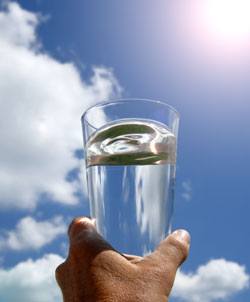
The temperature of a glass of cold water will eventually...
a)
Match the temperature of the surrounding environment.
b)
Always be colder than the surrounding environment.
c)
Become warmer than the surrounding environment.
d)
Never change temperature.
11.

What would be the effect on the particles if more heat is supplied to the system?
a)
They would slow down
b)
They would stop moving
c)
They would speed up
d)
There would be no effect
12.
If two objects have different temperatures when they come in contact, heat will flow from the warmer object to the cooler one UNTIL ____________
a)
one reaches a temperature of zero
b)
they both have an equal temperature
c)
one runs out of energy
13.
The movement of thermal energy from an object at a higher temperature to an object at a lower temperature is called ____________.
a)
thermal
b)
expansion
c)
temperature
d)
heat
14.
What does "q" mean?
a)
A change in temperature
b)
A change in heat energy
c)
A measure of kinetic energy
15.

A metal cube at temperature of 70°C is immersed in water at temperature of 20°C.
a)
The metal loses more heat than the water gains.
b)
The metal loses less heat than the water gains.
c)
The metal loses the same amount of heat that the water gains.
Reset

