wayground logo

Free Printable Worksheets

Font size

S
M
L
XL
Worksheets

Plate Tectonics Review 2021

Total questions: 71

Worksheet time: 52mins

Name
Class
Date
1.

The evidence is in ______________________, where coastlines and mountain ranges appear to fit together like a puzzle all over the world

a)

Continental drift

b)

Plate Tectonics

c)

The Rock Cycle

d)

Divergent boundaries

2.

Other evidence include __________________ that plate tectonics does occurr in the crust of the Earth.

a)

Rock formation, weather, fossils

b)

Mountain formation, fossils, climate

c)

Land features, fossils, climate

d)

Valleys, Ocean trenches, climate

3.

The __________________ are chains of undersea mountains.

a)

Mid-Ocean Ridges

b)

Ocean Trench

c)

Divergent boundary

d)

Transform boundary

4.

______________________ continually adds materials to the ocean floor creating ocean floor.

a)

Sea-floor spreading

b)

Ocean trenches

c)

Divergent mid-ocean ridges

d)

Convergent mid-ocean ridges

5.

Oceans plates sink back into the mantle at _______________ zones, keeping the crust the same size.

a)

Mid-ocean ridges

b)

Ocean trenches

c)

Subduction

d)

Transforming

6.

_____________________ are undersea that are the deepest part of the ocean.

a)

Divergent trenches

b)

Ocean trenches

c)

Transform trenches

d)

Mid-ocean trenches

7.

This plate boundary moves land apart, creating an ocean trench or a valley on land : ________________________

a)

Divergent boundary

b)

Transform boundary

c)

Convergent boundary

d)

Mid-Ocean voundary

8.

This tectonic plate boundary creates mountain ranges: ____________________

a)

Divergent boundary

b)

Convergent boundary

c)

Transform boundary

d)

Mid-oceanic boundary

9.

This tectonic plate slips past each other nor creating or destroying land formations: _____________

a)

Divergent boundary

b)

Transform boundary

c)

Convergent boundary

d)

Mid-Ocean boundary

10.

The region of the earth's interior between the crust and the core is called the ________________.

a)

Crust

b)

Mantle

c)

Both the crust and the mantle

d)

Both the mantle and the core

11.

Which tectonic plate boundary SLIDES past each other...

a)

Divergent

b)

Convergent

c)

Transform

d)

Continental

12.

Which tectonic plate moves TOWARDS each other...

a)

Divergent

b)

Convergent

c)

Transform

d)

Continental

13.

Which tectonic plate moves AWAY from each other...

a)

Divergent

b)

Continental

c)

Transform

d)

Covergent

14.

Which of these is NOT causes by the moving of tectonic plates?

a)

Valleys

b)

Mountains

c)

Earthquakes

d)

Hurricanes

15.
Name the boundary
a)
convergent boundary
b)
divergent boundary
c)
transform boundary
d)
sergent boundary
16.
Name the boundary
a)
convergent boundary
b)
divergent boundary
c)
transform boundary
d)
sergent boundary
17.
What kind of plate boundary is shown here?
a)
divergent
b)
convergent
c)
transform
d)
strike slip
18.
What kind of plate boundary is shown here?
a)
divergent
b)
convergent
c)
transform
d)
strike slip
19.
A subduction zone is formed...
a)
when one tectonic plate sinks below another
b)
at every type of convergent plate boundary
c)
at every type of divergent plate boundary
d)
at transform boundaries
20.
What is D?
a)
magma
b)
upper mantle
c)
lava
d)
convection
21.
What happens when two oceanic plates move apart from each other?
a)
A mid-ocean ridge forms
b)
An underwater volcano forms
c)
An underwater trench forms
d)
An oceanic plate subducts a continental plate
22.
What is the thinnest layer of the earth’s composition?
a)
mantle
b)
inner core
c)
crust
d)
outer core
23.
This is a picture of glacier scars found in Africa.  What are these evidence for?
a)
Africa has always been near the equator
b)
Africa was once in an area of the Earth that had a very cold climate
c)
The continents have not moved
d)
sea floor spreading
24.
What evidence did Wegener use in his theory?
a)
Continents and fossils fitting together/matching-up like puzzle pieces 
b)
glacier scars and other climate evidence from temperature
c)
mountain ranges and rocks line up across continents
d)
all of the above
25.
Which type of plate boundary would cause folded mountains to form? 
a)
transform
b)
convergent
c)
divergent
26.
When an oceanic plate and a continental plate collide, which one will subduct? 
a)
oceanic
b)
continental
c)
neither
d)
both
27.
A rift valley forms at a 
a)
convergent plate boundary
b)
divergent plate boundary
c)
transform boundary
d)
deep ocean trench
28.

When a continental crust and continental crust collide it produces a......

a)

mid-ocean ridge

b)

deep ocean trench

c)

volcanic mountain range

d)

folded mountain range

29.
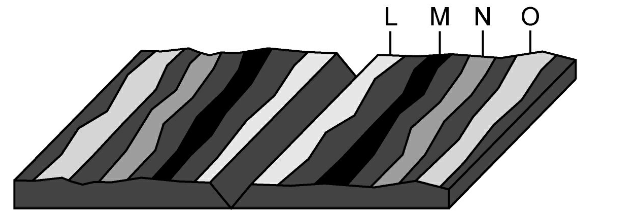
Where would the oldest rock be found?
a)
L
b)
M
c)
N
d)
O
30.
The transfer of heat by movements of a heated fluid
a)
Radiation
b)
Convection
c)
Conduction
d)
Infrared Radiation
31.

Which of the following is an accurate description of the movement of the tectonic plates in the diagram?

a)

Plate A is sliding past plate B.

b)

Plate A and plate B are diverging.

c)

Plate A and plate B are of equal density and are colliding.

d)

Plate A is denser than plate B, which results in subduction.

32.
The youngest material of the ocean floor is found at mid-ocean _________.
a)
ridges
b)
trenches
c)
basins
d)
rifts
33.

The presence of the same ________ on several continents supports the idea of continental drift.

a)

rocks

b)

fossils

c)

fossils and rocks

d)

neither fossils nor rocks

34.
The theory of _______ states that Earth’s crust and upper mantle are broken into sections that are in constant, slow motion.
a)
plate tectonics
b)
continental drift
c)
seafloor spreading
d)
divergent boundaries
35.
Matching ________ on different continents are evidence for continental drift.
a)
weather systems
b)
river systems
c)
rock structures
d)
wind systems
36.
Many scientists think hot plastic-like rock in the mantle is forced upward toward the surface, cools, and sinks.  This process is called a(n) _________.
a)
earthquake
b)
convergent boundary
c)
volcano
d)
convection current
37.
The San Andreas Fault in California is an example of a ________.
a)
divergent boundary
b)
convergent boundary
c)
transform fault
d)
subduction zone
38.
Which type of plate boundary occurs at B?
a)
convergent
b)
divergent
c)
transform
d)
country
39.
The feature labeled D is part of the continuous underwater mountain range that circles Earth. It is called ___.
a)
mid-ocean ridge
b)
trenches
c)
deep-sea vent
d)
abyssal plain
40.
What technology did scientists use in the mid-1900s to map the mid-ocean ridge?
a)
sonar
b)
submarines
c)
satellites
d)
deep-sea diving
41.
What types of fossils were used to develop the idea of continental drift?
a)
Anthodon
b)
Mesosaurus
c)
Tyrannosaurus Rex
d)
Velociraptor
42.
What does the theory of plate tectonics help explain?
a)
Earthquakes, Volcanoes, and Formation of New Crust
b)
Earthquakes, Magnetism, and the Age of Rocks
c)
Earthquakes, Volcanoes, and Magnetism
d)
Volcanoes, Magnetism, and the Age of Rocks
43.

This type of plate boundary forms when two continents collide. It is responsible for the formation of the Himalayan Mountains and the Alps. Lots of earthquakes, but no volcanoes go with these very high mountains.

a)

Convergent Boundary

b)

Divergent Boundary

c)

Rift Valley

d)

Transform Boundary

44.
What is a force at a subduction boundary that the sinking edge of the subducting plate exerts on the rest of the plate?
a)
Mantle Convection
b)
Ridge Push
c)
Slab Pull
d)
Sun Radiation
45.

What is the name given to the super continent that was formed when all of the continents were merged together?

a)

Gondwanaland

b)

Pangaea

c)

Ring of Fire

d)

Laurasia

46.

What is the Theory of Continental Drift?

a)

New continents are continually being created

and destroyed.

b)

The layout of the continents is the same today

as it has always been

c)

The continents have always been separate but

may one day drift together to form a single

continent

d)

All the continents were once one continent that

broke up and drifted apart over hundreds of

millions of years

47.

Alfred Wegener proposed the Theory of Continental Drift. Which one of these does NOT support the theory Wegener proposed?

a)

Fossils that were similar were found on different continents.

b)

Bacteria was found all over the world.

c)

Shape of continents fit together to form a supercontinent called Pangea

d)

Climate seen as glacial or ice sharring are found all over the world.

48.

What evidence in rocks supports the theory of seafloor spreading?

a)

plate movement

b)

subduction

c)

magnetic reversal

d)

horizontal fissures

49.

Which of the following features are evidence that many continents were at one time near Earth's south pole?

a)

glacial deposits

b)

earthquakes

c)

volcanoes

d)

battery magnets

50.

This theory states that hot, dense material (magma) below Earth’s crust rises to the surface and flows sideways, carrying dirt and other materials away from the ridge in both directions.

a)

erosion

b)

subduction

c)

seafloor spreading

d)

continental drift

51.
How is it possible for new crust to be formed without increasing the surface area of the Earth?
a)
Crust is destroyed at the same time it is created
b)
New crust is underwater where it sinks
c)
New crust breaks more easily than old crust
52.
Mountains are created when....
a)
Two continental plates collide
b)
Two oceanic plates pull apart
c)
An Oceanic plate subducts under a Continental Plate
d)
Two continental plates pull apart
53.
Most volcanoes and earthquakes occur...
a)
along the coast
b)
along tectonic plate boundaries
c)
in the Arctic
d)
in the ocean
54.
The Himalayas in Asia are an example of what type of plate boundary?
a)
divergent
b)
continent-to-continent convergent
c)
ocean-to-continent convergent
d)
transform
55.
The Great Rift Valley in Africa and the Mid-Ocean Ridge were all created by this boundary
a)
Divergent
b)
Convergent
c)
Reform
d)
Transform
56.
The average density of one of the continental crusts is 2.8 g/cm3 and the average density of one of the oceanic crusts is 3.2 g/cm3. If these two plates came together, what could be expected to happen? 
a)
  The two plates would push apart and form a rift zone. 
b)
The oceanic plate would rise up over the continental plate. 
c)
The oceanic plate would be pushed under the continental plate. 
d)
The two plates would meet head on and rise up to form mountains.
57.
Why does the ocean floor sink beneath the continent at Z?
a)
The ocean floor is less dense than the continent.
b)
The ocean floor is more dense than the continent.
c)
The ocean floor is moving faster than the continent.
d)
The ocean floor is moving slower than the continent.
58.
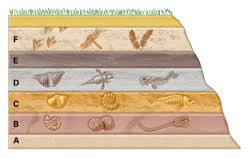
Which rock layer contains the newest fossils?
a)
F
b)
E
c)
B
d)
C
59.
What is molten rock that has formed deep within the Earth?
a)
Hot Spot
b)
Magma
c)
Lava
d)
Volcano
60.
Why does magma tend to rise to the surface?
a)
It has large amounts of silica.
b)
It contains very little silica.
c)
It is denser than the surrounding material.
d)
It is less dense than the surrounding material.
61.
Where are most volcanoes found?
a)
Southern Hemisphere
b)
Ring of Fire
c)
Mid-Atlantic Ridge
d)
Hot Spots
62.
What is molten rock that has reached the Earth's surface?
a)
Aa
b)
Lava
c)
Magma
d)
Pahoehoe
63.
Volcanoes that are NOT found at plate boundaries occur in the middle of plates in areas called ___________. 
a)
hot spots
b)
mid-ocean ridges
c)
fissure volcanoes
d)
shield volcanoes
64.
The volcanoes on the Hawaiian Islands form due to which of the following?
a)
Divergent Boundary
b)
Hot Spot
c)
Subduction Boundary
d)
Transform Boundary
65.

An area where material from deep within Earth's mantle rises through the crust and melts to form magma.

a)

hot spot

b)

rift zone

c)

hot soup

d)

hot mamma

66.
A subduction zone is...
a)
plates pull apart.
b)
the continental plate slides under the oceanic plate.
c)
where the oceanic plate slides under the continental plate.
d)
plates slap each other a high five.
67.

What is the earthquake/volcano zone that Iceland is located on?

a)

Mediterranean Zone

b)

Ring of Fire

c)

Mid-Atlanic Ridge Zone.

68.

Most earthquakes and volcanoes occur

a)

in the middle of plates.

b)

at plate boundaries

c)

in the oceans.

d)

randomly in no set pattern.

69.

Island arcs are curved chains of volcanic islands formed

a)

when 2 oceanic plates converge.

b)

when oceanic plates diverge.

c)

when an oceanic & continental plate converge.

d)

at a transform boundary between an oceanic & continental plate.

70.
What is a break in the lithosphere along which movement in an earthquake has first occurred?
a)
Earthquake
b)
Epicenter
c)
Fault
d)
Focus
71.
What is an instrument that detects and records waves produced by earthquakes? (This piece of equipment can measure the magnitude of an earthquake.)
a)
Epicenter
b)
Fault
c)
Seismogram
d)
Seismograph