wayground logo

Free Printable Worksheets

NEW

Font size

S
M
L
XL
Worksheets

Static Electricity

Total questions: 75

Worksheet time: 1hrs 27mins

Name
Class
Date
1.
In a neutral atom, the number of electrons is equal to the number of _______.
a)
Neutrons
b)
Orbits
c)
Protons
d)
subatomic particles
2.
If two charges repel each other, the two charges must be
a)
Positive and neutra
b)
Positive and negative
c)
positive and neutral
d)
negative and negative
3.
An object becomes charged when the atoms in the object gain or lose
a)
electrons
b)
protons
c)
neutrons
d)
all of the above
4.
If you rub a glass rod with a piece of silk, the rod becomes positively charged. This means that
a)
friction destroyed electrons in the rod.
b)
the silk has become negatively charged.
c)
protons have moved to the rod.
d)
glass attracts more protons.
5.
If you bring a charged object near an electrically neutral surface without allowing the object to touch the surface, the charges in the surface are rearranged by
a)
friction.
b)
convection.
c)
induction.
d)
conduction.
6.
Objects that have opposite charges
a)
are attracted to each other, and the force between the objects pulls them together.
b)
are attracted to each other, and the force between the objects pushes them apart.
c)
are repelled by each other, and the force between the objects pulls them together.
d)
are repelled by each other, and the force between the objects pushes them apart.  
7.
A region around a charged particle that can exert a force on another charged particle is called an
a)
electric pulse.
b)
electric charge.
c)
electric force.
d)
electric field.
8.
Charging by ____ occurs when electrons are transferred from one object to another by direct contact.
a)
reduction
b)
induction
c)
conduction
d)
friction
9.
The "Q" in Coulomb's Law stands for
a)
the mass of charges objects.
b)
the distance of charged objects.
c)
the force of charged objects.
d)
the charge of charged objects.
10.
Force between two bodies having charges 5.0 x 10² μC and 1.0 x 10² μC separated by distance of 0.50 m in air is
a)
1800 N
b)
1.0 x 10³ N
c)
2200 N
d)
3.0 x 10² N
11.
A positive charge of 4.0 µC exerts an attractive force of 8.0 N on an unknown charge 20.0 cm away. The unknown charge is
a)
+ 8.9 µC 
b)
- 8.9 µC
c)
+ 4  µC
d)
- 44  µC 
12.
When you pull a cotton sweater off your skin, electrons are transferred from the ___________________ (cotton, skin) to the __________________ (cotton, skin). As a result, your body acquires a ___________ (+ , -) charge and the cotton sweater acquires a ___________ (+ , -) charge.
a)
skin, cotton, +, -
b)
cotton, skin, +, -
c)
skin , cotton, -, +
d)
cotton, skin, -, +
13.
Which ranking is correct?
a)
A < B
b)
J < H < I
c)
F < G < E
d)
D < C
14.
Electric field lines are drawn
a)
In a radial direction, from negative to positive.
b)
In a radial direction, from positive to negative.
c)
In a tangent direction, from positive to negative.
d)
In a tangent direction, from negative to positive.
15.
Which part of Coulomb's Law is always squared?
a)
distance
b)
charge
c)
Coulomb's constant
d)
force
16.
A glass rod rubbed against your hair gains a charge of -14.0 nC. What is the electric force between the balloon and your hair when the two are separated by a distance of 7.1 cm?
a)
3.5 x 10⁴ N
b)
-3.5 x 10⁴ N
c)
- 3.5 x 10⁻⁴ N
d)
3.5 x 10⁻⁴ N
17.
The smallest unit of an element is
a)
An electron
b)
A proton
c)
A neutron
d)
An atom
18.
If an object has the same number of positive and negative charges, its electrical charge is...
a)
positive
b)
negative
c)
neutral or no charge
d)
opposite
19.
What charge does a proton have?
a)
negative (-)
b)
positive (+)
c)
neutral or no charge (0)
20.
Static electricity is 
a)
The balance of electrical charge on an object
b)
The imbalance of electrical charge on an object
c)
The discharge of electrical charge
d)
The build up of protons in the nucleus of an atom 
21.
What charge does an electron have?
a)
negative (-)
b)
positive (+)
c)
neutral or no charge (0)
22.
True or False
Like charges repel
a)
True
b)
False
23.
True or False
A positively charged object has lost electrons
a)
True
b)
False
24.
True or False
A negatively charged object has lost protons
a)
True
b)
False
25.
If an atom gain's a proton then
a)
it is positively charged
b)
it is negatively charged
c)
it changes into a new element
d)
it explodes due to nuclear fussion
26.
Materials that tightly hold on to their electrons are considered 
a)
Good conductors
b)
Good insulators
c)
Good anti-static agents
d)
Useful for storing charge
27.
Which one of these objects is a good insulator
a)
Copper wire
b)
Glass
c)
Aluminum 
d)
Gold
28.
Materials that easily loose or accept electrons are considered
a)
Good conductors
b)
Good insulators
c)
Good anti-static agents
d)
Good for storing charge
29.
What is the major difference between static electricity and current electricity?
a)
Current electricity involves a continuous flow of neutrons; static electricity is a sudden transfer of protons
b)
Current electricity can be deadly; static electricity is almost always safe
c)
In current electricity, there's a single transfer of electrons; in static electricity, there's a steady flow of electrons
d)
Current electricity involves a flow of electrons; static electricity involves a single transfer of electrons
30.
Charge separation in clouds is one way
a)
that freezing rain occurs
b)
that lightning occurs
c)
that low pressure system occurs
d)
that a tornado occurs
31.
Which term is not a method for charging an object with static electricity
a)
Alternating Current
b)
Induction
c)
Conduction
d)
Friction
32.
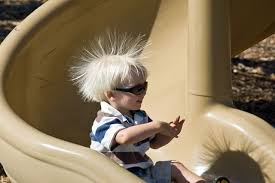
What method of static charging is shown in this picture
a)
Polarization
b)
Friction
c)
Induction
d)
Conduction
33.
The girl's hair and the comb are attracting  one another.  The hair and the comb have
a)
opposite charges
b)
like charges
34.
Two things with opposite charges will
a)
attract one another.
b)
repel one another.
35.
A plastic rod is rubbed with a dry piece of cloth and the rod becomes positively charged.  The rod has …  
a)
gained electrons
b)
lost electrons
c)
gained protons
d)
lost protons
36.
If an atom has 3 protons (+++) and 4 electrons (- - - -), it has a net charge of_____.
a)
-1
b)
+1
c)
0
d)
7
37.
If a substance has a higher number of electrons than protons on its surface, what type of charge does it have?
a)
A positive charge.
b)
A negative charge.
c)
A neutral charge
d)
No charge at all
38.

What happens when you touch a metal doorknob after rubbing your shoes on the carpet?

a)

The doorknob sends a burst of electric current into your body

b)

Millions of electrons go from your finger into the doorknob

c)

The doorknob sends millions of electrons into your finger

d)

Your finger becomes negatively charged

39.

What is static electricity caused by?

a)

A balance of power

b)

A balance of positive and negative charges

c)

A buildup of negative charges in one place

d)

An imbalance of protons and neutrons

40.
Which of the following an insulator?
a)
copper
b)
wood
c)
silver
d)
salt water
41.
An object becomes charged when the atoms in the object gain or lose
a)
electrons
b)
protons
c)
neutrons
d)
all of the above
42.
If you rub a glass rod with a piece of silk, the rod becomes positively charged. This means that
a)
friction destroyed electrons in the rod.
b)
the silk has become negatively charged.
c)
protons have moved to the rod.
d)
glass attracts more protons.
43.
A region around a charged particle that can exert a force on another charged particle is called an
a)
electric pulse.
b)
electric charge.
c)
electric force.
d)
electric field.
44.
Charging by ____ occurs when electrons are transferred from one object to another by direct contact.
a)
reduction
b)
induction
c)
conduction
d)
friction
45.
Which part of Coulomb's Law is always squared?
a)
distance
b)
charge
c)
Coulomb's constant
d)
force
46.
Walking across a carpet is an example of charge being transferred by
a)
friction.
b)
induction.
c)
contact.
d)
static electricity
47.
Electric field lines are drawn
a)
In a radial direction, from negative to positive.
b)
In a radial direction, from positive to negative.
c)
In a tangent direction, from positive to negative.
d)
In a tangent direction, from negative to positive.
48.
A region around a charged particle that can exert a force on another charged particle is called an
a)
electric pulse.
b)
electric charge.
c)
electric force.
d)
electric field.
49.

A stationary negative charge in an electric field experiences an electric force in the direction

shown.

What is the direction of the electric field?

a)

to the left

b)

to the right

c)

down the page

d)

up the page

50.

You are walking on a rug and gain a positive charge. When you touch a neutral doorknob

a)

Protons flow from your hand to the doorknob, and you get a shock

b)

Electrons flow from your hand to the doorknob, and you get a shock

c)

Electrons flow from the doorknob to your hand, giving you a shock

d)

No charges flow but you still get a shock

51.

An aircraft flying through the air becomes electrically charged.

What causes this to happen?

a)

radio waves emitted by the aircraft

b)

friction of the aircraft with the air

c)

heating of the aircraft surface

d)

background radiation in the aircraft

52.

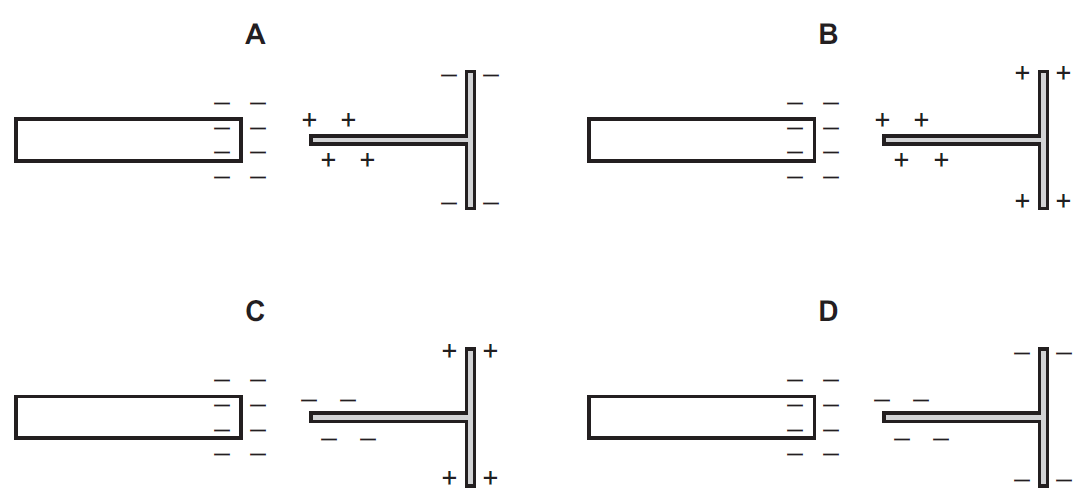
A negatively-charged rod is brought close to an isolated T-shaped piece of metal.

Initially, the metal is uncharged.

Which diagram shows the induced charge on the metal?

a)

A

b)

B

c)

C

d)

D

53.

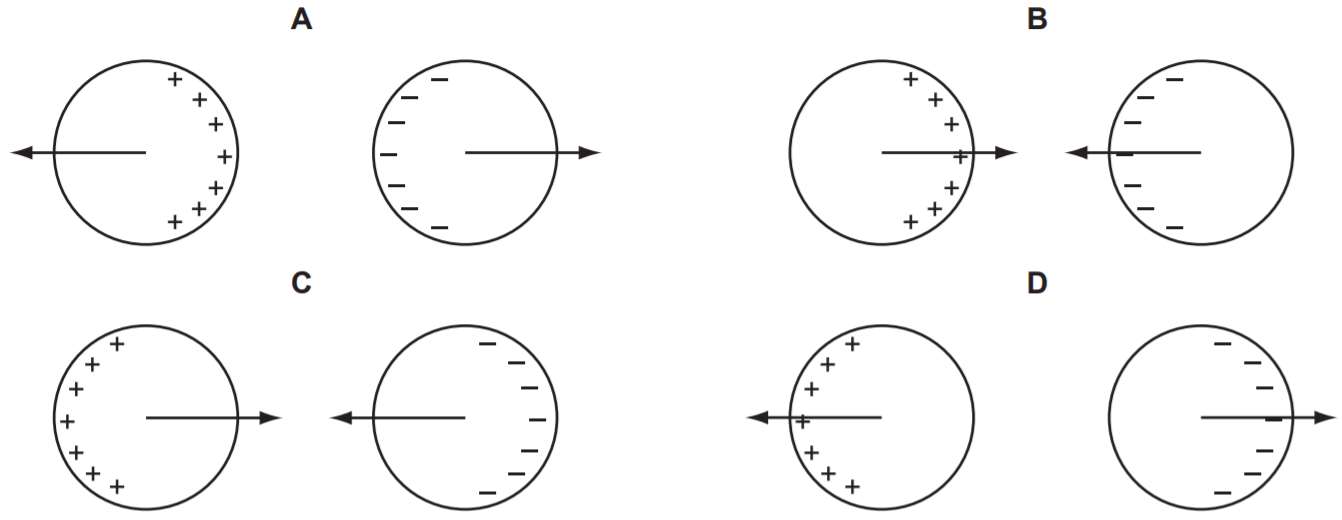
Two charged conducting spheres are placed close to one another. One sphere is positively charged and the other is negatively charged. Which diagram shows the distribution of charges and the forces acting on the spheres?

a)

A

b)

B

c)

C

d)

D

54.

Which list contains only electrical insulators?

a)

glass, plastic, rubber

b)

glass, plastic, steel

c)

glass, rubber, steel

d)

plastic, rubber, steel

55.

What is the definition of an electric field?

a)

A region in space in which a mass experiences a force due to earth's gravitational pull

b)

A region in space through which electromagnetic radiation passes

c)

A region in space in which a compass needle experiences a force

d)

A region in space in which an electric charge experiences a force

56.

A negatively charged strip is brought near to (but not touching) an uncharged conductor. If the conductor is earthed it

a)

becomes negatively charged

b)

becomes negatively charged on one side and positively charged on the other

c)

is attracted by the strip

d)

is repelled by the strip

57.

What do you call an object with more - than + charges?

a)

Positively Charged

b)

Negatively Charged

c)

Neutral

d)

Static Electricity

58.

A(n) ______________________________ is an instrument used to detect the presence of an electric charge.

a)

scale

b)

van de graaff generator

c)

electroscope

59.

In which picture(s) below will the charged objects attract?

a)

A and C

b)

B and D

c)

A and B

60.

Which diagram shows attraction?

a)
b)
c)
d)
61.

Electric Fields are represented by

a)

arrows

b)

lines

c)

dots

d)

empty circles

62.

Step (c) demonstrates

a)

Electrons travelling up the ground connection

b)

Electrons travelling down the ground connection due to repulsion

c)

Electrons being attracted to the positive charges in the sphere and moving up from ground to pair up

d)

Induced negative static charge on the wire

63.

TESTING YOUR KNOWLEDGE, TRUE OF FALSE?: A neutral body will always be attracted to a charged body

a)

True

b)

False

64.
Assuming the force exerted between two spheres is 40 N, what will be the magnitude of the force if the distance is doubled?
a)
80N
b)
20N
c)
10N
d)
5N
65.
How does distance between charges affect electrostatic force?
a)
Greater distance will weaken the force.
b)
Greater distance will strengthen the force.
c)
Distance between charges does not affect the force.
d)
Not enough information is given to decide.
66.

Which type of electricity isn't moving?

a)

AC

b)

DC

c)

Current

d)

Static

67.

Object A rubs over Object B and as a result, Object A becomes negatively charged. Which statement is true?

a)

Object A lost protons to Object B so Object B became positively charged

b)

Object A lost electrons to Object B so Object B became positively charged

c)

Object A took electrons from Object B so Object B became positively charged

d)

Object B took protons from Object A so Object B became positively charged

68.

Electrical grounding allows which of the following to happen?

a)

Electrons or protons to move to or from the ground in order to neutralize the charged object.

b)

Electrons to move to or from the ground in order to neutralize the charged object.

c)

Protons to move to or from the ground in order to neutralize the charged object.

d)

Neutrons to move to or from the ground in order to neutralize the charged object.

69.

The charge of one electron is -1.6 X 10 -19 Coulomb. If a neutral object loses 1.5x10⁶ electrons, then what will be its charge?

a)

+1.4 x 10 -13 C

b)

+2.4 x 10 -13 C

c)

-2.4 x 10 -12 C

d)

+2.4 x 10 -14 C

70.
Charging by ____ occurs when electrons are transferred from one object to another by direct contact.
a)
reduction
b)
induction
c)
conduction
d)
friction
71.
What is matter that has the same number of positive and negative charges?
a)
positively charged
b)
negatively charged
c)
electrically neutral
d)
static electricity
72.
How do like charges act on each other?
a)
Like charges repel
b)
Like charges attract
c)
Like charges build up 
d)
Like charges are neutral
73.
How do unlike charges act on each other?
a)
Unlike charges attract
b)
Unlike charges repel
c)
Unlike charges are neutral
d)
Unlike charges build up
74.
What are negative charges attracted to?
a)
Other negative charges
b)
Positive charges
c)
dust
d)
Neutral charges
75.
What will you likely see during an electrical discharge?
a)
A rainbow
b)
A spark
c)
Red
d)
Moisture