
 Worksheets
Chapter 23:Physical optics
Total questions: 54
Worksheet time: 54mins
To demonstrate the phenomenon of interference, we require two sources
Of the same frequency and having a constant phase difference
Of nearly the same frequency
Of the same frequency
Of different wavelengths
For Young's double slit experiment, the fifth dark fringe is equivalent to:
m=4 maximum
m=5 maximum
m=4 minimum
m=5 minimum
It is difficult to get clear Young's double slit fringes with white light because
The frequency of white light is too high
The wavelength of white light is too low
the different colour fringes overlap
white light is not bright enough
'Every points on the wave front of light are the sources of smaller waves called wavelets.' This is the statement of
Huygen
Hubble
Ronaldo
Fazlina
Which diagram best represents the shape and direction of a series of wave fronts after they have passed through a small opening in a barrier?
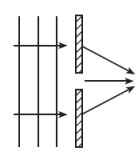
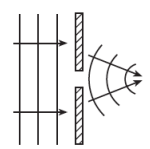
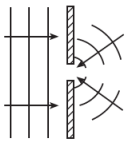
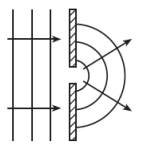

What type of interference is represented in this diagram?
Constructive
Destructive

What type of interference is represented in the diagram?
Constructive
Destructive
Which of the following will decrease the spacing of Young's double slit fringes
decreasing the wavelength of the waves
moving the screen further away
decreasing the distance between the slits
Using narrower slits
Extra distance travelled by one of waves compared with other is called
path.
displacement.
phase difference.
path difference.
Two light sources are said to be coherent if they
are of the same frequency.
are of the same frequency, and maintain a constant phase difference.
are of the same amplitude, and maintain a constant phase difference.
are of the same frequency and amplitude.
For Young's double slit experiment, the fifth bright fringe is equivalent to:
m=4 maximum
m=4 minimum
m=5 maximum
m=5 minimum

Which of the following figures represent is a double
slit interference pattern?
A
B
C
D

The top bright fringe order is?
Fourth order minimum
Third order minimum
Fourth order maximum
Third order maximum
If the distance of the slit separation is doubled, the fringe width is:
halved
doubled
no change
For Young's double slit interference distance of nth dark fringe from the center of the screen is
dnλD
Dnλd
(n+21) dλD
(n+21) Dλd
For diffraction at a single Slit, the angular position for nth minimum is
θ=nλ
θ= anλ
θ= (n+21)aλ
θ= λna
Which of the following statements is untrue when applied to Young's double slit pattern
The fringes are equally spaced
A bright fringe occurs when the waves arrive in phase
The sources must be coherent
The centre fringe is the brightest

What is the path difference of the reflected rays traveling through the film?
t
2nt
t/2
0

The index of refraction of the thin film (water) is higher than air as shown in Figure above - the reflected ray will undergo a phase change of π rad
True
False

At the bottom soap-air interface ( soap film has a higher index of refraction n > 1) there will be a phase change for ray 2.
TRUE
FALSE

What is the condition for the constructive interference of the thin film shown in figure above?
2t = mλ where m = 0,1,2,3,...
2nt = mλ where m = 0,1,2,3,...
2t = (m+½)λ where m = 0,1,2,3...
2nt = (m+½)λ where m = 0,1,2,3...

What is the condition for destructive interference to occur for the soap film shown?
2nt = mλ
2nt = (m+¼)λ
2nt = (m+½)λ
2nt = (m+¾)λ
Every time light hits a "thin film" - there is a phase change occurs for the reflected ray.
False
True
According to huygen's principle,light is a form of
particle
rays
wave
none of the above
A slit of width a is used to observe a diffraction pattern on a screen at a distance L from the slit.If the width of the slit were doubled, the width of the central bright band would
decrease by a factor of 4
decrease by a factor of 2
increase by a factor of 2
increase by a factor of 4
In a single slit diffraction experiment the width of the slit is reduced . What happens to the width of the central bright fringe in the resulting diffraction pattern
Stays the same
It becomes narrower
it becomes wider
the central bright fringe disappears
What is the formula used to find the separation between 2 adjacent line on a diffraction grating?
cos θnλ
sin θnλ
tan θnλ
sin θ(n+21)λ
Which of the following figures represent is a single slit diffraction pattern?
A
B
C
D

These two waves are _________.
monochromatic and in phase
monochromatic and out of phase
multichromatic and in phase
multichromatic and out of phase

A slide with three diffraction gratings on it is used for an experiment. Which has the largest value of slit spacing, d?
50 lines per mm
100 lines per mm
200 lines per mm
A student holds a laser and diffraction grating such that they are projecting a series of bright and dark fringes onto the whiteboard. As the student walks toward the board, the bright spots ______.
become closer together
moves farther apart
maintain the same spacing
Which of the following describes Huygens Principle?
Every point on a wavefront acts as a source of lots of secondary spherical wavelets, which can therefore interfere with each other.
A wave can produce an interference pattern.
The angle of incidence is equal to the angle of reflection.
The speed of light is constant in every direction.
The distance between two consecutive wavefronts is called
Time period
Frequency
Wavelength
Displacement
Two coherent light must have equal value in the following quantities EXCEPT their
Phase difference
Phase
Wavelength
Frequency
How does a bright fringe form from interference?
When a light beam has a path difference equal to one wavelength
When a light beam has a path difference equal to half wavelength
When a light beam has the same amplitudes
When a light beam has a path difference with odd integer multiple of it
Two sinusoidal wave with the same wavelength and amplitude is traveling in the same direction and have a phase difference of a quarter of a cycle. What will happen if the two waves are superimposed?
A wave with same wavelength but a larger amplitude will be produced.
No wave is produced because of complete destructive interference.
A wave with a longer wavelength but same amplitude will be produced
A wave with same wavelength but a smaller amplitude will be produced.
What is the characteristic of to coherent light waves?
same phase
Constant phase difference
Almost the same amplitude
Constructive disturbances.
Phase difference of 180° is equivalent to path difference of
2λ
λ
λ/2
λ/4
In Young’s double slit experiment, the distance between two adjacent bright fringes, ∆𝑦 is
d2λD
d3λD
dλD
Dλd

FIGURE shows two interference patterns, P and Q produced by illuminating two slits using two different coherent light sources. Which of the interference patterns is being produced by a light source with a longer wavelength?
P
Q
A colorful pattern is observed in a sop bubble. This phenomenon is caused by
Diffraction of light
Diffraction and refraction of light
Diffraction and reflection of light
Reflection and interference of light

At the bottom soap-air interface (soap film has a higher index of refraction n > 1) , Is there any phase change upon reflection for ray 1 and 2?
No phase change for Ray 1 ; 𝝅 phase change for Ray 2
𝝅 phase change for Ray 1 ; no phase change for Ray 2
no phase change for both rays
𝝅 phase change for both rays

Given the index of refractive for oil and water is 1.40 and 1.33 respectively for thin film shown in figure. Both of the reflected rays act as ............................ coherent source.
Inphase
Antiphase

Using cross pair method, identify what is the condition for missing in reflected rays to occur for the soap film shown?
2nt = m𝝀
2nt = (m+½) 𝝀
nt = m𝝀
nt = (m+½) 𝝀
Bending of light around the edges of an obstacle is known as:
Refraction
Polarization
Diffraction
Interference
All of the following conditions can increased the width of central bright obtained in a single slit diffraction EXCEPT
Change purple light to red light
increase the width of the slit
put the screen farther from the slit
decrease the width of the slit
Which of the following statement regarding single slit diffraction is FALSE ?
Between each pair of dark fringes there is a bright fringe due to constructive interference.
The higher order bright fringes are much less intense.
All waves interfere destructively creates a dark central fringe on the screen directly opposite the slit.
3rd minimum dark fringe is corresponding to order number n = 3
Number of bright dots can be seen for light passing through a diffraction grating depends on all of the following EXCEPT
Grating spacing
Wavelength of light used
Number of lines of a grating
Angle of incident
In grating experiment, if white light is used
Alternate dark and bright fringes will be seen
Colored fringes will be seen on either side of central bright fringe
A series of bright fringes will be seen
nothing happens

