
 Worksheets
Chapter 1 Quiz IGCSE KANAYATI CHEMISTRY
Total questions: 35
Worksheet time: 23mins
Which statement best describes the fact that gases can be compressed?
The particles in a gas do not have a fixed volume.
The particles in a gas are very far apart.
The particles in a gas have no force of attraction (bonds) between them.
The particles in a gas are constantly moving very rapidly.
A substance has a boiling point of 90°C. What changes occur when it is heated from 50°C to 120°C?
energy of particles increase; attractive forces decrease
energy of particles decrease; attractive forces increase
energy of particles increase; attractive forces increase
energy of particles decrease; attractive forces decrease

The three states of matter are represented by diagrams X, Y and Z. Which change occurs during condensation?
X to Y
X to Z
Y to X
Z to X
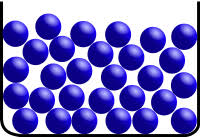
Which description best matches this particle model?
Closely packed and vibrate about a fixed position.
Particles are close together but can slide past each other.
Particles have lots of energy and can move around.
When ice melts...
The mass of the water decreases during melting.
The mass of the water stays the same before, during and after melting.
The mass of the water is always changing.
The mass of the water increases during melting.
When a liquid becomes a solid, what are the changes in the behaviour of the particles? Select all that apply.
Particles lose energy
Particles are unable to overcome forces of attraction
Particles move closer together
The volume decreases
Particles become smaller
In a solid, ___________________. (Select all that apply).
Particles are packed closely together
Particles have a fixed shape
Particles vibrate about their fixed positions
Particles slide across one another
There are strong forces of attraction between particles.
When a liquid becomes a solid, what are the changes in the behaviour of the particles? Select all that apply.
Particles lose energy
Particles are unable to overcome forces of attraction
Particles move closer together
The volume decreases
Particles become smaller
In a solid, ___________________. (Select all that apply).
Particles are packed closely together
Particles have a fixed shape
Particles vibrate about their fixed positions
Particles slide across one another
There are strong forces of attraction between particles.
what causes brownian motion?
diffusion of smoke particles in the air
molecules in the air hitting the smoke particles
sublimation of smoke particles
smoke particles hitting the walls of the containers
Which statements describe the arrangement of particles in solids?
particles are moving in all directions
Particles are arranged in an orderly manner
particles can slide over one another.
particles vibrate about their positions
Which statement about liquids is correct?
They have a fixed shape and a fixed volume.
They have a fixed shape but not a fixed volume.
They have no fixed shape but they do have a fixed volume.
They have no fixed shape and no fixed volume.
The particles of solids ________________
vibrate about their fixed postions
are able to slide over each other
move about freely at high speeds and in random direction
do not move
The particles of liquids ________________
vibrate about their fixed postions
are able to slide over each other
move about freely at high speeds and in random direction
do not move
The particles of gases ________________
vibrate about their fixed postions
are able to slide over each other
move about freely at high speeds and in random direction
do not move
A sample of solid was heated for 3 minutes and was melted , explain why there was no increase in the temperature of the sample .
The temperature was not high enough
Energy given during heating is used to overcome attraction forces between particles
What happens when ice is melting
Temperature of mixture increases
Temperature of mixture decreases
Temperature of mixture stays the same
Kinetic energy of particles increases
Energy is used to overcome attractive forces
What happens to water particles when water boils
They gain energy and move further apart
They gain energy and stay close together
They lose energy and move further apart
They lose energy and stay close together

Name the change of state happening between points A and B
(a)
Name the process which happens when a solid changes directly to gaseous state
(a)
Which test is used to show that a sample of water is pure
evaporate the water to see if any solid remains
heat the water to check its boiling point
test with anhydrous cobalt (II) chloride
use universal indicator paper to check its pH
The formula of methane is CH4 and the formula of ethane is C2H6
which describes the diffusion and the realtive rates of diffusion methane and ethane
particles move from higher to lower concentration
particles move from lower to higher concentration
methane diffuses more quickly than ethane
ethane diffuses more quickly than methane

Hydrogen chloride gas (Mr=36.5 ) is released at P in the apparatus shown
the universal indicator paper turns red after 38 Seconds
the experiment is repeated using sulfur dioxide (Mr 64)
what is the result for sulfur dioxide?
universal indicator turns blue
universal indicator turns red
Time for universal indicator to change color is 26 S
Time for universal indicator to change color is 51 S
1.Which of the following processes causes the distance between the particles to increase the most?
Melting
Freezing
Sublimation
condensation
3.Bleach spilled on the kitchen floor and after sometime whole kitchen smelled of bleach. Which process occurred?
Evaporation and brownian motion
Diffusion
Evaporation
Evaporation and diffusion
- Oxygen diffuses .......... than fluorine as its .............. is less than that of the fluorine
(a)
10.Due to no (a) ,gas particles are in random motion

In which changes do the particles move further apart?
W and X
W and Z
X and Y
Y and Z
The three states of matter are represented by diagrams X, Y and Z. Which change occurs during condensation?
X to Y
X to Z
Y to X
Z to X

Why solids and liquids cannot be compressed?
The particles are closely packed together and there are no empty spaces.
The particles are far apart from one another and there are empty spaces.
The particles are arranged in an orderly manner.
The particles are not arranged in an orderly manner.
The boiling points of four different liquids are given below. The particles in the liquids have approximately the same mass. Which liquid has the weakest bonds between its particles?
Liquid A boils at 20°C
Liquid B boils at 30°C
Liquid C boils at 40°C
Liquid D boils at 50°C

Between which two points is the melting point of the substance?
A to B
B to C
C to D
D to E
Between which two points is the boiling point of the substance?
A to B
B to C
C to D
D to E

The experiment shown in the diagram demonstrates the process of...
(a)

1
3
2
4

