
NEW
Font size
 Worksheets
ideal gas laws
Total questions: 50
Worksheet time: 3hrs 25mins
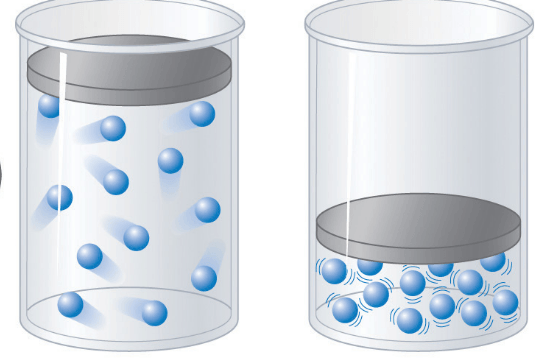
(Charles Law) There are 65 liters of helium in a balloon at 35 K. If the temperature of the balloon is increased to 40 K, what will the new volume of the balloon be?
40 L
70 L
74.3 L
75.9 L
(Charles Law) There are 40 liters of helium in a balloon at 100 K. If the temperature of the balloon is increased to 200 K, what will the new volume of the balloon be?
80 L
45 L
54 L
45.33 L
(Don’t forget about what must be done to temperatures!)
What does R stand for
Ideal gas constant
Real gas constant
Temperature constant
Ideal gas law
Which is a correct unit for R?
L.atm/mol.k
L.atm
mmHg/mol.K
L.atom/mol
PV=nRT


Determine the Kelvin temperature required for 0.0470 mol of gas to fill a balloon to 1.20 L under .998 atm pressure. pV=nRT and R = 0.0821 L*atm/mol*K
0 K
107 K
207 K
307 K
Adding heat to a non-flexible container of gas will cause
the molecules to slow and down hit the sides less often. The pressure will decrease.
the container to explode.
the molecules to speed up and hit the sides more often. The pressure will increase.

What is happening as you move from volume 1 to volume 2?
The pressure is held constant
There are the same number of molecules in a smaller container, so volume 2 will have a higher pressure because the molecules are hitting the sides more often.
There are more molecules in volume 2, which would cause them to be hotter and move faster, therefore pressure is increased.
Volume 1 would have a higher pressure.

