
 Worksheets
kylies make up test for bio
Total questions: 40
Worksheet time: 10hrs 0mins
Where does oogenesis take place?
Uterus
Fallopian tubes
Ovaries
Vagina
The ovarian cycle lasts about
14 days
28 days
one week
2 days
The hormones that help prepare the uterine lining for implantation of an embryo are
Oestrogen and progesterone
Oestrogen and testosterone
Progesterone and FSH
FSH and LH
Produce the female gamete and the hormone estrogen
Ovary
Fallopian tube
Pituitary gland
Cervix
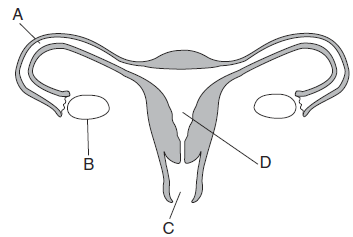
The human female reproductive system is represented below. Where will the embryo attach itself after fertilization?
A
B
C
D

On what day of the month does ovulation usually occur?
1
5
14
28

What word is used to describe when the embryo buries into the uterus lining?
fertilisation
implantation
menstruation
ovulation

A decrease in which hormone results in menstruation (shedding of the uterus lining)
progesterone
oestrogen
follicle stimulating hormone
luteinising hormone
In oogenesis, when does meiosis finish?
Before a girl is born
At puberty
After ovulation
After fertilisation
Which type(s) of reproduction involves only ONE parent?
asexual
sexual
both
Which type(s) of reproduction involves TWO parents?
asexual
sexual
both
The male reproductive system produces sex hormones called
Estrogen
Progesterone
Testosterone
Andresterone
Which part of the uterus is connected to the vagina?
The fallopian tubes
The cervix
The ovaries
The fallopian tubes connect
the ovaries to the uterus
the uterus to the vagina
the ovaries to the vagina

Which structure is the vas deferens?
A
B
C
D

Which label indicates the ovary?
d
i
c
h
g

Which structure is the Fallopian tube?
1
4
2
5
Check all that apply.
Reproductive cells are _______.
haploid
gametes
somatic
identical
diverse

What process creates reproductive cells used in sexual production?
meiosis
mitosis
cellular respiration
photosynthesis
Meiosis results in _____.
4 haploid daughter cells
2 diploid daughter cells
2 haploid daughter cells
4 diploid daughter cells

Potatoes have a diploid number of 48. How many chromosomes do the gametes of a potato plant have?
96
48
24
12
In which part of the female reproductive system does a baby develop?
Ovaries
Vagina
Cervix
Uterus
The lining of the uterus starts to grow thicker after
menstruation
ovulation
The fertilised egg is called
zygote
embryo
foetus
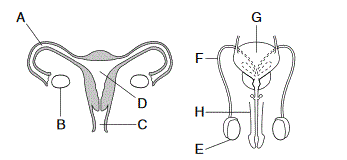
The diagram represents the reproductive systems of the human female and male. In which two structure are the gametes made
B and E
B and H
H and E
D and G
In oogenesis, when does meiosis finish?
Before a girl is born
At puberty
After ovulation
After fertilisation
Male sex hormone
Testosterone
azoospermia
vasovasostomy
oligospermia
Gametes
low sperm count
Male sex hormone
sex cells
inflammation of the glans penis
What part regulates the temperature of the testes?
prostate gland
epididymis
scrotum
bladder
The birth canal is also called the
uterus
fallopian tubes
ovaries
vagina

In the diagram above, where does fertilization take place?
#1
#3
#4
#5
Check the two boxes below for the female hormones.
Insulin
Estrogen
Testosterone
Progesterone
The ovaries in the human female reproductive system produced ______________.
egg
ovules
sperm
pollen grain

Fertilisation is when a sperm fuses with an egg.
True
False

A developing baby in a female's womb obtain its nutrients through the _________________________.
fallopian tube
pollen tube
umbilical cord
Which hormone causes the re-growth of the endometrial lining of the uterus?
Testesterone
GnRH
Estrogen
Progesterone

